


What Is Perforated Metal Sheet
In industrial engineering and filtration design, selecting the right substrate is critical for ensuring structural integrity and operational efficiency. One of the most versatile components used across these sectors is the perforated metal sheet. Understanding what is perforated metal sheet requires looking beyond its simple appearance to the precise manufacturing processes, material science, and fluid dynamic considerations that make it a staple in modern industry.
At its core, a perforated metal sheet is a plate or coil of metal that has been mechanically or manually stamped or punched to create a specific pattern of holes, slots, or decorative shapes. For engineers and purchasing teams, these sheets are not merely "metal with holes"; they are precision-engineered components designed to manage flow, filter particulates, and provide structural support in demanding environments.
The Engineering Behind Perforated Metal Production
The manufacturing of Perforated & Expanded Metal involves advanced CNC (Computer Numerical Control) technology to ensure that every perforation meets exact dimensional tolerances. The process typically begins with a solid sheet of metal—most commonly stainless steel in filtration applications—which is fed through a perforating press.
Punching and Stamping
There are two primary methods for creating the perforations: All-Across Presses and Sectional Presses. All-Across presses feature a wide bank of punches that can create an entire row of holes in a single stroke, making them highly efficient for high-volume production. Sectional presses, or CNC punching machines, move a smaller set of punches across the sheet, allowing for complex patterns, varied hole sizes on a single sheet, and the maintenance of specific unperforated margins.
Material Selection
While perforated sheets can be made from aluminum, carbon steel, or copper, industrial filtration solutions almost exclusively utilize stainless steel. Specifically, Grade 304 and Grade 316L are preferred for their superior corrosion resistance and mechanical strength. In chemical processing or pharmaceutical applications, 316L is often the standard due to its resistance to pitting and crevice corrosion in chloride-rich environments.
Technical Specifications: Patterns and Open Area
When asking what is perforated metal sheet in a technical context, the answer lies in the geometry of the perforations. The configuration of the holes dictates how the sheet will perform under pressure and how much fluid or gas can pass through it.
Hole Patterns
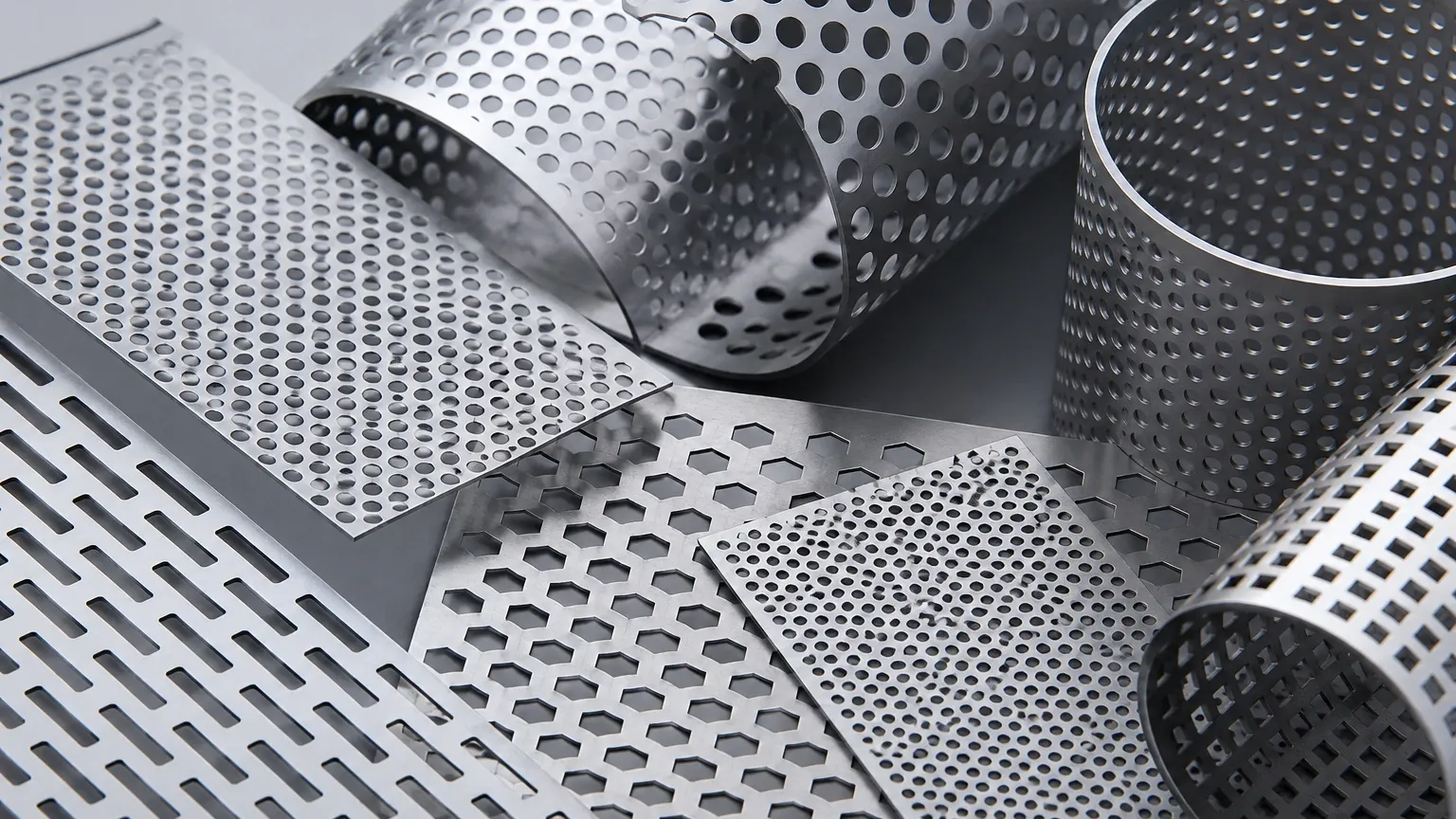
1. Round Holes: The most common and efficient pattern. Round holes offer the best structural strength-to-weight ratio and are the easiest to manufacture with high precision.
2. Square Holes: Often used when a higher open area is required, though they can be more prone to stress concentrations at the corners.
3. Slotted Holes: Ideal for sorting and filtering elongated materials or for applications requiring specific directional flow.
Pitch and Orientation
The "pitch" is the distance from the center of one hole to the center of the adjacent hole. Orientation is typically categorized as either "Staggered" or "Straight." A 60-degree staggered pattern is the industry standard because it provides the highest degree of structural uniformity and maximizes the open area without compromising the sheet's rigidity.
Calculating Open Area
The open area is the total area of the holes divided by the total area of the sheet, expressed as a percentage. This is a critical metric for engineers calculating pressure drop and flow rates. For a 60-degree staggered round hole pattern, the formula is:
* Open Area % = (D² × 90.69) / C²
*(Where D = Hole Diameter and C = Center-to-Center Pitch)*
Achieving the correct open area is a balancing act; too high, and the sheet may fail under hydraulic load; too low, and it may cause excessive backpressure in the system.
Perforated vs. Expanded Metal: Key Differences
Within the category of Perforated & Expanded Metal, it is important to distinguish between these two types of materials, as they serve different engineering purposes.
Perforated Metal is created by removing material (the "slugs") from the sheet. This allows for absolute precision in hole size and spacing, which is vital for filtration where specific micron ratings or flow characteristics are required. It also allows for solid margins (unperforated edges), which simplify welding and installation into filter housings.
Expanded Metal, conversely, is produced by slitting and stretching the metal simultaneously. This process creates diamond-shaped openings and involves no material waste. While expanded metal is cost-effective and provides excellent grip or reinforcement, it lacks the precise aperture control offered by perforated sheets. In high-precision filtration, perforated metal is usually the preferred choice for support cores and primary screens.
The Role of Perforated Metal in Industrial Filtration
In the context of Kaifil’s expertise, perforated metal sheets serve several critical functions in industrial filtration systems. They are rarely used in isolation for fine filtration but are indispensable as part of a larger assembly.
Support Cores for Filter Cartridges
In high-pressure hydraulic or chemical processing systems, fine wire mesh filters lack the structural strength to withstand the differential pressure. Perforated metal sheets are rolled and welded into tubes to act as the internal support core or the outer protective shroud. The perforated core ensures the filter media does not collapse under the force of the flow.
Pre-Filtration and Coarse Screening
In water treatment and food processing, perforated sheets act as the primary line of defense. They are used to remove large debris, stones, or organic matter before the fluid reaches more sensitive downstream components. Their durability allows them to be cleaned repeatedly through backwashing or mechanical scraping without deformation.
Diffusion and Flow Distribution
Perforated plates are often placed at the inlet of a pressure vessel to break up high-velocity streams. By distributing the flow evenly across the entire surface of a filter bed or catalyst, they prevent "channeling" and ensure that the entire volume of filter media is utilized effectively.
Engineering Considerations for Selection
When specifying a perforated metal sheet for a project, engineers must confirm several factors to ensure long-term performance and cost-effectiveness.
1. Thickness vs. Hole Diameter: A general rule of thumb in perforating is that the hole diameter should not be smaller than the material thickness. Attempting to punch holes smaller than the thickness increases the risk of tool breakage and can lead to structural inconsistencies in the metal.
2. Margins and Blank Areas: Does the application require unperforated borders for welding? Specifying exact margin dimensions is essential for ensuring the sheet fits perfectly into its frame or housing without requiring secondary trimming.
3. Surface Finish: For the pharmaceutical and food industries, the finish is as important as the holes. Perforated sheets can be electropolished to remove burrs and create a mirror-like finish that prevents bacterial growth and facilitates easy cleaning.
4. Flatness and Leveling: The perforating process naturally introduces internal stresses into the metal, which can cause it to curl or bow. High-quality industrial sheets undergo a leveling process after perforation to ensure they meet flatness requirements for precision assembly.
Common Risks and Quality Assurance
Failure to properly specify or inspect perforated metal can lead to significant operational risks. One common issue is "burring." If the punching tools are not perfectly sharp or the clearance is incorrect, small metal burrs can remain on the exit side of the hole. In a filtration system, these burrs can break off and contaminate the downstream fluid, or they can trap fibers and particles, leading to premature clogging.
Another risk is stress corrosion cracking. If the material is not properly annealed after the high-stress perforating process, it may be more susceptible to cracking when exposed to corrosive chemicals and cyclic pressure loads. Working with an experienced manufacturer like Kaifil ensures that these metallurgical factors are managed through proper material selection and post-processing treatments.
Conclusion
Understanding what is perforated metal sheet involves recognizing it as a sophisticated engineering tool defined by its material grade, hole geometry, and open area. Whether it is providing the backbone for a stainless steel filter cartridge or acting as a flow distributor in a chemical reactor, the perforated sheet must be tailored to the specific demands of the application.
For technical professionals, the next step in the procurement process should involve a detailed review of the operating environment—including temperature, pressure, and chemical exposure—to determine the optimal perforation pattern and material grade. By focusing on precision and structural integrity, engineers can optimize filtration performance and extend the service life of their industrial equipment.
To explore specific configurations or request a technical consultation on customized filtration components, engineers are encouraged to Review product options and application support to ensure their designs meet the highest industry standards.
