


Dimensi Perforated Metal
In industrial filtration and structural engineering, the term "dimensi perforated metal" refers to the precise geometric specifications that define a perforated sheet's performance, durability, and suitability for a specific application. Whether used as a support medium for fine wire mesh or as a primary filtration stage, the dimensions of the perforations and the base material determine the flow rate, pressure drop, and mechanical strength of the component.
For engineers and procurement specialists, understanding these dimensions is critical to ensuring that the Perforated & Expanded Metal components integrated into their systems meet the rigorous demands of chemical processing, food production, or hydraulic applications. As a specialized manufacturer, Kaifil emphasizes the importance of technical accuracy in defining these dimensions to optimize filtration efficiency and long-term reliability.
Core Dimensional Parameters of Perforated Metal
When specifying perforated metal, several key dimensions must be defined to ensure the product meets the engineering requirements of the project. These parameters are not merely aesthetic; they dictate the physical behavior of the material under load and fluid flow.
Hole Diameter (D)
The hole diameter is perhaps the most fundamental dimension. In filtration, this determines the maximum particle size that can pass through the medium. For industrial applications, hole diameters can range from less than a millimeter to several centimeters. Precision in hole diameter is vital for maintaining consistent filtration across the entire surface area of the sheet.
Center-to-Center Pitch (P)
The pitch is the distance from the center of one hole to the center of the adjacent hole. This dimension is crucial because it determines the density of the perforations. A smaller pitch results in more holes per square inch, which increases the open area but may reduce the structural integrity of the metal sheet.
Sheet Thickness (T)
The thickness of the base material, often referred to by gauge or in millimeters, affects the weight, strength, and life expectancy of the filter. Thicker materials offer greater resistance to high-pressure environments and abrasive fluids but may require more energy to manufacture and can be more difficult to form into cylindrical filter cartridges.
Margins and Blank Areas
Margins are the unperforated areas along the edges of the sheet. In custom OEM manufacturing, specifying the exact dimensions of these margins is necessary for welding, framing, or mounting the perforated metal into a larger assembly. Properly defined margins ensure that the structural integrity of the edges is maintained during installation.
Calculating Open Area and Its Engineering Significance
The "dimensi perforated metal" directly influences the percentage of open area, which is the ratio of the total area of the holes to the total area of the sheet. This is a critical calculation for engineers designing filtration systems or ventilation components.
The Open Area Formula
For a standard 60-degree staggered pattern—the most common and structurally efficient layout—the open area percentage is calculated using the following formula:
Open Area % = (D² × 90.69) / P²
Where:
* D = Hole Diameter
* P = Center-to-Center Pitch
Impact on Flow and Pressure Drop
A higher open area percentage allows for greater flow rates and lower pressure drops, which is essential in energy-efficient hydraulic and water treatment systems. However, an excessively high open area can lead to "bridge failure" between holes, where the metal becomes too thin to support the mechanical stresses of the application. Engineers must balance the need for high throughput with the requirement for mechanical durability.
Common Hole Patterns and Their Dimensional Variations
The arrangement of holes is as important as their size. Different patterns offer different mechanical properties and filtration characteristics.
60-Degree Staggered Pattern
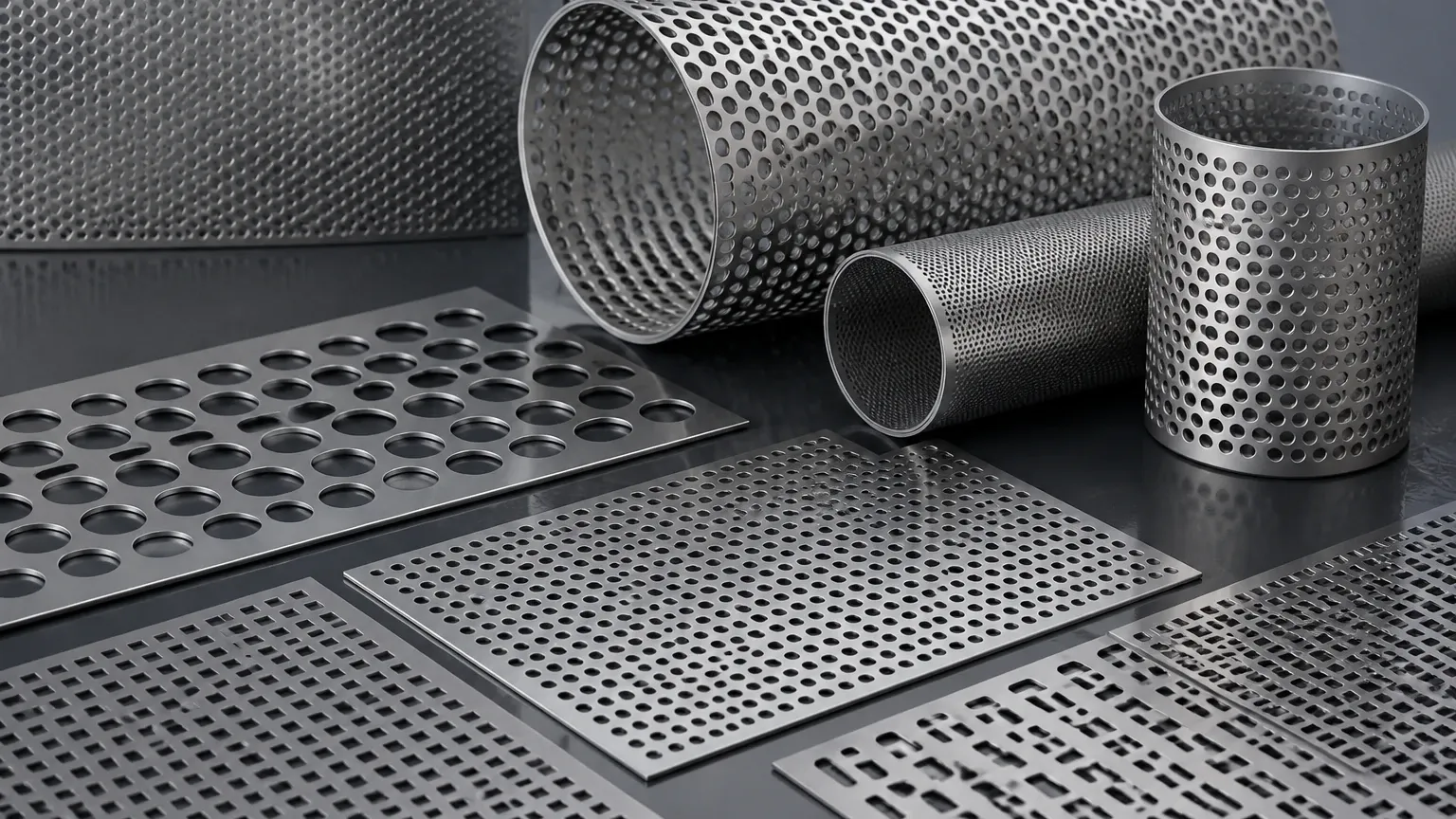
This is the industry standard for perforated metal. The holes are arranged so that each hole is equidistant from its neighbors. This pattern provides the highest open area and the most uniform strength across the sheet, making it ideal for high-pressure filtration cartridges.
Straight Line Pattern
In this configuration, holes are aligned in both horizontal and vertical rows. While simpler to manufacture, this pattern is generally weaker than the staggered layout and provides a lower open area for the same hole size and pitch. It is often used in architectural applications or where specific linear alignment is required for secondary processes.
Slotted and Decorative Patterns
For specific industrial needs, such as screening elongated particles or fibers, slotted dimensions are used. The length and width of the slots, along with the end-style (round or square), must be precisely defined. These dimensions are particularly relevant in the pulp and paper industry or in food processing where specific material shapes must be separated.
Material Selection and Dimensional Stability
The choice of material significantly impacts how well the dimensions are maintained over time. In the demanding environments Kaifil serves, stainless steel is the preferred choice due to its resistance to corrosion, heat, and mechanical wear.
Stainless Steel 304 and 316
Stainless steel 304 provides excellent performance for general industrial use, while 316 stainless steel, containing molybdenum, offers superior resistance to chlorides and acids. Choosing the right alloy ensures that the hole dimensions do not change due to corrosion or "pitting," which could bypass the filtration intent.
Thermal Expansion Considerations
In high-temperature chemical processing, the thermal expansion coefficient of the metal must be considered. If the dimensions of the perforated metal change significantly under heat, it can lead to warping or the failure of seals in a filter housing. Precise manufacturing ensures that the dimensions remain within tolerance across the operating temperature range.
Customizing Perforated & Expanded Metal for OEM Applications
For many industrial projects, standard off-the-shelf dimensions are insufficient. Customization is often required to meet specific flow requirements or to fit unique hardware configurations. When requesting a custom "dimensi perforated metal" solution, engineers should provide detailed specifications including:
1. Material Grade: (e.g., SS304, SS316L, Duplex).
2. Hole Shape and Size: Round, square, or slotted.
3. Pitch and Orientation: Staggered or straight.
4. Sheet Dimensions: Length, width, and thickness.
5. Margin Requirements: Finished or unfinished ends.
6. Secondary Processing: Whether the sheet needs to be rolled into a cylinder, welded, or coated.
By focusing on these technical details, manufacturers like Kaifil can produce Perforated & Expanded Metal components that integrate seamlessly into complex industrial systems. This level of customization is particularly important for filter support cores, where the perforated metal must withstand the collapsing pressure of the outer filter media while maintaining a clear path for the filtrate.
Quality Control and Dimensional Accuracy
In the context of industrial B2B procurement, the reliability of a supplier is often measured by their ability to maintain tight tolerances. Dimensional accuracy in perforated metal is achieved through advanced CNC punching and laser cutting technologies.
Tolerance Standards
Standard industry tolerances for hole diameter and pitch are typically within +/- 0.1mm to 0.5mm, depending on the thickness of the material. For high-precision filtration, even tighter tolerances may be required to ensure that the open area remains consistent across large production runs. Inconsistent dimensions can lead to "hot spots" in a filter, where certain areas experience higher flow and faster wear than others.
Flatness and Leveling
The punching process can introduce internal stresses into the metal, causing it to curl or bow. Post-perforation leveling is a critical step in maintaining the dimensional integrity of the sheet. A flat sheet is essential for subsequent operations like forming filter cartridges or installing the sheet into a frame.
Installation and Maintenance of Perforated Components
The dimensions of the perforated metal also dictate the ease of installation and the effectiveness of maintenance cycles.
Fitment in Filter Housings
If the outer dimensions of a perforated sheet or the diameter of a rolled cylinder are off by even a few millimeters, it can prevent a proper seal within the filter housing. This leads to bypass, where unfiltered fluid escapes the system, potentially damaging downstream equipment like pumps or valves.
Cleaning and Reusability
One of the primary advantages of stainless steel perforated metal is its cleanability. The dimensions of the holes must be smooth and burr-free to prevent particles from becoming permanently trapped. Properly specified dimensions allow for effective backwashing or ultrasonic cleaning, extending the service life of the component and reducing the total cost of ownership.
Conclusion
Understanding the "dimensi perforated metal" is a fundamental requirement for any engineer involved in the design or maintenance of industrial filtration systems. From calculating the open area to selecting the appropriate material and hole pattern, every dimension plays a role in the overall efficiency and durability of the system. By partnering with a manufacturer that prioritizes technical precision and offers extensive customization, businesses can ensure that their Perforated & Expanded Metal solutions provide reliable performance in even the most demanding environments.
