


Gold Perforated Metal Sheet
In industrial design and high-end engineering applications, the requirement for functional components often intersects with the need for specific aesthetic or protective finishes. A gold perforated metal sheet represents a specialized category of industrial materials where the structural utility of perforated or expanded metal is enhanced by advanced surface treatments. While the term "gold" frequently refers to the visual finish—typically achieved through Titanium Nitride (TiN) coating or Physical Vapor Deposition (PVD) on stainless steel—it can also refer to specific brass or bronze alloys used in precision filtration and architectural screening.
For engineers and procurement professionals, selecting a gold perforated metal sheet involves more than just specifying a color. It requires a deep understanding of the substrate material, the perforation pattern's impact on structural integrity, and the chemical compatibility of the finish with the operating environment. This guide explores the technical nuances of these materials, focusing on their role in industrial filtration and specialized equipment manufacturing.
Understanding Gold Perforated Metal Sheet: Materials and Finishes
The performance of a gold perforated metal sheet is primarily dictated by its base material. In most industrial contexts, the "gold" appearance is a surface modification applied to a durable substrate to provide both corrosion resistance and a specific technical or aesthetic profile.
Stainless Steel Substrates
Stainless steel (typically Grade 304 or 316) is the most common substrate for gold-finished perforated sheets. Grade 316 is preferred in marine or highly corrosive chemical environments due to its molybdenum content, which provides superior resistance to pitting and crevice corrosion. When these metals are perforated and then treated with a PVD coating, they retain their mechanical properties while gaining a hard, wear-resistant gold surface.
Titanium Nitride (TiN) Coating
TiN is an extremely hard ceramic material, often applied via PVD. In industrial filtration and component design, TiN is used not just for its gold color but for its ability to increase surface hardness and reduce friction. This is particularly useful in vibrating screens or components subject to abrasive media. The coating is chemically stable and does not flake or peel, making it suitable for food processing and pharmaceutical applications where contamination must be avoided.
Copper-Based Alloys
In some specialized filtration applications, brass (a copper-zinc alloy) or phosphor bronze is used. These materials have a natural "gold" or yellow hue. While they do not offer the same tensile strength as stainless steel, they provide excellent electrical conductivity and non-sparking properties, which are critical in certain volatile industrial environments.
Perforated vs. Expanded Metal: Engineering Distinctions
When specifying a gold-finished metal component, it is essential to distinguish between the two primary manufacturing methods: perforating and expanding. Each method results in different mechanical behaviors and flow characteristics.
Perforated Metal Characteristics
Perforated metal is produced by punching a series of holes into a solid sheet. This process allows for extreme precision in hole size, shape, and arrangement. For filtration applications, perforated metal serves as a robust support structure for finer wire mesh or as a standalone coarse filter. The primary advantage of Perforated & Expanded Metal in a perforated format is the ability to maintain high dimensional accuracy and a flat, smooth surface, which is critical for uniform coating application.
Expanded Metal Characteristics
Expanded metal is created by simultaneously slitting and stretching the sheet. This process results in a diamond-shaped pattern without any material waste. Expanded metal is generally more rigid than perforated metal of the same weight because the strands and bonds form a truss-like structure. However, the expanding process creates a three-dimensional surface that may require "flattening" if a smooth gold finish is required. Expanded metal is often used in protective grilles and heavy-duty filtration supports where high strength-to-weight ratios are paramount.
Technical Performance Parameters for Industrial Filtration
Selecting a gold perforated metal sheet for industrial use requires calculating several technical parameters to ensure the component meets the system's operational demands.
Open Area Calculation
The open area is the percentage of the sheet that is occupied by holes. This is the most critical factor in determining flow rate and pressure drop. For a standard round hole pattern with a staggered 60-degree pitch, the formula is:
Open Area % = (D² × 90.69) / R²
Where:
* D = Hole diameter
* R = Center-to-center distance (pitch)
An engineer must balance the need for a high open area (to minimize pressure drop) with the need for structural strength. A gold perforated metal sheet with an excessively high open area may deform under high-pressure hydraulic loads.
Hole Geometry and Pitch
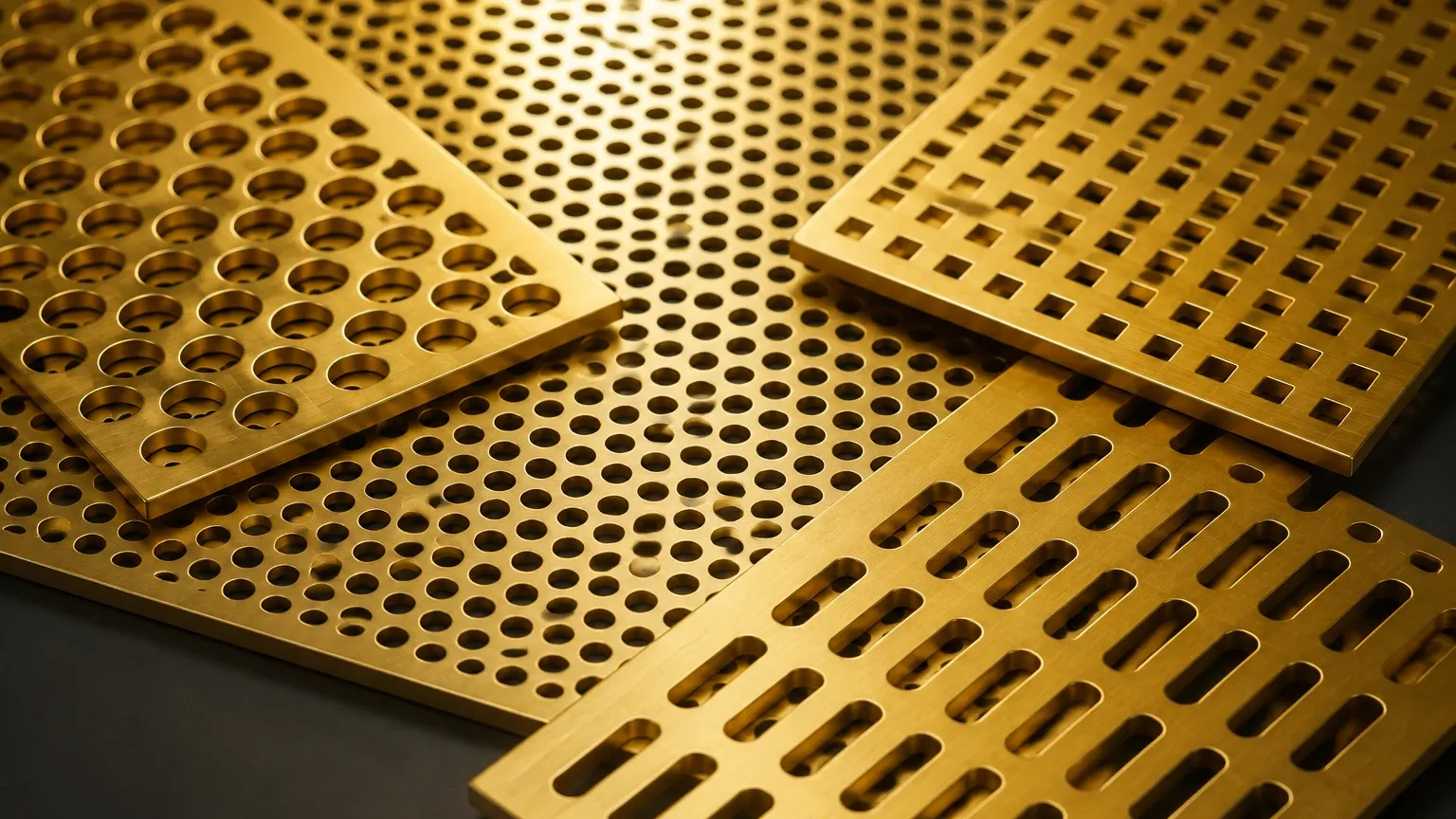
* Round Holes: The most common and efficient for filtration, offering the best balance of strength and open area.
* Square Holes: Provide a larger open area but are more prone to stress concentrations at the corners.
* Hexagonal (Honeycomb) Holes: Offer the highest possible open area and are often used in high-airflow applications like electronic cooling or architectural vents.
Pitch Configuration
Staggered patterns are generally preferred over straight-row patterns because they provide higher strength and more uniform flow distribution across the surface of the filter or screen.
Application Scopes in Demanding Environments
The use of gold perforated metal sheets extends beyond simple decorative panels. In industrial sectors, these materials are chosen for their specific performance characteristics.
Pharmaceutical and Food Processing
In these industries, the gold TiN coating on stainless steel provides a non-reactive, biocompatible surface. The smoothness of the perforated sheet prevents bacterial buildup and allows for easier Clean-in-Place (CIP) procedures. The gold finish also serves as a visual indicator of wear; if the silver substrate begins to show through, it signals that the component may need replacement.
Chemical and Petrochemical Processing
Gold-finished components are often used in specialized separation equipment where the substrate requires protection against specific corrosive agents. The PVD process creates a dense, non-porous layer that acts as an additional barrier against chemical attack, extending the service life of the internal filtration components.
Architectural Industrial Design
In high-end industrial facilities, such as data centers or cleanrooms, gold perforated metal sheets are used for acoustic dampening and air diffusion. The perforation pattern is engineered to break up sound waves or distribute airflow evenly, while the gold finish provides a premium appearance that aligns with corporate branding or high-tech aesthetics.
Key Evaluation Criteria for Engineers and Procurement
Before finalizing a purchase order for gold perforated metal sheets, technical teams should evaluate the following criteria to ensure the product is fit for purpose.
1. Coating Uniformity and Adhesion
For gold-finished sheets, the quality of the PVD or TiN coating is paramount. Poor adhesion can lead to delamination, which can contaminate the process stream. Engineers should request data on the coating thickness (typically measured in microns) and adhesion test results (such as the Rockwell C adhesion test).
2. Dimensional Tolerances
Perforation processes can introduce internal stresses into the metal, leading to warping or "oil canning." It is vital to specify flatness tolerances, especially if the sheet is to be welded into a filter cartridge or frame. Standard industrial tolerances for hole diameter and pitch should be strictly followed to ensure consistent filtration performance.
3. Edge Configurations
Specify whether the sheet requires "safe margins" (unperforated edges) or if the pattern should be "perforated to edge." Margins are generally required for welding and mounting to ensure the structural integrity of the final assembly.
4. Material Certification
Always insist on Mill Test Reports (MTRs) for the base metal. For the gold finish, a Certificate of Conformance (CoC) should be provided, detailing the coating process used and the resulting surface hardness.
Common Risks and Quality Assurance
Procuring gold perforated metal sheets involves managing risks related to both the mechanical fabrication and the surface finishing.
Burr Management
The punching process naturally creates burrs on the underside of the sheet. In filtration, these burrs can trap particles or cause turbulence. For gold-finished sheets, deburring must be performed *before* the coating process. If deburring is done after coating, the gold finish will be removed from the hole edges, exposing the substrate to potential corrosion.
Flatness and Stress Relief
Large sheets with high open areas are prone to bowing. Leveling processes, such as roller leveling, are necessary to ensure the sheet remains flat. Procurement teams should confirm that the manufacturer has the capability to level the sheets without damaging the gold finish.
Color Consistency
In large-scale projects involving multiple batches of gold perforated metal, color consistency can be a challenge. Variations in the PVD vacuum chamber conditions can lead to slight shifts in hue. Specifying a color range or providing a physical master sample is recommended for projects where visual uniformity is critical.
Customization and Manufacturing Capabilities
Manufacturers like Kaifil specialize in providing tailored solutions that go beyond off-the-shelf specifications. Customization options for gold perforated metal sheets include:
* Custom Hole Patterns: Engineering unique hole shapes or variable pitch patterns to meet specific flow dynamics.
* Secondary Fabrication: Providing fully fabricated components, such as gold-finished filter cylinders, cones, or baskets, which are ready for immediate installation.
* Material Combinations: Bonding gold perforated metal with fine stainless steel wire mesh to create multi-layered filtration media that combines aesthetic appeal with high-precision particle retention.
By working closely with a manufacturer that understands both the metallurgy of the substrate and the physics of the perforation process, engineers can develop filtration and screening solutions that are both highly functional and durable.
Conclusion: Selecting the Right Solution
A gold perforated metal sheet is a high-performance material that serves critical roles in industrial filtration, protective screening, and specialized equipment design. Whether the goal is to enhance surface hardness, provide chemical resistance, or achieve a specific aesthetic in an industrial setting, the key to success lies in the technical specification of the substrate, the perforation geometry, and the quality of the finish.
When evaluating suppliers, focus on those who offer comprehensive technical support, from open area calculations to material compatibility advice. For more information on available patterns and technical specifications, Review product options and application support to ensure your selection meets the rigorous demands of your specific industrial application.
