


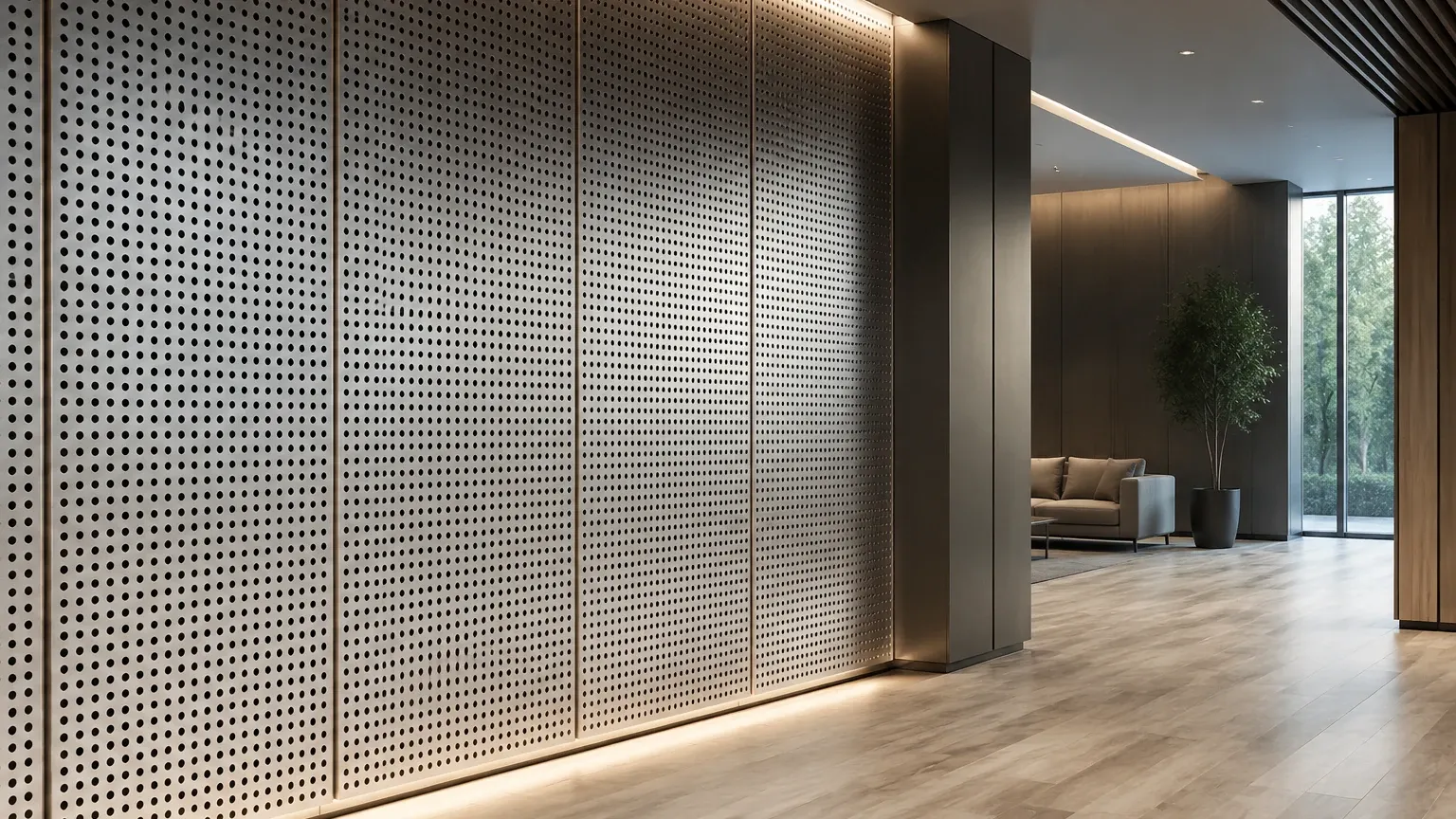
Interior Perforated Metal Wall Panels
In modern industrial and commercial architecture, the selection of wall cladding materials extends beyond simple aesthetics. Engineers and facility managers must balance structural integrity, acoustic performance, and environmental durability. Interior perforated metal wall panels have emerged as a primary solution for these demanding environments, offering a unique combination of versatility and technical performance. By utilizing Perforated & Expanded Metal, designers can achieve specific functional goals—such as noise reduction or ventilation—without compromising the mechanical strength of the interior envelope.
As a specialized manufacturer of precision metal components, Kaifil provides high-performance metal solutions tailored to the rigorous standards of chemical processing, food and beverage, and pharmaceutical sectors. Understanding the technical nuances of perforated and expanded metal is essential for selecting the right panel system for your specific application.
Engineering Fundamentals of Perforated and Expanded Metal
The performance of interior perforated metal wall panels is dictated by the manufacturing process and the resulting geometric configuration. There are two primary methods used to create these functional surfaces: perforating and expanding.
Perforated Metal
Perforated metal is produced through a CNC punching or laser-cutting process where material is removed from a solid sheet. This method allows for extreme precision in hole size, shape, and spacing (pitch). For interior wall panels, common patterns include round, square, slotted, or hexagonal holes. The "open area"—the percentage of the sheet that is comprised of holes—is a critical engineering metric. It determines the panel's transparency, airflow capacity, and acoustic transparency.
Expanded Metal
Expanded metal is manufactured by simultaneously slitting and stretching a metal sheet. Unlike perforation, this process involves no material waste. The resulting diamond-shaped openings are set at an angle to the plane of the sheet, providing inherent structural rigidity and a three-dimensional texture. In interior applications, expanded metal is often favored for its high strength-to-weight ratio and its ability to act as a directional screen for light or air.
Material Selection Criteria for Interior Industrial Environments
The choice of alloy is the most significant factor in the longevity and maintenance requirements of interior perforated metal wall panels. While aesthetic finishes are available, the underlying material must withstand the specific environmental stresses of the facility.
1. Stainless Steel (304 and 316 Grades): Stainless steel is the gold standard for industrial interiors, particularly in pharmaceutical and food processing plants. Grade 304 offers excellent corrosion resistance for most indoor applications, while Grade 316 is recommended for environments exposed to chlorides or heavy chemical cleaning agents. Its durability ensures that the filtration and protective qualities of the panels remain intact over decades.
2. Aluminum: Aluminum is frequently selected for its lightweight properties and natural resistance to atmospheric corrosion. It is an ideal choice for large-scale interior wall panels where reducing the dead load on the building structure is a priority. Aluminum panels are also highly conductive, which can be a factor in specific electrical or thermal management applications.
3. Carbon Steel: For dry, low-corrosion environments, carbon steel provides a cost-effective structural solution. However, it requires a protective coating, such as powder coating or galvanizing, to prevent oxidation. This is common in warehouse or mezzanine applications where mechanical impact resistance is more critical than chemical inertness.
Acoustic Control and Airflow Optimization
One of the primary technical reasons for specifying interior perforated metal wall panels is their ability to manage the acoustic environment. In industrial settings, reverberation from heavy machinery can create hazardous noise levels.
Acoustic Performance
Perforated panels act as a protective face for acoustic insulation materials. Sound waves pass through the perforations and are trapped by an acoustic medium (such as mineral wool or specialized foam) placed behind the panel. The "Noise Reduction Coefficient" (NRC) of the system is heavily influenced by the open area of the metal panel. Generally, an open area of 20% to 40% is sufficient to allow sound waves to pass through without significant reflection, though custom configurations can be engineered for specific frequency ranges.
Ventilation and Thermal Management
In facilities housing sensitive electronics, hydraulic systems, or heat-generating equipment, wall panels must facilitate airflow. Perforated metal allows for passive or forced-air ventilation while maintaining a secure barrier. Engineers must calculate the pressure drop across the panel to ensure that the HVAC system can maintain the required air exchange rates. The precision manufacturing capabilities at Kaifil allow for the production of panels with exact open-area specifications to meet these thermal requirements.
Structural Design and Installation Considerations
Integrating perforated metal into an interior wall system requires careful consideration of the mounting hardware and panel geometry. Unlike solid sheets, perforated panels have different mechanical properties depending on the hole pattern and orientation.
Gauge and Stiffness
The thickness of the metal (gauge) must be sufficient to prevent oil-canning or sagging, especially in large-format panels. For interior perforated metal wall panels, common thicknesses range from 1.0mm to 3.0mm. To increase stiffness without adding significant weight, panels can be formed with returned edges (flanges) or mounted within a perimeter frame.
Attachment Methods
* Stand-off Mounts: Panels are fixed at a distance from the structural wall, creating a gap for acoustic insulation, lighting, or mechanical services.
* Framed Systems: The metal mesh is welded or mechanically fastened into a structural frame, which is then bolted to the wall substrate. This is the most robust method for high-traffic industrial zones.
* Concealed Fasteners: For architectural interiors where a seamless look is required, interlocking panel systems can hide the screws or clips from view.
Customization Options and Manufacturing Precision
Every industrial project has unique constraints. Standard off-the-shelf panels rarely meet the specific filtration, acoustic, or structural needs of a specialized facility. Customization is where engineering expertise becomes vital.
At Kaifil, we focus on providing tailored solutions. Customization options for interior perforated metal wall panels include:
* Variable Perforation Patterns: Transitioning from high-density holes to solid metal within a single sheet to accommodate mounting points or specific airflow zones.
* Precision Margin Control: Ensuring solid borders around the perimeter of the panel for easier welding or bolting.
* Complex Geometries: Fabricating panels to fit around existing piping, ductwork, or structural columns.
* Surface Finishes: Beyond raw mill finishes, panels can be electropolished for high-purity environments or powder-coated to meet specific color-coding safety standards.
Evaluating Total Cost and Lifecycle Performance
When purchasing interior perforated metal wall panels, procurement teams should look beyond the initial price per square foot. The total cost of ownership (TCO) is influenced by installation speed, maintenance requirements, and the replacement cycle.
Stainless steel perforated panels, while higher in initial cost than plastic or wood alternatives, offer a significantly longer service life in industrial settings. They are non-combustible, resistant to impact, and can be cleaned with high-pressure washdowns without degrading. Furthermore, metal panels are fully recyclable at the end of their lifecycle, contributing to corporate sustainability goals.
Key Questions for Procurement and Engineering Teams:
* Compatibility: Does the metal alloy react with the cleaning chemicals used in the facility?
* Load Requirements: Will the panels support secondary equipment, such as monitors or fire extinguishers?
* Filtration/Airflow: Is the open area percentage verified to meet the HVAC design specifications?
* Compliance: Do the panels meet local fire safety and building codes for interior finishes?
Conclusion
Interior perforated metal wall panels are more than decorative elements; they are engineered components that contribute to the safety, efficiency, and acoustic health of industrial spaces. By selecting the appropriate material, hole pattern, and mounting system, engineers can solve complex environmental challenges with a single, durable solution.
Kaifil’s extensive experience in custom stainless steel filtration and precision metal fabrication ensures that every panel is manufactured to exact tolerances. Whether your project requires high-purity stainless steel for a pharmaceutical cleanroom or robust expanded metal for a manufacturing plant, our technical team supports you from material selection through to final production.
For detailed specifications and to explore how our manufacturing capabilities can support your next project, Review product options and application support to find the ideal solution for your facility’s needs.
