


Perforated Metal Mesh Drawers
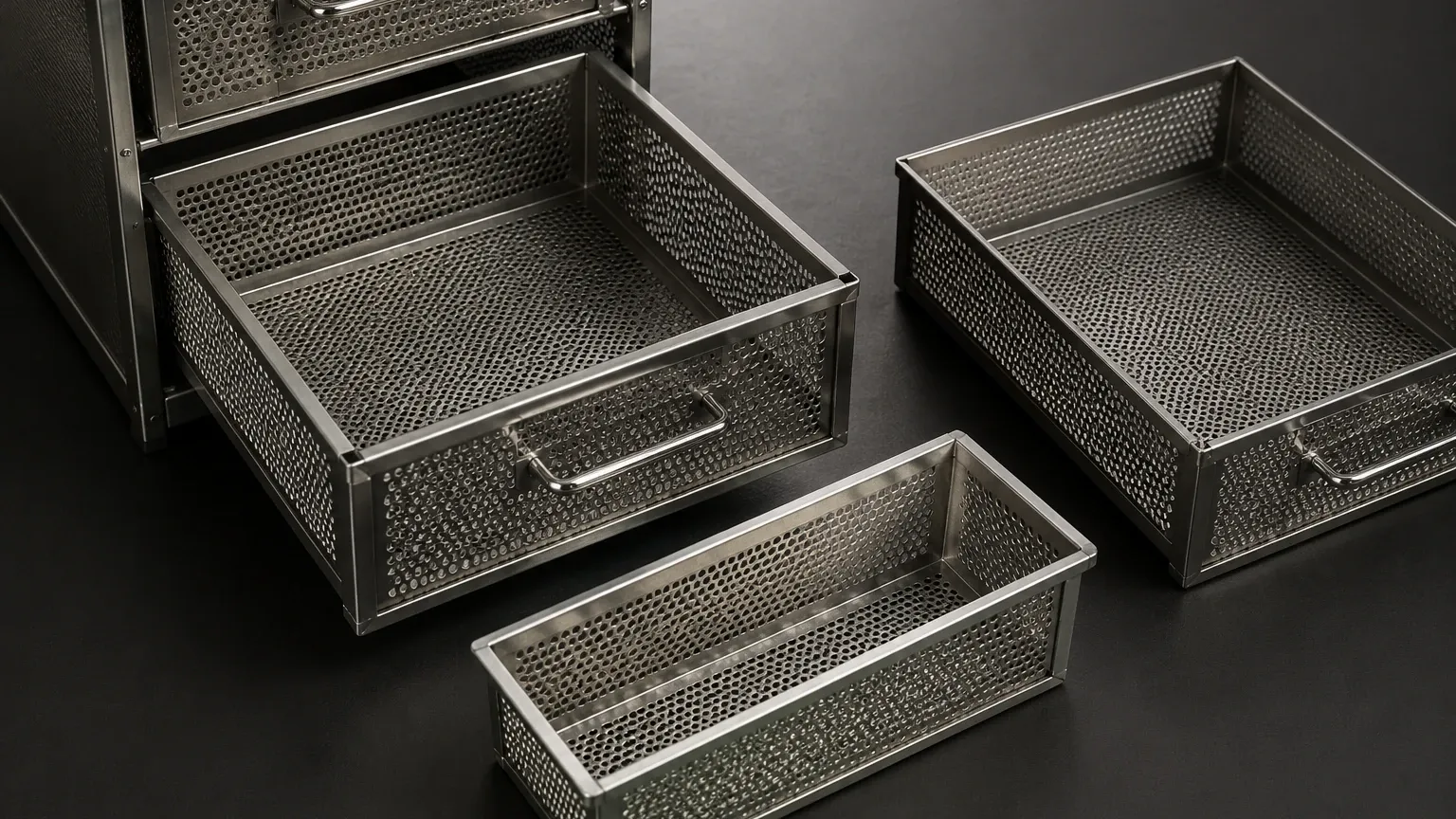
In industrial environments, storage and processing components must often perform dual roles: providing structural containment while facilitating specific environmental interactions such as airflow, liquid drainage, or thermal exchange. Perforated metal mesh drawers represent a specialized engineering solution designed to meet these requirements. Unlike solid-wall containers, these components utilize precision-engineered Perforated & Expanded Metal to create a permeable yet high-strength enclosure suitable for demanding applications in the pharmaceutical, food processing, and chemical industries.
Selecting or designing the correct perforated metal mesh drawers requires an understanding of material science, mechanical load requirements, and the specific filtration or ventilation needs of the application. This guide examines the technical specifications, manufacturing considerations, and industrial applications of these versatile components.
Technical Fundamentals of Perforated and Expanded Metal
The performance of an industrial drawer is primarily dictated by the characteristics of the base material. In the context of metal mesh drawers, two primary manufacturing methods are employed: perforation and expansion.
Perforated Metal
Perforated metal is produced by mechanically punching or laser-cutting a series of holes into a solid metal sheet. This process allows for extreme precision in hole size, shape, and spacing. For industrial drawers, this precision is critical when the drawer must double as a sizing screen or when specific airflow rates are required for drying processes. Common patterns include round, square, and slotted holes, with staggered or straight configurations depending on the required structural integrity.
Expanded Metal
Expanded metal is created by simultaneously slitting and stretching a metal sheet. This process creates a diamond-shaped mesh pattern that is integral to the sheet, meaning there are no welds or joins within the mesh itself. Expanded metal is often preferred for heavy-duty perforated metal mesh drawers because it offers a high strength-to-weight ratio and excellent rigidity. However, the uneven surface of standard expanded metal may require "flattening" if a smooth interior drawer surface is necessary to prevent damage to delicate parts.
Material Selection for Industrial Environments
Industrial drawers are frequently exposed to corrosive chemicals, high temperatures, and rigorous cleaning cycles. Therefore, material selection is the most critical factor in determining the service life and safety of the component.
1. Stainless Steel 304: The standard choice for most industrial applications. It offers excellent corrosion resistance and durability for general manufacturing and storage.
2. Stainless Steel 316/316L: Essential for pharmaceutical and food-grade applications. The addition of molybdenum provides superior resistance to chlorides and acidic environments, making it suitable for drawers used in sterilization or chemical processing.
3. Specialty Alloys: In highly specialized environments, such as those involving high-temperature furnaces or extreme chemical exposure, alloys like Monel or Inconel may be utilized to ensure structural stability.
When specifying materials for perforated metal mesh drawers, engineers must also consider the surface finish. Electropolishing is often applied to stainless steel drawers to remove surface impurities, improve corrosion resistance, and create a smooth, "cleanable" surface that prevents bacterial growth.
Engineering Considerations: Open Area and Structural Integrity
The "open area" of a perforated metal sheet refers to the percentage of the sheet that is comprised of holes. This is a vital metric for perforated metal mesh drawers used in drying, cooling, or filtration.
Calculating Open Area
A higher open area increases airflow and drainage but reduces the mechanical strength of the drawer. For example, a drawer designed to hold heavy metal castings will require a lower open area and thicker gauge material than a drawer designed for drying lightweight pharmaceutical granules. Engineers must balance the hole diameter and the "bridge" (the distance between holes) to ensure the drawer does not sag or deform under load.
Load-Bearing Capacity
The structural design of the drawer frame is just as important as the mesh itself. For larger industrial drawers, the perforated mesh is often reinforced with a solid metal frame or internal support ribs. This prevents the mesh from bowing when fully loaded. The gauge of the metal—typically ranging from 16 to 22 gauge for standard industrial use—must be selected based on the total weight capacity and the frequency of handling.
Key Applications for Perforated Metal Mesh Drawers
Perforated metal mesh drawers are utilized across various sectors where airflow, visibility, and drainage are paramount.
Pharmaceutical and Laboratory Sterilization
In laboratory settings, drawers made from 316L stainless steel are used in autoclaves and sterilization cabinets. The perforated design allows steam or sterilizing gases to circulate freely around the instruments or containers, ensuring total exposure. The high-grade stainless steel withstands repeated thermal cycling without warping.
Industrial Drying and Cooling
In food processing and chemical manufacturing, products often need to be dried or cooled after production. Perforated metal mesh drawers allow heated air or ambient air to pass through the product from all sides, significantly reducing processing time compared to solid-bottom trays. This is particularly effective in batch drying systems where uniform moisture removal is required.
Parts Cleaning and Degreasing
For automotive and aerospace manufacturing, small components often undergo ultrasonic cleaning or chemical degreasing. Drawers with specific perforation sizes allow the cleaning fluid to penetrate the batch and drain away quickly once the cycle is complete, preventing the carry-over of chemicals between stages.
Specialized Storage
In environments where inventory must be visible for safety or auditing purposes, perforated drawers provide a clear view of the contents without opening the unit. Furthermore, in facilities with fire suppression systems (sprinklers), perforated drawers allow water to pass through the storage racks, meeting stringent fire safety codes that solid drawers might fail.
Customization and OEM Capabilities
Standard off-the-shelf storage solutions rarely meet the precise needs of specialized industrial processes. Customization is often necessary to integrate drawers into existing machinery or to handle unique materials.
At Kaifil, the manufacturing process for perforated metal mesh drawers involves close collaboration with engineering teams to define the exact parameters required for the application. Customization options include:
* Bespoke Hole Patterns: Tailoring hole shapes and sizes to match the particle size of the material being processed.
* Integrated Filtration: Combining fine wire mesh with a perforated metal support structure to create a drawer that acts as a high-precision filter.
* Variable Mounting Options: Designing drawers with specific slide rails, handles, or locking mechanisms for integration into industrial cabinetry or automated retrieval systems.
* Reinforced Edges: Utilizing hemmed edges or welded frames to eliminate sharp corners, enhancing operator safety and structural longevity.
Evaluating Quality and Reducing Total Cost of Ownership
When purchasing industrial filtration or storage components, the initial purchase price is only one part of the total cost of ownership (TCO). High-quality perforated metal mesh drawers reduce costs over time through durability and reduced maintenance.
Common Risks to Avoid
* Burrs and Sharp Edges: Inadequately finished perforated metal can have sharp burrs that damage products or injure workers. High-quality manufacturing includes deburring and smoothing processes.
* Inconsistent Perforation: Variations in hole size or spacing can lead to uneven airflow or structural weak points. Precision CNC punching ensures uniformity across the entire surface.
* Poor Weld Integrity: In drawers that require welding (such as at the corners or frame), poor weld penetration can lead to failure under vibration or heavy loads.
Maintenance and Replacement Cycles
Stainless steel perforated drawers are designed for long-term use, but they require regular inspection. In chemical applications, engineers should check for signs of pitting or crevice corrosion. In mechanical applications, checking for mesh deformation ensures the drawer continues to slide and seat correctly within its housing. Because stainless steel is fully recyclable, these components also support corporate sustainability goals when they eventually reach the end of their service life.
Conclusion: Selecting the Right Solution
Perforated metal mesh drawers are more than simple storage containers; they are functional tools that facilitate essential industrial processes. By selecting the appropriate material grade, hole pattern, and structural reinforcement, facilities can improve efficiency, ensure product safety, and extend the lifespan of their equipment.
For engineers and procurement professionals, the next step involves defining the specific environmental constraints and performance goals of the application. Whether the priority is maximum airflow for drying or extreme corrosion resistance for chemical baths, utilizing high-quality Perforated & Expanded Metal ensures that the final component meets the rigorous demands of the modern industrial landscape.
