


Perforated Metal Mesh Screen
In industrial filtration and separation, the perforated metal mesh screen serves as a fundamental component for mechanical sorting, fluid management, and structural support. Unlike woven wire mesh, which is created by interlacing wires, a perforated metal mesh screen is manufactured by punching or laser-cutting precise hole patterns into a solid metal sheet. This process results in a rigid, durable medium capable of withstanding high pressure and abrasive environments.
For engineers and procurement teams, selecting the correct perforated screen involves more than choosing a hole size. It requires a deep understanding of material properties, open area ratios, and structural integrity to ensure the component performs reliably within a specific industrial process. This guide explores the technical parameters and engineering considerations essential for specifying perforated and expanded metal solutions in B2B applications.
Understanding Perforated Metal Mesh Screen Engineering
The performance of a perforated metal mesh screen is dictated by its geometric configuration. The most critical factors include the hole shape, the hole size, the pitch (the distance between the centers of adjacent holes), and the arrangement pattern. These variables directly influence the screen’s filtration efficiency and mechanical strength.
Hole Patterns and Arrangements
Standard hole patterns include round, square, and slotted configurations. Round holes are the most common due to their versatility and structural stability. They are typically arranged in either a 60-degree staggered pattern or a straight-line pattern.
* 60-Degree Staggered: This is the most popular arrangement because it provides the highest open area and uniform strength across the sheet. It is ideal for high-flow filtration applications.
* Straight Line: Holes are aligned both horizontally and vertically. While easier to manufacture for certain specific dimensions, this pattern offers lower structural integrity compared to staggered arrangements.
* Slotted Holes: Often used for the filtration of viscous fluids or for sorting elongated particles, slotted patterns help prevent "blinding" (clogging) where spherical particles might otherwise get stuck.
Calculating Open Area
The "Open Area" is the percentage of the total sheet area that consists of holes. This is the primary metric for determining flow rates and pressure drops. For a 60-degree staggered round hole pattern, the open area percentage is calculated using the formula:
Open Area % = (D² × 90.7) / P²
*(Where D = Hole Diameter and P = Pitch)*
Maintaining a high open area is essential for reducing energy consumption in pumping systems, but it must be balanced against the required thickness of the metal to prevent the screen from deforming under hydraulic load.
Material Specifications and Chemical Compatibility
Industrial filtration often occurs in aggressive environments involving corrosive chemicals, high temperatures, or strict hygienic requirements. Consequently, material selection is the most significant factor in determining the service life of a perforated metal mesh screen.
Stainless Steel Alloys
Stainless steel is the industry standard for most B2B filtration applications due to its corrosion resistance and mechanical durability.
* Grade 304: Suitable for general-purpose applications, including water treatment and food processing where mild corrosion resistance is required.
* Grade 316/316L: Contains molybdenum, providing superior resistance to chlorides and acids. This is the preferred choice for chemical processing, pharmaceutical manufacturing, and marine environments.
* Duplex Stainless Steel: Used in highly demanding applications where both high strength and extreme resistance to stress corrosion cracking are necessary.
Surface Treatments and Finishing
To enhance performance, perforated screens may undergo various finishing processes. Electropolishing is frequently used in the pharmaceutical and food industries to remove surface burrs and create a microscopically smooth finish, which minimizes bacterial growth and simplifies the cleaning process. Additionally, specialized coatings can be applied to increase hardness or provide non-stick properties for specific filtration media.
The Role of Perforated & Expanded Metal in Filtration Systems
While perforated metal is often used as a standalone filter for coarse particles, it frequently functions as a structural backbone in multi-stage filtration systems. Within a high-performance filter cartridge, the perforated metal mesh screen acts as an inner or outer support tube.
Structural Support for Fine Media
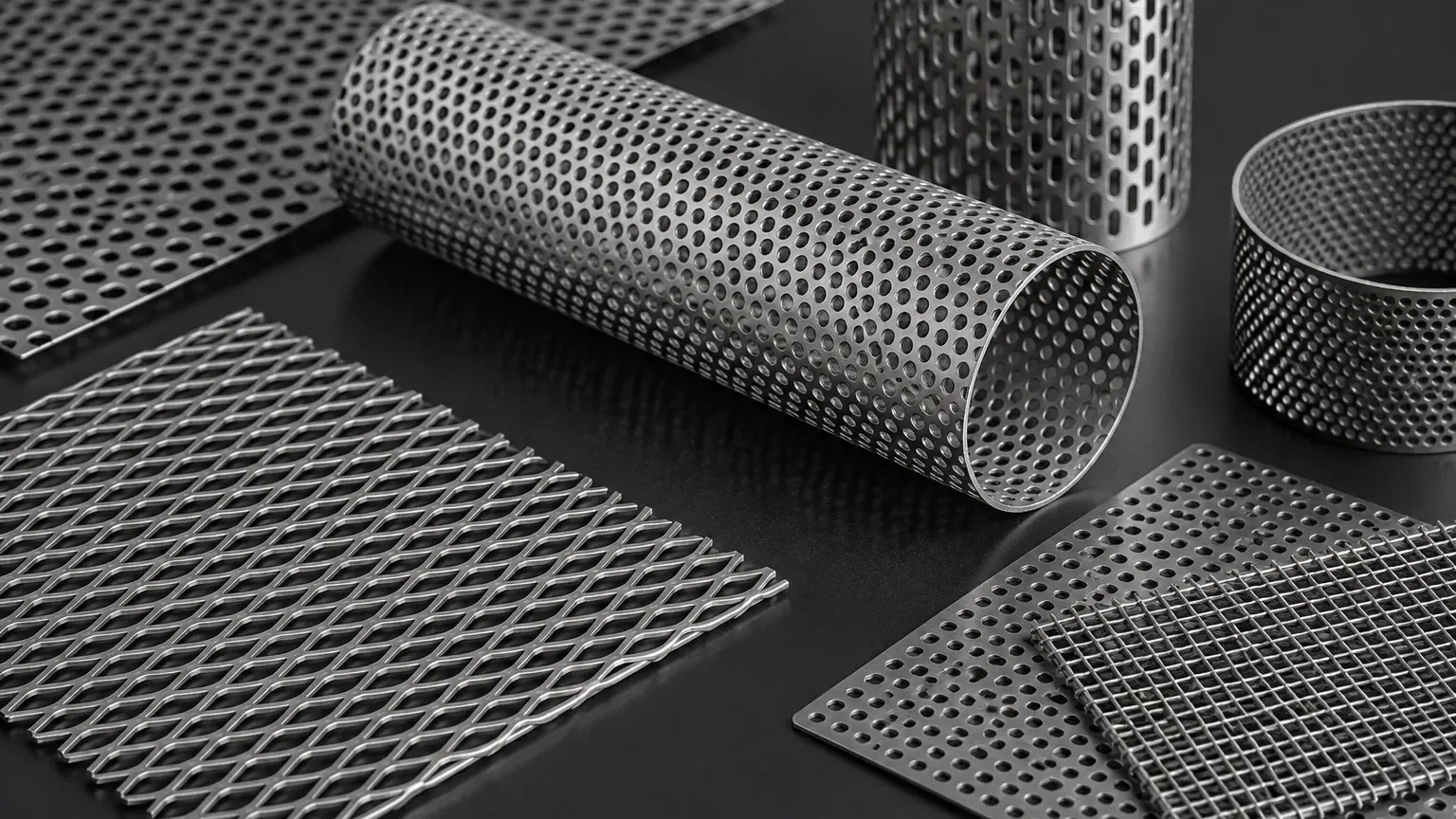
Fine wire mesh or non-woven filter media lack the structural rigidity to withstand high differential pressures. In these designs, Perforated & Expanded Metal provides the necessary reinforcement. The perforated tube prevents the fine mesh from collapsing or expanding under the force of fluid flow, ensuring the filtration pleats maintain their shape and efficiency.
Expanded Metal vs. Perforated Metal
It is important to distinguish between perforated and expanded metal. Expanded metal is produced by slitting and stretching a metal sheet simultaneously, creating diamond-shaped openings. This process involves no material waste, making it a cost-effective alternative for certain support structures. However, perforated metal offers superior precision in hole sizing and a smoother surface, which is often critical for fine-tuned industrial separation processes.
Critical Design Parameters for Industrial Screens
When specifying a perforated metal mesh screen for an OEM project or a replacement part, engineers must define several secondary parameters that affect installation and long-term performance.
Margins and Blank Areas
Margins refer to the unperforated areas along the edges of the sheet. Proper margin specification is vital for welding the screen into a filter housing or frame. Incomplete patterns or "random" margins can lead to structural weak points or difficulties during the assembly of filter cartridges. Engineers should specify whether they require "safe sides" (no broken holes at the edge) or "finished ends."
Gauge and Thickness
The thickness of the material (gauge) must be sufficient to handle the maximum expected pressure drop (Delta P) across the filter. If the metal is too thin, the screen may fatigue over time due to pressure pulsations. Conversely, excessively thick material increases weight and cost and can make the perforation process more difficult, potentially leading to tapered holes where the exit diameter is smaller than the entry diameter.
Flatness and Deburring
The punching process naturally introduces stresses into the metal, which can cause the sheet to curl. For precision applications, the material must be leveled to ensure flatness. Furthermore, the "break side" of the perforated hole often has sharp burrs. In filtration, these burrs can trap contaminants or damage secondary fine-mesh layers, making professional deburring an essential step in the manufacturing process.
Installation, Maintenance, and Service Life Considerations
The total cost of ownership for a perforated metal mesh screen is influenced by its durability and the ease with which it can be maintained. Unlike disposable polymer filters, stainless steel perforated screens are designed for long-term reuse.
Cleaning and Regeneration
In many industrial processes, screens are cleaned via backwashing, ultrasonic cleaning, or chemical soaking. The smooth surface of a perforated screen makes it significantly easier to clean than woven mesh, as there are no wire intersections where particles can become permanently wedged. This "cleanability" is a major advantage in industries like food and beverage, where Clean-in-Place (CIP) protocols are standard.
Monitoring Pressure Drop
The primary indicator that a screen requires maintenance is an increase in differential pressure. As the holes become partially blocked by debris, the velocity of the fluid through the remaining open area increases, leading to higher energy costs and potential bypass issues. Implementing a regular inspection schedule and monitoring pressure gauges allows for scheduled cleaning before a critical failure occurs.
Replacement Cycles
While highly durable, perforated screens are subject to mechanical wear, especially in abrasive slurry applications. Erosion of the hole edges can eventually lead to a loss of filtration accuracy. Regular thickness testing and visual inspections for "rounding" of the hole edges can help predict the end of the component's service life.
Sourcing Custom Perforated Metal Solutions
Standard off-the-shelf perforated sheets rarely meet the exacting requirements of specialized industrial equipment. Customization is often necessary to optimize the balance between flow rate, filtration rating, and mechanical strength.
When partnering with a manufacturer like Kaifil, engineers can specify exact dimensions for OEM integration. Custom capabilities include:
* Cylindrical Forming and Welding: Transforming flat perforated sheets into precision-welded filter tubes or baskets.
* Variable Hole Densities: Designing screens with different open areas in different sections to manage flow distribution.
* Precision Tolerances: Ensuring that hole diameters and pitches meet the tight tolerances required for high-accuracy separation.
By focusing on these technical details, purchasing teams can ensure they receive a component that not only fits their equipment but also enhances the overall efficiency of their filtration process. Whether utilized in chemical reactors, hydraulic systems, or food processing lines, the perforated metal mesh screen remains a cornerstone of reliable industrial performance.
