


Non Perforated Metal Sheet
In the landscape of industrial manufacturing and filtration engineering, the non perforated metal sheet serves as the fundamental building block for a vast array of components. While filtration often focuses on the passage of fluids through media, the structural integrity, containment, and direction of those fluids depend heavily on solid, non-permeable sections. For engineers and procurement specialists, understanding the technical specifications, material grades, and fabrication potential of solid metal sheets is essential for designing robust filtration systems, housings, and industrial assemblies.
At Kaifil, our expertise in stainless steel filtration solutions begins with the selection of high-quality raw materials. Whether a project requires a solid barrier or a base material to be transformed into Perforated & Expanded Metal, the choice of the initial sheet dictates the performance, longevity, and chemical compatibility of the final product.
Technical Characteristics of Non Perforated Metal Sheets
A non perforated metal sheet is defined by its continuous, solid surface. Unlike mesh or perforated media, it provides a total barrier to fluid and gas flow. In industrial filtration, these sheets are utilized where structural rigidity is paramount or where fluid must be diverted to specific filtration zones.
Material Composition and Grades
The performance of a metal sheet is primarily determined by its alloy composition. In the filtration industry, stainless steel is the preferred material due to its mechanical strength and resistance to environmental degradation. Common grades include:
* AISI 304/304L: The most versatile and widely used stainless steel. It offers excellent weldability and good corrosion resistance for general industrial applications, such as water treatment and food processing.
* AISI 316/316L: Containing molybdenum, this grade provides superior resistance to chlorides and pitting. It is the standard for marine environments, pharmaceutical manufacturing, and chemical processing where aggressive cleaning agents or corrosive fluids are present.
* AISI 310S: A high-temperature alloy designed for applications reaching up to 1100°C. It is frequently used in hot gas filtration housings and furnace components.
* Duplex and Super Duplex: These alloys offer higher yield strength and exceptional resistance to stress corrosion cracking, making them suitable for high-pressure hydraulic systems and offshore oil and gas applications.
Mechanical Properties
Engineers must evaluate several mechanical properties when selecting a solid sheet for industrial use:
1. Tensile Strength: The maximum stress the material can withstand while being stretched before breaking.
2. Yield Strength: The stress level at which the metal begins to deform plastically.
3. Elongation: A measure of the material's ductility, which is critical for sheets that will undergo deep drawing or complex forming.
4. Hardness: Measured on the Rockwell or Brinell scales, hardness affects the wear resistance and machinability of the sheet.
The Relationship Between Solid Sheets and Perforated & Expanded Metal
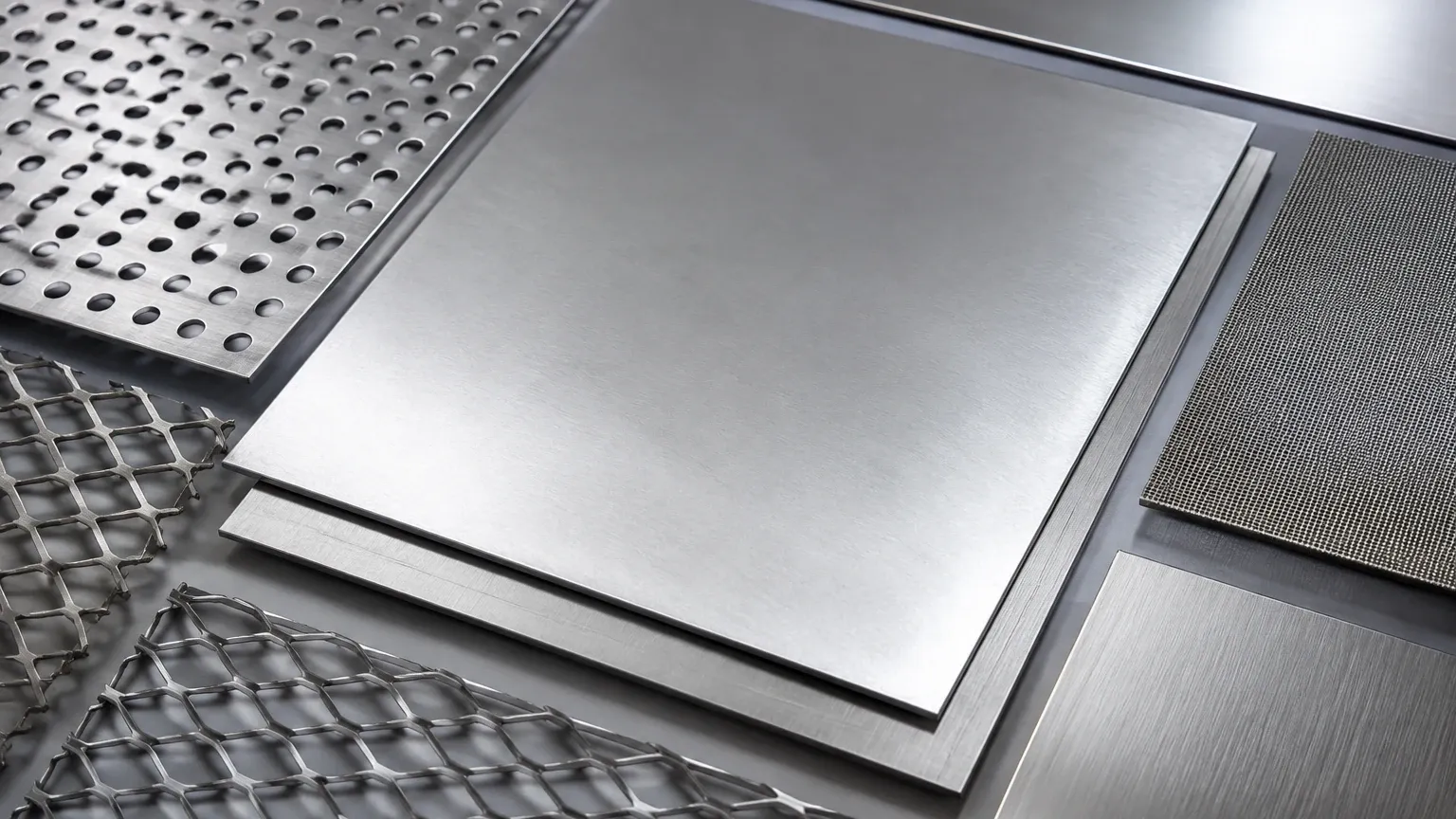
In many filtration applications, the non perforated metal sheet is the precursor to functional filtration media. The transition from a solid sheet to a permeable component involves precision engineering and specialized machinery.
The Perforation Process
To create Perforated & Expanded Metal, solid sheets are fed into CNC punching presses or rotary pin perforators. The pattern—whether round, square, slotted, or hexagonal—is calculated based on the required "open area percentage." This percentage is critical for determining pressure drop and flow rates in filtration systems. A solid sheet provides the necessary margins and unperforated zones required for welding or mounting in a housing.
The Expansion Process
Expanded metal is created by simultaneously slitting and stretching a solid sheet. This process increases the surface area without losing the structural continuity of the metal. Unlike woven wire mesh, expanded metal is a single piece of material, which eliminates the risk of fiber shedding or wire migration—a crucial factor in pharmaceutical and food-grade filtration.
Engineering Considerations: Solid vs. Perforated Components
When designing a filtration assembly, the engineer must decide where to use a non perforated metal sheet and where to utilize perforated media. This decision is based on several functional requirements:
Structural Support and Rigidity
Solid sheets provide the structural skeleton for filter cartridges. For example, in high-pressure hydraulic filters, a solid outer shroud or inner core might be used to prevent the pleats of the filter media from collapsing under the force of the fluid flow. The thickness of the sheet is calculated to withstand the maximum differential pressure (ΔP) expected during the system's operation.
Fluid Direction and Containment
In multi-stage filtration systems, solid sheets act as baffles or diverters. They ensure that the fluid is forced through the filtration media rather than bypassing it. Non-perforated end caps are welded to the ends of filter cartridges to create a leak-proof seal, ensuring that 100% of the process fluid passes through the intended mesh or membrane.
Weight and Cost Optimization
While a solid sheet is heavier than its perforated counterpart, it is often more cost-effective for components that do not require permeability. However, if weight reduction is a primary goal—such as in aerospace or mobile hydraulic applications—engineers may opt for perforated sheets even in non-filtering areas, provided the structural integrity remains within safety margins.
Applications of Non Perforated Sheets in Filtration Systems
In the context of Kaifil’s manufacturing capabilities, the non perforated metal sheet is integrated into several key components of industrial filtration solutions:
Filter Housings and Pressure Vessels
The outer shell of a filtration unit must be non-porous and capable of withstanding internal pressures. These housings are fabricated from heavy-gauge solid sheets, rolled into cylinders, and longitudinal-seam welded using TIG (Tungsten Inert Gas) or Plasma welding techniques to ensure a sanitary and pressure-tight finish.
End Caps and Flanges
Filter cartridges, whether they use wire mesh or sintered metal media, require solid end caps. These are typically stamped or CNC-machined from a non perforated metal sheet. The end caps provide the interface for O-rings, gaskets, or threaded connections, ensuring a secure fit within the filter housing.
Mounting Plates and Baffles
In large-scale water treatment or chemical reactors, solid plates are used to secure multiple filter elements in place. These tube sheets or mounting plates must be precision-machined to ensure perfect alignment and prevent bypass leakage.
Fabrication and Customization Capabilities
To meet the specific needs of OEM customers, solid metal sheets undergo various fabrication processes. Kaifil utilizes advanced manufacturing techniques to ensure that every component meets the rigorous standards of industrial applications.
1. Precision Cutting: Using CNC laser or waterjet cutting, sheets are cut to exact dimensions with minimal heat-affected zones. This is vital for maintaining the corrosion resistance of stainless steel.
2. Forming and Bending: CNC press brakes are used to form the sheets into complex geometries. For filtration components, this might include specialized troughs, support brackets, or conical sections.
3. Surface Finishing: Depending on the application, the sheet may require a specific finish. A 2B finish is standard for industrial use, while electropolishing or a No. 4 brushed finish is required for food and pharmaceutical applications to eliminate surface irregularities where bacteria could thrive.
4. Welding and Assembly: High-quality welding is essential for the longevity of the component. We employ specialized welding procedures to minimize distortion and ensure that the chemical properties of the weld bead match the parent material.
Selection Criteria for Engineers and Purchasing Teams
Before procuring a non perforated metal sheet or a finished component, technical teams should confirm several key parameters to ensure the product is fit for purpose:
* Chemical Compatibility: Does the alloy (e.g., 316L) withstand the specific pH levels, temperatures, and chemical concentrations of the process fluid?
* Dimensional Tolerances: What are the required tolerances for thickness, flatness, and edge squareness? In precision filtration, even a fraction of a millimeter can affect the seal integrity.
* Certification Requirements: Does the project require Mill Test Reports (MTRs) to verify the heat number and chemical composition of the steel? For food and pharmaceutical sectors, FDA or 3A compliance may be necessary.
* Total Cost of Ownership: While carbon steel is cheaper upfront, the longevity and reduced maintenance of a stainless steel sheet often lead to a lower total cost over the lifecycle of the filtration system.
Conclusion
While the focus of high-performance filtration is often on the media that captures contaminants, the role of the non perforated metal sheet cannot be overlooked. It provides the essential structure, containment, and sealing necessary for any industrial filtration system to operate efficiently. By understanding the material properties and fabrication possibilities of these solid sheets, engineers can design systems that offer superior durability and performance.
For applications requiring controlled permeability, flow optimization, or specialized screening, transitioning from a solid sheet to a precision-engineered Perforated & Expanded Metal solution is the next logical step. Kaifil remains committed to providing the technical expertise and manufacturing precision required to turn raw metal into high-performance filtration components across the global industrial sector.
