


Perforated Metal Patterns
In industrial filtration and structural engineering, the selection of perforated metal patterns is a critical decision that directly influences flow dynamics, mechanical strength, and filtration efficiency. Perforated metal is produced by mechanically punching or laser-cutting holes into a metal sheet, creating a specific arrangement of openings. For engineers and procurement teams, understanding the technical nuances of these patterns is essential for optimizing the performance of filter cartridges, strainers, and protective screens.
At Kaifil, we specialize in manufacturing precision Perforated & Expanded Metal components designed to meet the rigorous demands of chemical processing, water treatment, and food production. This guide examines the engineering considerations behind pattern selection, the impact of geometry on industrial applications, and the technical trade-offs inherent in different configurations.
Fundamental Geometries in Perforated Metal Patterns
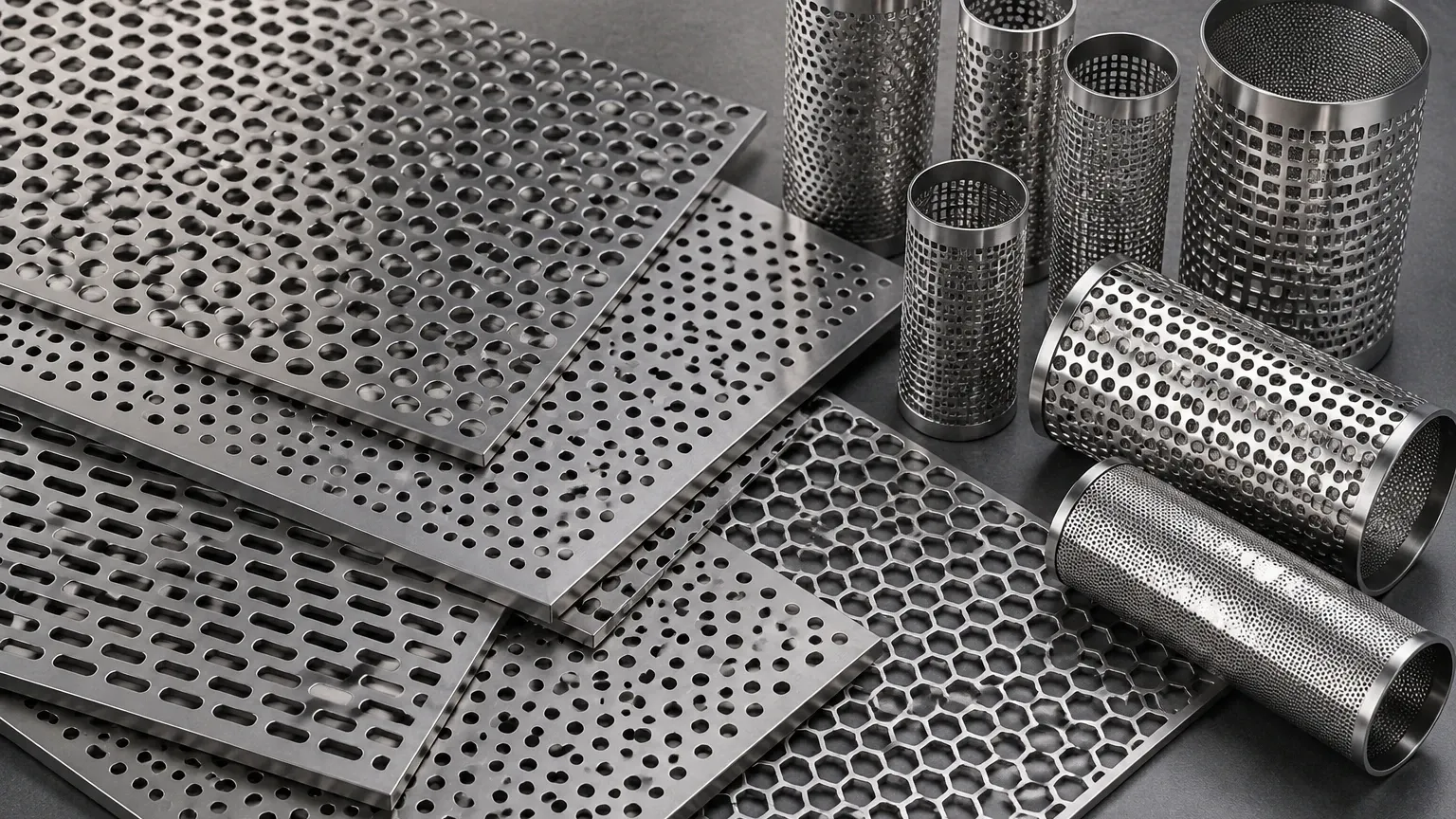
The geometry of the perforation determines the primary characteristics of the metal sheet, including its open area, strength-to-weight ratio, and how it interacts with particles or fluids. While custom shapes are possible, four standard geometries dominate industrial applications.
Round Hole Patterns
Round holes are the most common choice for industrial filtration due to their versatility and structural stability. They offer the most efficient distribution of stress across the metal sheet, reducing the risk of fatigue failure in high-pressure environments. Round holes are typically used in support cores for filter cartridges and as primary screens in water intake systems.
Square Hole Patterns
Square holes provide a higher open area compared to round holes of the same diameter, which can be advantageous for high-flow applications. However, the sharp corners of square perforations act as stress concentrators, making them less suitable for applications subject to significant mechanical vibration or high-pressure differentials. They are frequently used in architectural grilles and protective machinery guards where visibility and airflow are prioritized over maximum structural rigidity.
Slotted Hole Patterns
Slotted or oblong patterns are characterized by long, narrow openings with either round or square ends. These patterns are specifically engineered for sorting and sifting applications. In the filtration of viscous fluids or the processing of granular materials, slotted holes prevent "blinding" (clogging) more effectively than round holes. They are often arranged in a staggered formation to maximize the screening surface while maintaining the integrity of the sheet.
Hexagonal (Honeycomb) Patterns
Hexagonal patterns offer the highest possible open area—often exceeding 80%—while maintaining a respectable level of structural integrity. These are common in weight-sensitive applications or where maximum airflow is required, such as in electronic enclosure cooling or specialized aerospace components.
Staggered vs. Straight Hole Orientations
The orientation of the holes—how they are aligned relative to one another—is as important as the hole shape itself. The orientation affects the "bridge" (the metal remaining between the holes) and the overall durability of the component.
60-Degree Staggered Pattern
This is the industrial standard for perforated metal patterns. In a 60-degree staggered arrangement, the holes in successive rows are offset so that each hole is equidistant from its neighbors. This configuration provides the highest degree of structural uniformity and the most efficient use of space, allowing for a high open area without compromising the strength of the metal bridge. For filtration support cores, the 60-degree stagger ensures that the pressure load is distributed evenly across the cylinder.
45-Degree Staggered Pattern
Less common than the 60-degree variant, the 45-degree stagger is used when specific aesthetic qualities are required or when a specific directional flow is needed. It generally offers lower open area percentages than the 60-degree orientation but can be useful in specialized screening equipment.
Straight Row Patterns
In a straight row pattern, holes are aligned both horizontally and vertically. While this is the simplest pattern to manufacture, it is mechanically the weakest. The continuous "gutters" of solid metal between the rows make the sheet prone to bending or stretching along those lines. Straight patterns are typically reserved for decorative applications or low-stress environments where alignment with other components is critical.
Calculating Open Area and Its Impact on Filtration
The "Open Area" is the percentage of the sheet that is comprised of holes. This figure is the most important metric for engineers calculating flow rates and pressure drops. A higher open area reduces the resistance to fluid flow but decreases the mechanical strength of the filter.
For a standard 60-degree staggered round hole pattern, the formula for calculating the open area percentage (OA%) is:
OA% = (D² × 90.69) / P²
* D = Hole Diameter
* P = Pitch (the distance from the center of one hole to the center of the adjacent hole)
In industrial filtration, the goal is often to find the "sweet spot" where the open area is sufficient to prevent excessive pressure drop (which increases energy costs and pump wear) while ensuring the bridge thickness is substantial enough to withstand the collapse pressure of the system. In high-pressure hydraulic applications, for instance, a lower open area with thicker bridges is often preferred to prevent the media from migrating or the support core from buckling.
Material Selection for Perforated Components
The performance of perforated metal patterns is inextricably linked to the material substrate. Environmental factors such as temperature, chemical exposure, and mechanical stress dictate the choice of alloy.
1. Stainless Steel (304 and 316L): The gold standard for industrial filtration. Grade 316L, with its addition of molybdenum, offers superior resistance to pitting and crevice corrosion in chloride-rich environments, making it ideal for marine and chemical processing applications.
2. Carbon Steel: Frequently used in oil and gas applications where corrosion is managed through chemical inhibitors or where the cost of stainless steel is prohibitive. It offers excellent mechanical strength but requires coating or plating for longevity.
3. Aluminum: Chosen for its high strength-to-weight ratio and natural corrosion resistance. It is commonly used in aerospace and architectural applications, though its lower melting point limits its use in high-temperature industrial processes.
4. Specialty Alloys: For extreme environments involving highly acidic or alkaline fluids, alloys like Monel, Hastelloy, or Titanium may be perforated to provide the necessary longevity.
Perforated vs. Expanded Metal: Engineering Trade-offs
When evaluating Perforated & Expanded Metal, it is important to distinguish between the two manufacturing processes. While perforated metal is created by removing material (punching), expanded metal is created by slitting and stretching the sheet simultaneously.
* Perforated Metal: Offers precise control over hole size, shape, and spacing. It is the preferred choice for high-precision filtration where specific particle retention is required. It also provides a smooth surface, which is easier to clean and less likely to trap contaminants.
* Expanded Metal: Is a more cost-effective solution for large-scale screening because there is no material waste. The stretching process creates a diamond-shaped opening with a raised profile. This provides excellent grip and strength but is less precise for fine filtration and can be more difficult to clean in food-grade or pharmaceutical applications.
Technical Considerations for Customization
When ordering custom perforated metal patterns for industrial use, engineers must confirm several technical parameters to ensure the final product meets the application requirements:
* Hole Size vs. Material Thickness: As a general rule of thumb in the punching process, the hole diameter should not be less than the material thickness. For example, punching 1mm holes in 2mm thick stainless steel is technically challenging and can lead to frequent tool breakage and burr formation.
* Margins and Unperforated Areas: Specify if the sheet requires solid margins around the edges for welding or mounting. Standard "finished" patterns may have random perforations at the edges, whereas "specified" margins ensure a clean, solid border.
* Flatness and Stress Relief: The punching process introduces internal stresses into the metal, which can cause the sheet to curl or bow. For high-precision filter assemblies, the material must undergo leveling or stress-relieving processes to ensure it remains flat during subsequent fabrication steps like rolling or welding.
* Burr Direction: In filtration, the direction of the burr (the slight protrusion of metal on the exit side of the punch) can affect flow and cleaning. Specifying which side should be the "clean" side is vital for components used in the food and beverage industry.
Applications in Industrial Filtration Systems
Perforated metal patterns serve multiple roles within a filtration system, often acting as the backbone of the entire assembly.
Filter Support Cores
In pleated filter cartridges, a perforated metal tube serves as the inner core. It must withstand the inward pressure of the fluid (collapse pressure). A staggered round hole pattern is typically used here to provide maximum support to the filter media while allowing for uniform flow across the entire surface area.
Basket Strainers
For large-scale debris removal in piping systems, perforated metal baskets are used to capture stones, scale, and other large particles. The pattern choice depends on the minimum particle size that needs to be captured and the total volume of fluid passing through the system.
Centrifuge Screens
In pharmaceutical and chemical processing, perforated metal with extremely fine holes is used in centrifuges to separate solids from liquids. These patterns require high precision and often utilize specialized coatings to prevent material adhesion.
Conclusion: Selecting the Right Pattern for Your Project
Choosing the correct perforated metal pattern involves balancing the physical requirements of the application with the limitations of the manufacturing process. A well-engineered pattern optimizes the flow rate, ensures structural longevity, and minimizes maintenance requirements.
Before finalizing a design, engineers should evaluate the total cost of ownership, including the potential for pressure-drop-related energy losses and the expected replacement cycle based on material fatigue. For complex filtration challenges, consulting with a manufacturer experienced in custom stainless steel solutions ensures that the selected pattern, material, and tolerances are perfectly aligned with the operational environment.
