


Perforated Metal Pipe
In industrial filtration and fluid handling, the perforated metal pipe serves as a fundamental structural and functional component. Unlike standard piping, these specialized tubes are engineered with precise patterns of holes to allow for the controlled passage of liquids or gases while retaining solid particles or providing mechanical support for finer filter media. As a subset of Perforated & Expanded Metal solutions, these pipes are critical in environments ranging from deep-well water extraction to high-pressure chemical processing.
Selecting the right perforated metal pipe requires a deep understanding of fluid dynamics, material science, and mechanical engineering. For engineers and procurement teams, the decision-making process involves balancing flow rates, structural integrity, and chemical compatibility to ensure long-term operational efficiency.
Understanding Perforated Metal Pipe in Industrial Systems
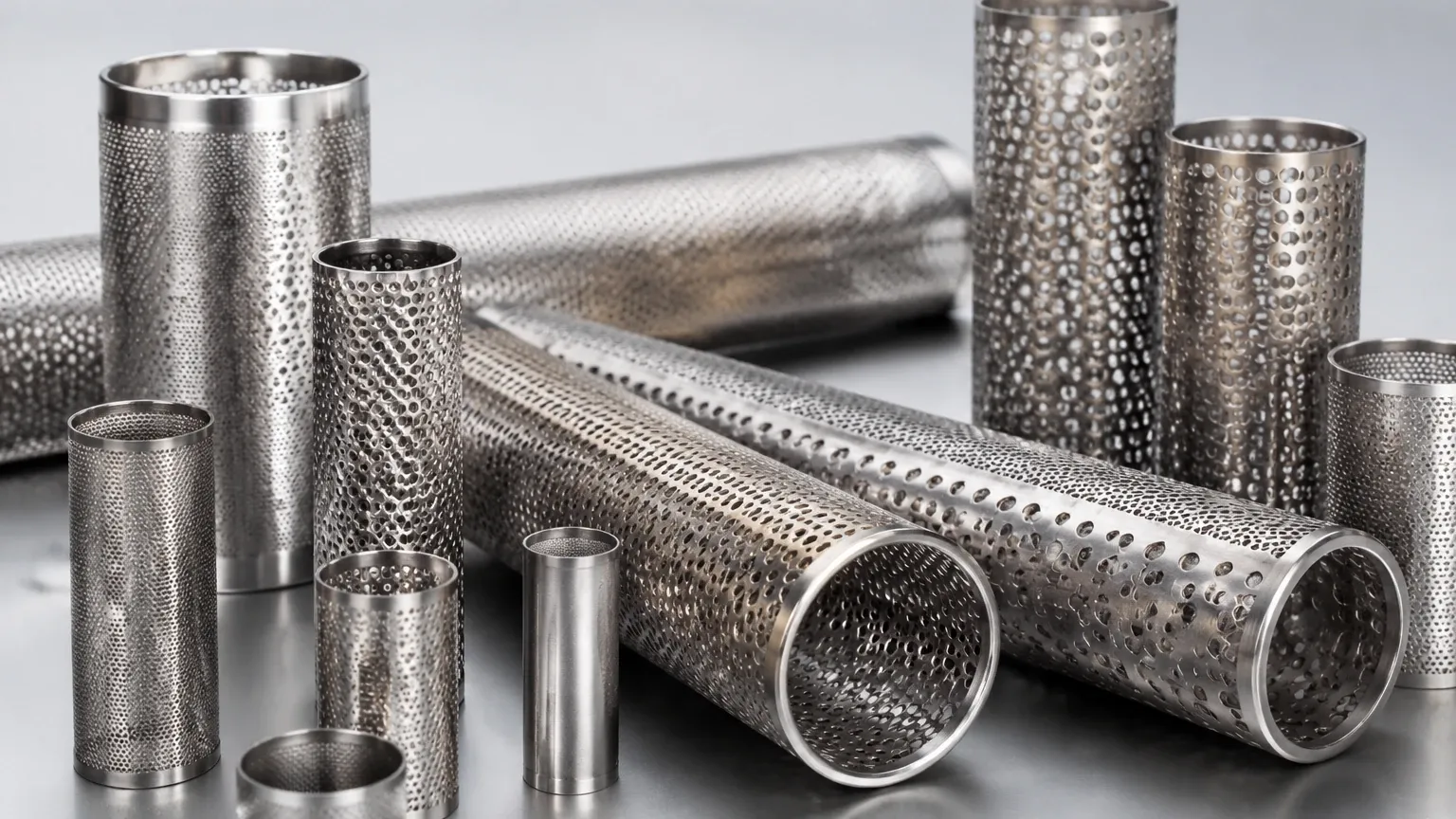
A perforated metal pipe is essentially a metal sheet that has been punched with a specific hole pattern, rolled into a cylindrical shape, and welded along the seam. In industrial filtration, these pipes often function in one of two roles: as a primary coarse filter or as a support core (center tube) for pleated or depth filter cartridges.
When used as a support core, the pipe provides the necessary rigidity to prevent the collapse of delicate filter media under high differential pressure. When used as a primary strainer, the hole size determines the largest particle that can pass through the system. Because these components are often exposed to corrosive fluids, high temperatures, and mechanical stress, the choice of base material and manufacturing precision is paramount. Most high-performance industrial applications utilize stainless steel due to its superior durability and resistance to oxidation.
Engineering Specifications: Hole Patterns and Open Area
The performance of a perforated metal pipe is primarily governed by its geometric configuration. Engineers must specify the hole shape, size, and arrangement to meet the specific needs of their application.
Hole Shapes and Arrangements
* Round Holes: The most common and cost-effective pattern. Round holes offer excellent structural strength and are available in staggered or straight-row configurations. Staggered patterns (usually 60 degrees) provide the highest open area and uniform strength.
* Square Holes: Often used when a higher open area is required for high-flow applications, though they may offer slightly less structural rigidity than round holes.
* Slotted Holes: These are ideal for filtering elongated particles or for use in well screens where sand control is a priority.
Calculating Open Area
The "open area" is the percentage of the pipe surface that consists of holes. This is a critical metric because it directly influences the pressure drop across the filter. A higher open area reduces resistance to flow (lowering energy costs for pumps) but can compromise the mechanical strength of the pipe.
For a standard 60-degree staggered round hole pattern, the open area percentage is calculated using the formula:
Open Area % = (D² × 90.69) / P²
*(Where D is the hole diameter and P is the center-to-center pitch between holes.)*
Engineers must ensure that the open area is sufficient to maintain the required flow rate without causing a significant pressure spike, while still maintaining a wall thickness that can withstand the system's operating pressure.
Material Selection for Demanding Environments
The longevity of a perforated metal pipe is largely determined by its material composition. In industrial B2B contexts, stainless steel is the industry standard for its balance of cost and performance.
Stainless Steel 304
This is the most common grade used in general industrial applications, including food and beverage processing and water treatment. It offers good corrosion resistance to most oxidizing acids and is highly durable. However, it is susceptible to pitting in high-chloride environments (such as seawater).
Stainless Steel 316 and 316L
For chemical processing, pharmaceutical manufacturing, or marine applications, SS 316 is preferred. The addition of molybdenum enhances its resistance to chloride-induced corrosion and pitting. SS 316L (low carbon) is used when extensive welding is required, as it prevents carbide precipitation that can lead to intergranular corrosion in the heat-affected zones of the weld.
Specialized Alloys
In extreme environments involving high-temperature gases or highly aggressive chemicals, specialized alloys like Monel, Inconel, or Hastelloy may be specified. These materials ensure that the Perforated & Expanded Metal components do not degrade, preventing system failure and contamination.
Manufacturing Processes and Quality Control
The transition from a flat metal sheet to a finished perforated metal pipe involves several high-precision manufacturing steps. Each step must be controlled to ensure the pipe meets industrial tolerances.
1. Perforating: Heavy-duty CNC presses punch the pattern into the metal sheet. Precision here is vital to ensure uniform hole distribution and to avoid material warping.
2. Leveling: After punching, the sheet may become slightly distorted. Leveling machines restore the flatness of the sheet to ensure accurate rolling.
3. Rolling: The sheet is rolled into a cylinder. The diameter must be tightly controlled, especially if the pipe is intended to fit into a larger housing or serve as a core for a filter cartridge.
4. Welding: The longitudinal seam is joined using TIG (Tungsten Inert Gas), MIG (Metal Inert Gas), or plasma welding. For filtration applications, the weld must be smooth and free of burrs or slag to prevent damage to the filter media and to ensure a clean flow path.
5. Finishing: Post-welding treatments such as pickling and passivation are performed to remove surface contaminants and restore the protective oxide layer of the stainless steel. Electropolishing may also be used for pharmaceutical or food-grade applications to achieve a mirror-like, ultra-smooth finish.
Critical Applications of Perforated Metal Pipes
Perforated metal pipes are utilized across a broad spectrum of industries, each with unique performance requirements.
Oil and Gas Industry
In upstream operations, perforated pipes are used as base pipes for sand screens in oil wells. They must withstand immense collapse pressures while allowing hydrocarbons to flow into the wellbore. The precision of the perforation ensures that the sand control media remains intact and functional.
Chemical and Petrochemical Processing
These pipes often serve as catalyst support tubes in reactors. They must remain stable under high temperatures and resist chemical attack from aggressive reagents. The uniformity of the holes ensures even distribution of fluids through the catalyst bed.
Water Treatment and Desalination
Perforated pipes are used in intake screens and as support structures for reverse osmosis (RO) pre-filtration. In these settings, resistance to biofouling and corrosion (especially in seawater) is the primary concern.
Food and Beverage Industry
Used in strainers and centrifugal filters, these pipes must meet strict hygienic standards. The smooth finish and lack of crevices are essential to prevent bacterial growth and ensure effective Clean-in-Place (CIP) cycles.
Evaluating Mechanical Strength and Pressure Limits
One of the most common mistakes in specifying a perforated metal pipe is underestimating the mechanical loads. A pipe with a high open area is inherently weaker than a solid pipe. Engineers must calculate the collapse pressure and burst pressure.
* Collapse Pressure: This is the external pressure at which the pipe will deform inward. This is critical for suction-side filters or pipes used in deep-well applications.
* Burst Pressure: This is the internal pressure at which the pipe will rupture. This is a vital consideration for high-pressure discharge filtration.
Factors such as wall thickness, pipe diameter, and the "unperforated margins" (the solid metal areas at the ends and along the seam) significantly contribute to the overall strength. Customizing these margins allows for easier welding to end caps or flanges without compromising the integrity of the perforated pattern.
Total Cost of Ownership and Replacement Cycles
While the initial purchase price of a perforated metal pipe is a factor, procurement professionals should focus on the Total Cost of Ownership (TCO). A lower-quality pipe may suffer from:
* Premature Corrosion: Leading to frequent replacements and system downtime.
* Structural Failure: Potentially damaging downstream equipment like pumps or turbines.
* Excessive Pressure Drop: Increasing the energy consumption of the entire system.
Investing in high-grade stainless steel and precision-manufactured Perforated & Expanded Metal components usually results in longer service life and lower maintenance costs. In many industrial settings, these pipes are designed to be cleaned and reused. Understanding the proper cleaning protocols—such as ultrasonic cleaning or backwashing—can significantly extend the replacement cycle.
Technical Confirmation Before Purchase
Before finalizing a custom order for perforated metal pipes, engineers should confirm the following technical details with the manufacturer:
1. Exact Alloy Grade: Ensure the material certifications (MTRs) match the application's chemical environment.
2. Dimensional Tolerances: Confirm the Inner Diameter (ID), Outer Diameter (OD), and length tolerances, especially for integrated systems.
3. Burr Removal: Specify the required level of deburring. Internal burrs can cause turbulence, while external burrs can tear filter membranes.
4. Weld Integrity: Confirm that the welding process is compatible with the material and that the seam is tested for strength.
5. Compliance Standards: Ensure the product meets relevant industry standards, such as ISO, ASTM, or specific food-grade certifications if applicable.
By focusing on these technical parameters, industrial operators can ensure that their filtration systems remain reliable, efficient, and cost-effective over their entire operational lifespan.
