


Perforated Metal Squares
In industrial filtration and structural engineering, the selection of the correct media geometry is critical to achieving the desired flow rates, structural integrity, and filtration efficiency. Perforated metal squares, characterized by their square-hole patterns, represent a versatile solution within the broader category of Perforated & Expanded Metal. Unlike traditional round-hole perforations, square holes offer a higher percentage of open area, making them particularly effective for applications requiring high throughput and minimal pressure drop.
For engineers and procurement specialists, understanding the technical nuances of perforated metal squares—ranging from material grade selection to hole alignment—is essential for optimizing system performance. This guide examines the engineering principles, application benefits, and selection criteria for square-hole perforated metal in demanding industrial environments.
Understanding Perforated Metal Squares in Industrial Filtration
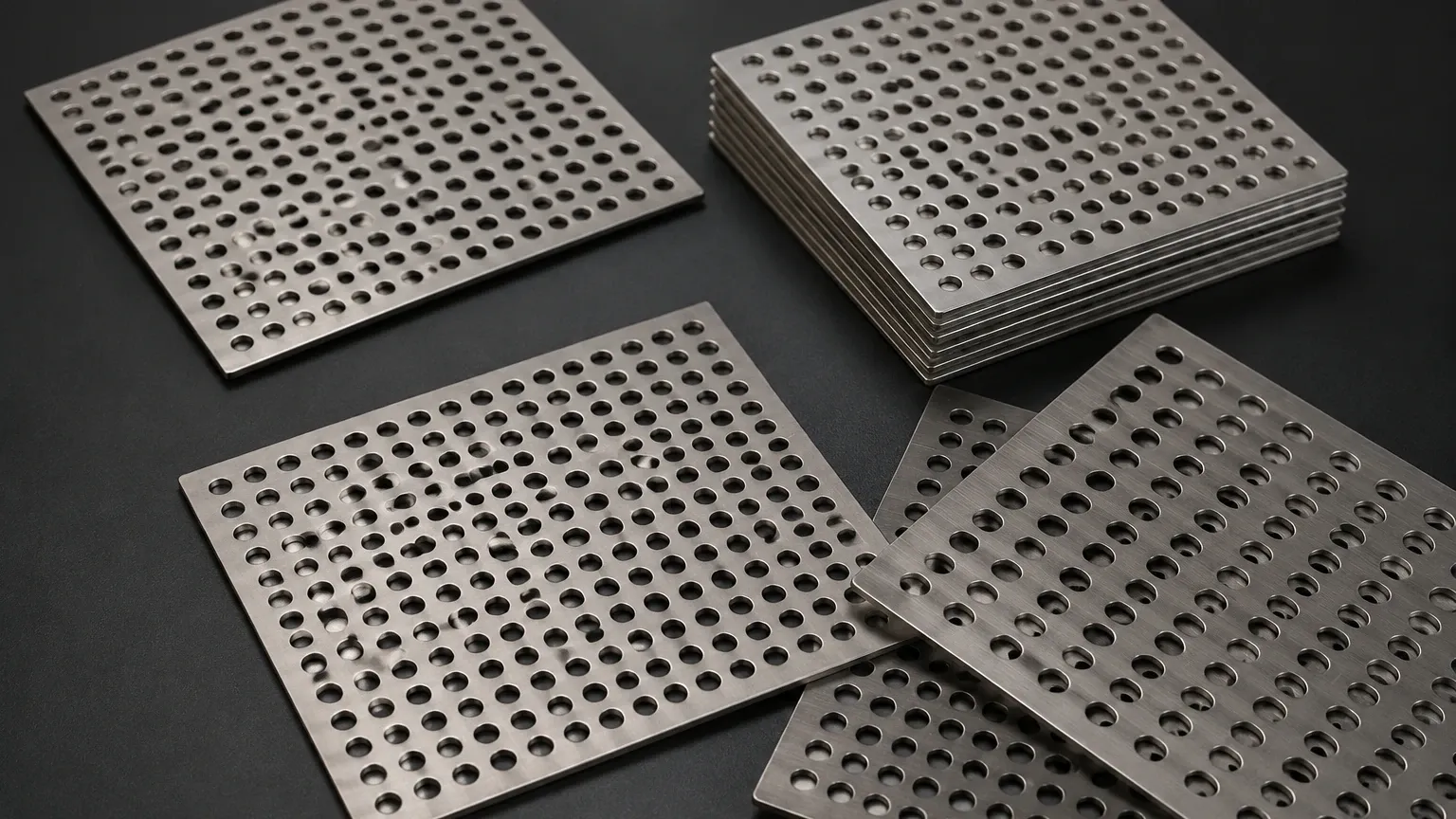
Perforated metal squares are manufactured by mechanically punching a series of square holes into a metal sheet or coil. This process creates a clean, precise aperture that is often preferred in filtration and separation processes where the shape of the particles or the flow dynamics of the fluid require a specific geometric interface.
In the context of industrial filtration, these components serve two primary roles. First, they can act as the primary filtration media for coarse separation, where the square apertures are sized to retain large debris while allowing the fluid or gas to pass through with minimal resistance. Second, and perhaps more commonly, they serve as a high-strength support structure (a "skeleton") for finer wire mesh or synthetic filter media. By providing a rigid backing, the perforated metal prevents the finer mesh from collapsing under high differential pressures, ensuring the longevity of the filter cartridge or basket.
Technical Specifications and Geometry
The performance of perforated metal squares is dictated by three primary geometric factors: the hole size, the pitch (center-to-center distance), and the hole arrangement.
Hole Size and Pitch
The hole size refers to the length of one side of the square aperture. The pitch is the distance from the center of one hole to the center of the adjacent hole. These dimensions determine the "bar" or "bridge" width—the amount of solid metal remaining between the holes. A narrower bridge increases the open area but reduces the structural rigidity of the sheet. Conversely, a wider bridge enhances the load-bearing capacity but increases the resistance to flow.
Straight vs. Staggered Patterns
Perforated metal squares are typically offered in two patterns:
1. Straight Line: Holes are aligned in both horizontal and vertical rows. This is the most common configuration for square holes, providing a uniform appearance and predictable flow paths.
2. Staggered: Holes are offset in adjacent rows. While more common in round-hole patterns, staggered square holes can be utilized to increase the overall strength of the sheet in specific directions, though this often complicates the manufacturing process and the calculation of flow dynamics.
Material Selection for Demanding Environments
Given that many industrial filtration applications involve corrosive fluids, high temperatures, or strict hygiene requirements, material selection is a foundational engineering decision. Kaifil specializes in stainless steel solutions, which are the industry standard for durability and chemical resistance.
Stainless Steel 304
Grade 304 is the most widely used stainless steel for perforated metal. It offers excellent forming and welding characteristics and provides sufficient corrosion resistance for many food processing, architectural, and general industrial applications. It is a cost-effective choice for environments where exposure to highly corrosive chemicals is limited.
Stainless Steel 316 and 316L
For more aggressive environments, such as chemical processing plants, pharmaceutical manufacturing, or marine applications, Stainless Steel 316 is preferred. The addition of molybdenum enhances its resistance to pitting and crevice corrosion, particularly in chloride-rich environments. The "L" (low carbon) variant, 316L, is often specified when the component requires extensive welding, as it minimizes the risk of carbide precipitation and subsequent intergranular corrosion.
Specialized Alloys
In extreme cases involving high-temperature oxidation or highly acidic conditions, specialized alloys like Monel, Inconel, or Hastelloy may be used. These materials ensure that the perforated metal squares maintain their structural integrity and aperture precision over long service cycles in environments where standard steels would fail.
Calculating Open Area and Flow Efficiency
One of the primary advantages of perforated metal squares is the high percentage of open area they can achieve. The open area is the ratio of the total area of the holes to the total area of the sheet, expressed as a percentage. This value is a direct indicator of the material's transparency to fluid or gas flow.
For a straight-line square hole pattern, the formula for calculating the open area is relatively straightforward:
Open Area % = (S² / P²) × 100
*Where:*
* S = Side length of the square hole
* P = Pitch (center-to-center distance)
Because square holes do not have the "dead space" found between the curves of round holes, they can reach open area percentages exceeding 60% or even 70% while still maintaining a viable bridge of metal for structural support. This high efficiency is critical in hydraulic systems and high-velocity gas filtration where minimizing the pressure drop (ΔP) is essential to reducing energy consumption and pump wear.
Applications in Chemical and Food Processing
The unique geometry of perforated metal squares makes them suitable for several specialized industrial sectors.
Chemical Processing
In chemical reactors and catalyst recovery systems, perforated metal squares are used as support grids. Their ability to provide a flat, stable surface for catalyst beds while allowing for high-volume liquid or gas throughput makes them superior to many other support media. The precision of the square apertures ensures uniform distribution of flow across the entire bed, preventing "channeling" and ensuring efficient chemical reactions.
Food and Beverage Industry
In the food industry, square-hole perforated metal is frequently used in drying trays, sorting screens, and juice extraction equipment. The clean lines of the square holes are easier to sanitize than complex mesh weaves, reducing the risk of bacterial growth. Furthermore, when used in grain drying or malt kilning, the square apertures prevent the clogging often seen with round holes when dealing with non-spherical organic materials.
Pharmaceutical and Biotech
In these sectors, the focus is on material purity and surface finish. Perforated metal squares made from 316L stainless steel are often electropolished to achieve a mirror-like finish. This process removes microscopic peaks and valleys where contaminants could lodge, ensuring that the filtration components meet stringent FDA and cGMP requirements.
Engineering Considerations for Custom Filtration Solutions
When designing a system that incorporates perforated metal squares, engineers must look beyond the basic dimensions. Several secondary factors influence the final performance and total cost of ownership.
Margins and Blank Areas
Custom perforated sheets often require unperforated areas, known as margins, along the edges to facilitate welding or mounting into a frame. Specifying the exact width of these margins is crucial. Large margins can affect the total flow capacity of the component, while insufficient margins may lead to structural failure at the attachment points during high-pressure pulses.
Flatness and Leveling
The perforation process naturally introduces internal stresses into the metal sheet, which can cause it to bow or curl. For precision filtration components, such as those used in automatic self-cleaning filters, the material must undergo a leveling process to ensure it is perfectly flat. This ensures that wiper blades or backwash arms can maintain a consistent seal against the surface.
Deburring and Surface Finishing
Punching holes creates a "die side" (smooth) and a "punch side" (which may have a slight burr). In filtration, burrs can trap particles, increase turbulence, or even break off and contaminate the filtrate. High-quality perforated metal squares undergo mechanical or chemical deburring to ensure all edges are smooth, protecting both the process fluid and any secondary filter media layered against the perforation.
Maintenance, Cleaning, and Service Life
The durability of stainless steel perforated metal squares makes them a cost-effective long-term investment compared to disposable synthetic filters. However, their service life depends on proper maintenance and cleaning protocols.
Cleaning Methods
Because of their rigid structure, square-hole perforated metals are highly compatible with various cleaning techniques:
* Backwashing: High-pressure reversal of flow to dislodge particles.
* Ultrasonic Cleaning: Using high-frequency sound waves in a solvent bath to remove fine contaminants from the corners of the square holes.
* Chemical CIP (Clean-in-Place): Circulating caustic or acidic cleaning agents through the system to dissolve organic or mineral scaling.
Identifying Wear and Fatigue
While stainless steel is resistant to wear, the constant cycling of pressure in hydraulic or pneumatic systems can lead to metal fatigue, particularly at the corners of the square holes where stress concentration is highest. Regular inspection should look for hairline cracks or deformation of the bridges. Choosing a material thickness that accounts for the maximum peak pressure, rather than just the average operating pressure, is a key engineering safeguard.
Conclusion: Selecting the Right Partner for Perforated Metal
Choosing the right perforated metal squares requires a balance between filtration requirements, structural demands, and material compatibility. By focusing on the specific needs of the application—whether it is the high open area required for gas exhaust or the extreme corrosion resistance needed for chemical processing—engineers can significantly improve the efficiency and reliability of their filtration systems.
At Kaifil, we provide the technical expertise and manufacturing precision necessary to produce custom perforated metal components that meet the rigorous standards of global industry. From initial material selection to final surface treatment, our focus remains on delivering filtration solutions that optimize performance and reduce the total cost of operation for our partners.
