


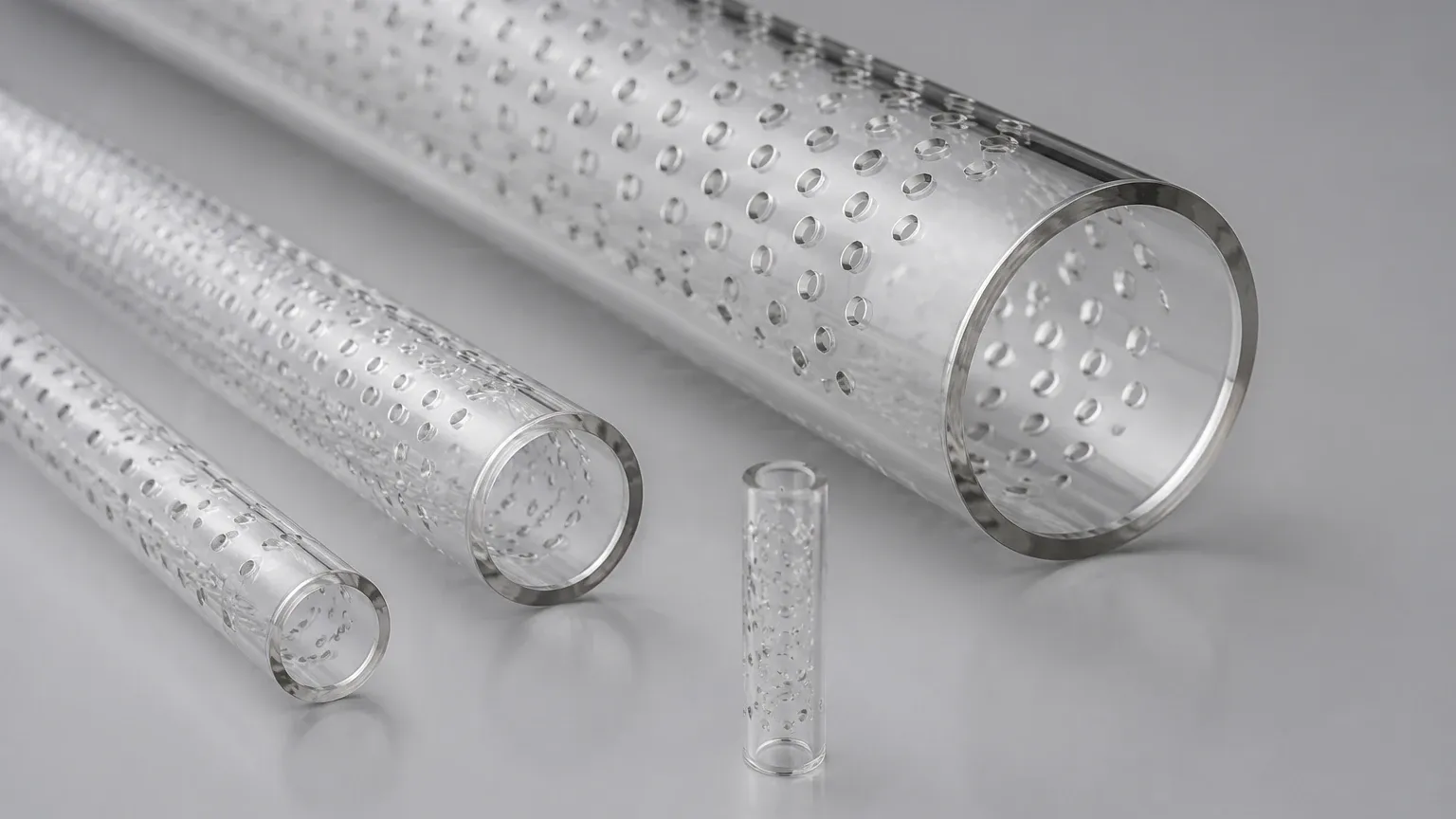
Perforated Quartz Tube
In high-performance industrial environments, material selection is often the deciding factor between system failure and operational efficiency. While stainless steel and specialty alloys dominate the filtration and processing landscape, certain applications—particularly those involving extreme temperatures, aggressive chemical reagents, or ultraviolet (UV) transmission—require the unique properties of a perforated quartz tube. For engineers and procurement specialists, understanding the technical nuances of perforated quartz, its manufacturing constraints, and its integration with traditional metal components is essential for optimizing system design.
As a manufacturer specializing in precision filtration components, Kaifil recognizes that industrial systems often require a hybrid approach. While our core expertise lies in Perforated & Expanded Metal solutions, we frequently see these metal components used in conjunction with quartz to provide structural reinforcement, EMI shielding, or housing for fragile ceramic and glass-like elements. This article provides a technical deep dive into the engineering considerations of perforated quartz tubes and how they interface with industrial filtration assemblies.
Understanding the Material Properties of Perforated Quartz
Quartz, specifically fused silica or fused quartz, is distinguished by its near-zero thermal expansion coefficient and exceptional purity. When processed into a perforated tube, these characteristics translate into several critical functional advantages:
Thermal Stability and Shock Resistance
Unlike most metals and standard glasses, quartz can withstand rapid temperature fluctuations without fracturing. A perforated quartz tube can be heated to over 1,000°C and then immediately quenched in cold water. This makes it an ideal candidate for semiconductor processing and high-heat chemical reactors where thermal cycling is frequent.
Chemical Inertness
Quartz is highly resistant to most acids, including sulfuric and nitric acids, at high concentrations. This inertness ensures that the filtration or processing medium remains uncontaminated by the tube material itself. In pharmaceutical and laboratory environments, this prevents the leaching of metallic ions, a common concern with even the highest grades of stainless steel.
Optical and UV Transmission
One of the most significant reasons for selecting quartz over perforated metal is its transparency to ultraviolet light. Perforated quartz tubes are often used as protective sleeves for UV lamps in water treatment or air sterilization systems. The perforations allow for the passage of air or fluid while the quartz maintains a controlled environment for the internal components.
Engineering and Manufacturing Processes for Perforations
Creating perforations in quartz is a significantly more complex process than punching or expanding metal. Because quartz is brittle, traditional mechanical drilling can introduce micro-cracks that lead to structural failure under thermal stress. Engineers must select the appropriate manufacturing method based on the required precision and application.
Laser Drilling
Laser technology is the primary method for creating high-precision holes in quartz tubes. CO2 or UV lasers can vaporize the material with minimal heat-affected zones. This method allows for extremely small hole diameters and complex patterns that would be impossible with mechanical tools. It is the preferred choice for precision filtration where specific flow rates and pressure drops must be maintained.
Ultrasonic Machining
For larger holes or specific geometries, ultrasonic machining uses an abrasive slurry and a vibrating tool bit. This process is "cold," meaning it does not introduce thermal stress into the quartz, preserving the integrity of the tube’s molecular structure. It is often used for custom intake or exhaust ports in larger quartz assemblies.
Mechanical Diamond Drilling
While less common for high-precision applications, diamond-tipped core drills can be used for thicker-walled quartz tubes. This requires constant cooling and slow feed rates to prevent cracking. After drilling, the tube often undergoes a fire-polishing or chemical etching process to smooth the edges of the perforations and remove surface imperfections.
Key Applications in Specialized Industrial Environments
The use of a perforated quartz tube is typically reserved for environments where metal would fail or interfere with the process.
Semiconductor and Photovoltaic Manufacturing
In the production of silicon wafers, high-purity environments are mandatory. Perforated quartz tubes serve as gas distribution manifolds in Chemical Vapor Deposition (CVD) and diffusion furnaces. The perforations ensure uniform gas flow across the wafers, while the quartz material prevents metallic contamination that would ruin the semiconductor's electrical properties.
UV Sterilization Systems
In large-scale water treatment, perforated quartz tubes act as baffles or protective sleeves. They allow the fluid to move through the system in a controlled manner while ensuring maximum exposure to UV radiation. In these setups, a stainless steel outer cage made of Perforated & Expanded Metal is often used to protect the quartz tube from mechanical impact or debris.
Laboratory and Analytical Instrumentation
Quartz is a staple in analytical chemistry. Perforated tubes are used in combustion analysis and gas chromatography, where they must withstand high temperatures and provide a non-reactive surface for chemical reactions. The precision of the perforations is critical here for maintaining accurate flow measurements.
Comparing Perforated Quartz to Perforated & Expanded Metal Solutions
When designing a filtration or processing system, engineers must weigh the benefits of quartz against the durability and cost-effectiveness of metal.
| Feature | Perforated Quartz Tube | Perforated & Expanded Metal |
| :— | :— | :— |
| Mechanical Strength | Low (Brittle) | High (Ductile) |
| Temperature Limit | Up to 1,200°C | Up to 800°C (depending on alloy) |
| Chemical Resistance | Excellent (Acids) | Good (Depends on grade, e.g., 316L) |
| Transparency | High (UV/Visible) | Opaque |
| Cost | High | Moderate to Low |
| Customization | Complex/Expensive | Highly Flexible |
In many industrial scenarios, a hybrid design is the most effective. For example, a perforated quartz tube might handle the primary chemical reaction or UV exposure, while an outer layer of stainless steel expanded metal provides the structural frame and mounting points. This combination leverages the chemical and thermal properties of quartz with the mechanical resilience of metal.
Design Specifications and Selection Criteria for Technical Buyers
When specifying a perforated quartz tube for a project, several technical parameters must be defined to ensure compatibility and performance:
1. Hole Diameter and Pitch: The size and spacing of the holes determine the open area percentage, which directly impacts flow rate and pressure drop. For filtration, the hole size must be smaller than the particles intended to be retained.
2. Wall Thickness: Thicker walls provide more mechanical strength but can be more difficult and expensive to perforate. The wall thickness must be balanced against the internal pressure of the system.
3. Tolerances: Quartz manufacturing often has wider tolerances than metal machining. Engineers should specify the minimum acceptable tolerances for hole alignment and tube concentricity.
4. Surface Finish: Depending on the application, the inner and outer surfaces may need to be fire-polished to reduce friction or chemically etched to increase surface area.
5. End Configurations: Consider how the tube will be sealed. Options include ground joints, flanged ends, or integration into metal housings using specialized gaskets that can handle thermal expansion differentials.
Installation, Maintenance, and Operational Longevity
The primary risk associated with perforated quartz tubes is mechanical breakage. Unlike metal, which deforms under stress, quartz will shatter. Therefore, installation requires precision alignment and the use of soft gaskets (such as PTFE or high-temperature silicone) to prevent point-loading stress.
Cleaning and Maintenance
Maintenance cycles for quartz tubes often involve chemical cleaning to remove mineral scale or organic buildup. Because quartz is resistant to most acids, strong cleaning agents can be used that would otherwise corrode metal components. However, hydrofluoric acid must be avoided as it will dissolve the quartz.
Total Cost of Ownership (TCO)
While the initial purchase price of a perforated quartz tube is higher than a metal equivalent, the TCO may be lower in specific applications. The reduction in contamination-related downtime and the ability to operate at temperatures that would melt or oxidize metal often justify the investment. Furthermore, if the quartz is protected by a secondary Perforated & Expanded Metal shroud, the risk of accidental breakage is significantly mitigated, extending the component's service life.
Conclusion: Optimizing Filtration and Processing Systems
Selecting the right medium for industrial filtration and processing requires a deep understanding of the operating environment. A perforated quartz tube offers unparalleled performance in high-temperature, chemically aggressive, and UV-dependent applications. However, its fragility necessitates a thoughtful engineering approach, often involving protective metal housings and precision mounting.
At Kaifil, we provide the technical expertise and manufacturing capabilities to support complex industrial assemblies. Whether you require high-precision stainless steel filter cartridges or the structural Perforated & Expanded Metal components needed to house specialized quartz elements, our team works closely with you to ensure your system meets its performance targets. By understanding the interplay between different materials, engineers can design more robust, efficient, and cost-effective industrial solutions.
