


Round Perforated Metal
In the landscape of industrial filtration and structural engineering, round perforated metal stands as the most versatile and widely utilized configuration. Characterized by a series of holes punched into a metal sheet, this material provides a critical balance between open area, structural integrity, and manufacturing cost-efficiency. For engineers and procurement specialists, selecting the correct round perforated metal specification is not merely a matter of aesthetics but a technical decision that influences flow dynamics, pressure drop, and the longevity of filtration systems.
As a specialized manufacturer of custom stainless steel filtration solutions, Kaifil provides precision-engineered components that integrate round perforated metal into complex industrial environments. Whether used as a standalone coarse filter or as a structural support core for fine wire mesh, the technical performance of these components depends on a deep understanding of hole patterns, material properties, and manufacturing tolerances.
The Engineering Principles of Round Hole Patterns
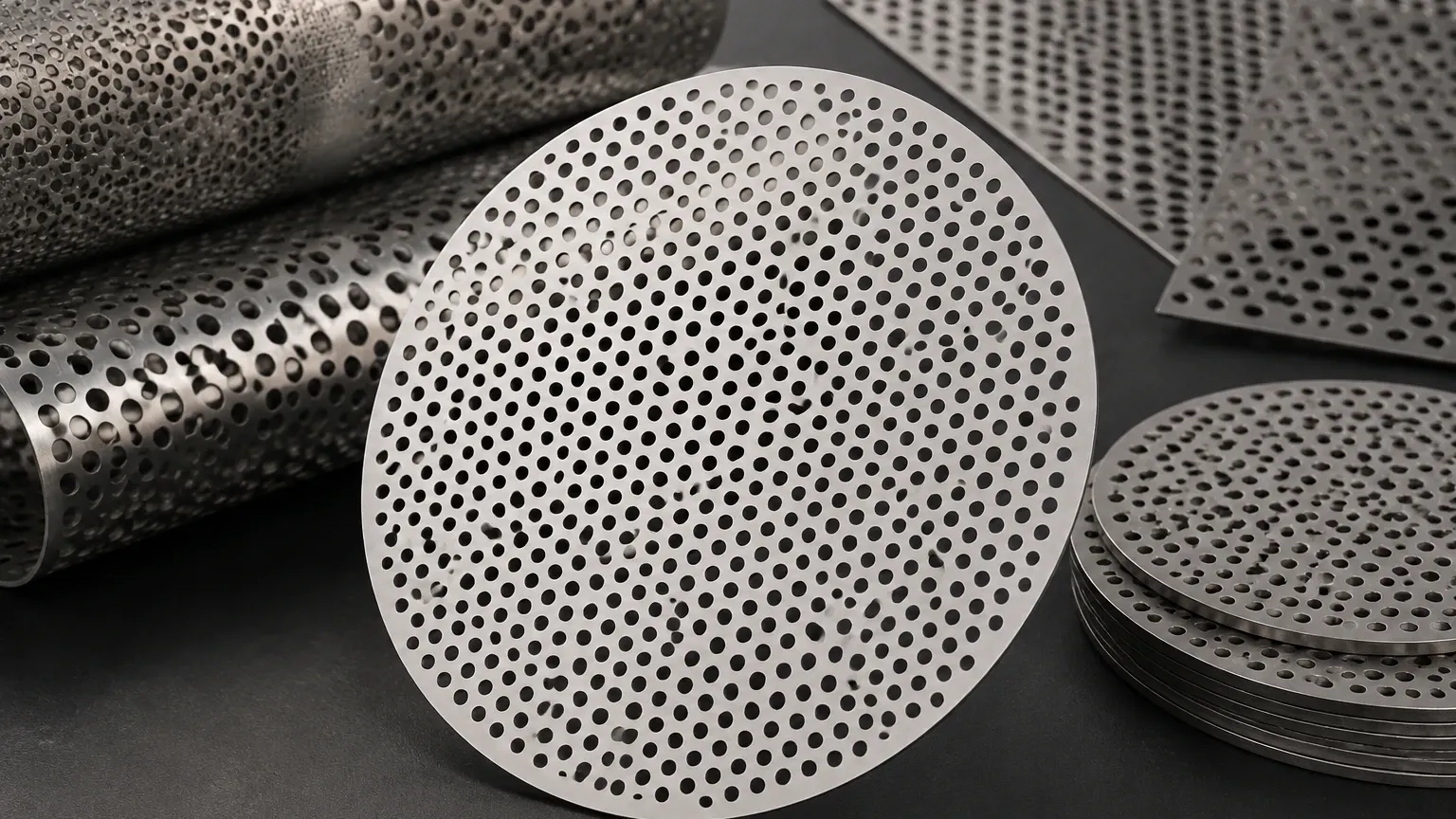
Round perforated metal is defined by its hole diameter, pitch (the distance from the center of one hole to the center of the next), and the arrangement of those holes. The pattern chosen directly affects the mechanical strength of the sheet and its performance in fluid handling applications.
Staggered vs. Straight Row Patterns
There are two primary orientations for round holes: staggered and straight.
1. 60-Degree Staggered Pattern: This is the industry standard for industrial applications. By offsetting each row, the pattern maximizes the open area while maintaining high structural strength in all directions. It provides a uniform distribution of holes, which is essential for consistent flow rates in filtration cartridges.
2. 45-Degree Staggered Pattern: Occasionally used for specific aesthetic or mechanical requirements, though less common in high-performance filtration compared to the 60-degree variant.
3. Straight Row Pattern: In this configuration, holes are aligned both horizontally and vertically. While simpler to design, straight rows generally offer lower structural stability and a lower percentage of open area compared to staggered patterns. This arrangement is typically reserved for specialized screening or decorative applications where directional strength is less critical.
The Importance of the "Bridge"
The "bridge" is the solid metal remaining between the holes. In industrial filtration, the bridge must be wide enough to withstand the mechanical stresses of the application—such as high differential pressure—yet narrow enough to allow for the required flow. A common engineering rule of thumb is that the bridge thickness should at least equal the material thickness to ensure the structural integrity of the sheet during the punching process and subsequent fabrication.
Material Selection: Balancing Corrosion Resistance and Mechanical Strength
Material choice is the most significant factor in determining the service life of round perforated metal in industrial environments. At Kaifil, the focus is predominantly on stainless steel and high-performance alloys due to their durability in demanding chemical and thermal conditions.
Stainless Steel Grades
* Grade 304/304L: The most common choice for general industrial use. It offers excellent formability and good corrosion resistance for water treatment, food processing, and standard hydraulic applications.
* Grade 316/316L: Containing molybdenum, Grade 316 provides superior resistance to chlorides and acids. It is the preferred material for marine environments, pharmaceutical processing, and aggressive chemical filtration.
* Duplex Stainless Steel: For high-pressure applications or environments with extreme stress-corrosion cracking risks, duplex grades offer nearly double the yield strength of austenitic stainless steels.
Material Thickness and the 1:1 Rule
When specifying round perforated metal, engineers must consider the relationship between the hole diameter and the sheet thickness. Standard mechanical punching typically requires the hole diameter to be equal to or greater than the material thickness (the 1:1 rule). Attempting to punch holes smaller than the material thickness increases the risk of tool breakage and can result in irregular hole shapes or excessive burring. For applications requiring micro-perforations in thick materials, alternative methods like laser cutting or electron beam drilling may be required, though these often come at a higher unit cost.
Technical Specifications: Open Area and Flow Efficiency
The "Open Area" percentage is the primary metric used to calculate the flow capacity and pressure drop across a perforated metal component. For a 60-degree staggered round hole pattern, the formula for calculating the percentage of open area is:
Open Area % = (D² × 90.69) / P²
*Where D = Hole Diameter and P = Pitch.*
Understanding this calculation is vital for engineers designing filtration systems. A higher open area reduces the initial pressure drop and allows for higher flow rates, but it also reduces the mechanical strength of the filter core. In high-viscosity fluid applications, such as oil or polymer filtration, finding the optimal balance between open area and the ability to withstand collapse pressure is critical.
Manufacturing Excellence: From Punching to Secondary Fabrication
The quality of round perforated metal is not determined solely by the punching process. For B2B applications, secondary operations are often what define the suitability of the component for the final assembly.
Precision Punching and Deburring
High-speed CNC punching presses can create thousands of holes per minute with extreme accuracy. However, the punching process naturally creates a "burr" on the exit side of the hole. In filtration, especially for the food, beverage, and pharmaceutical industries, these burrs must be removed. Kaifil employs advanced deburring and polishing techniques to ensure that the internal and external surfaces of the filter components are smooth, preventing media entrapment and ensuring hygienic operation.
Leveling and Flatness
Perforating a metal sheet introduces internal stresses that can cause the material to curl or bow. Precision leveling is required to return the sheet to a flat state. This is particularly important if the perforated metal is to be rolled into a cylinder for a filter cartridge; an un-leveled sheet will result in an out-of-round cylinder, making welding and end-cap fitting difficult.
Margins and Unperforated Zones
Customization often involves specifying "margins"—unperforated areas along the edges of the sheet. These solid borders are essential for welding, as they provide a clean surface for TIG, MIG, or plasma welding without the interference of holes. Proper margin specification ensures the structural integrity of the seam in cylindrical filter cores.
Applications in Industrial Filtration and Separation
Round perforated metal serves several distinct roles within industrial filtration systems. Its primary advantage is its ability to provide a rigid structure that can support finer, more delicate filtration media.
Filter Support Cores
In many high-pressure hydraulic or chemical filters, the primary filtration is performed by a fine stainless steel wire mesh. However, the mesh itself lacks the structural strength to resist the force of the fluid flow. A round perforated metal tube acts as the internal or external support core, preventing the mesh from collapsing or bursting under differential pressure.
Coarse Strainers and Pre-Filters
In water treatment and large-scale industrial piping, round perforated metal is used as a primary strainer to remove large debris before the fluid reaches more sensitive downstream equipment. The round hole shape is preferred here because it is less prone to clogging than slotted or square patterns and is easier to clean via backwashing or mechanical scraping.
Centrifuge Baskets and Vibratory Screens
In the pharmaceutical and chemical sectors, perforated metal is used in centrifuges to separate solids from liquids. The precision of the hole diameter ensures consistent particle retention, while the smooth surface finish facilitates easy cake discharge.
Quality Assurance and Compliance in B2B Procurement
When sourcing round perforated metal for critical industrial applications, technical professionals must confirm that the manufacturer adheres to strict quality control standards. Key considerations include:
* Dimensional Tolerances: Ensuring the hole diameter, pitch, and sheet dimensions fall within the specified +/- tolerances (often governed by ISO or ASTM standards).
* Surface Finish: Verifying that the material has been properly passivated (for stainless steel) to restore corrosion resistance after the punching and welding processes.
* Material Certification: Obtaining mill test reports (MTRs) to verify the chemical composition and mechanical properties of the alloy used.
Conclusion and Selection Support
Round perforated metal is a fundamental component in modern industrial filtration, offering a unique combination of durability, flow efficiency, and customization potential. By understanding the nuances of hole patterns, material grades, and the mechanical limits of the punching process, engineers can optimize their filtration systems for both performance and cost.
Kaifil specializes in translating these technical requirements into high-performance filtration components. From initial material selection to the final fabrication of custom filter cartridges, our engineering team supports global customers in achieving precise filtration outcomes in the most demanding environments. For more detailed information on our manufacturing capabilities and to explore our full range of Perforated & Expanded Metal solutions, technical teams are encouraged to review product options and application support to ensure the most effective integration into their specific industrial processes.
