


Perforated Metal Tiles
In industrial engineering and large-scale manufacturing, perforated metal tiles serve as critical components that bridge the gap between structural integrity and functional permeability. While often associated with architectural aesthetics, these precision-engineered components are foundational to industrial filtration, acoustic management, and fluid dynamics. For engineers and procurement specialists, selecting the appropriate perforated metal tiles requires a deep understanding of material science, mechanical load requirements, and the specific nuances of perforation patterns.
As a specialized manufacturer, Kaifil provides comprehensive solutions in the realm of Perforated & Expanded Metal, ensuring that industrial components meet the rigorous demands of chemical processing, pharmaceutical production, and hydraulic systems. This guide explores the technical parameters and engineering considerations essential for the effective integration of perforated metal tiles in industrial environments.
Engineering Fundamentals of Perforated Metal Tiles
Perforated metal tiles are produced through a process of cold-punching or CNC-controlled perforation of metal sheets. Unlike woven wire mesh, which relies on the interlacing of wires, perforated tiles are monolithic structures. This provides a higher degree of dimensional stability and mechanical strength, making them ideal for high-pressure applications where mesh might deform or migrate.
Manufacturing Processes
The primary method for creating these tiles is the use of an all-across wide-strip perforation press. This machinery allows for the simultaneous punching of multiple holes across the width of the material, ensuring high throughput and consistent hole spacing. For thicker materials or more complex geometries, laser cutting or water-jet cutting may be employed, though these are typically reserved for low-volume, high-precision requirements where the heat-affected zone (HAZ) must be minimized.
Perforated vs. Expanded Metal
It is important to distinguish between perforated metal and expanded metal. While both fall under the broader category of industrial screens, expanded metal is created by slitting and stretching the material simultaneously, resulting in a diamond-shaped aperture with no scrap loss. Perforated metal tiles, conversely, involve the removal of material (slugs) to create specific hole shapes—round, square, slotted, or hexagonal. For filtration support and cleanroom environments, perforated tiles are often preferred due to their flat surface profile and easier cleaning characteristics.
Technical Specifications: Hole Patterns and Open Area Ratios
The performance of perforated metal tiles is governed by the geometry of the perforations. Engineers must calculate the "Open Area Ratio," which is the percentage of the total sheet area that is occupied by the holes. This ratio directly impacts flow rates, pressure drop, and the structural rigidity of the tile.
Common Hole Patterns
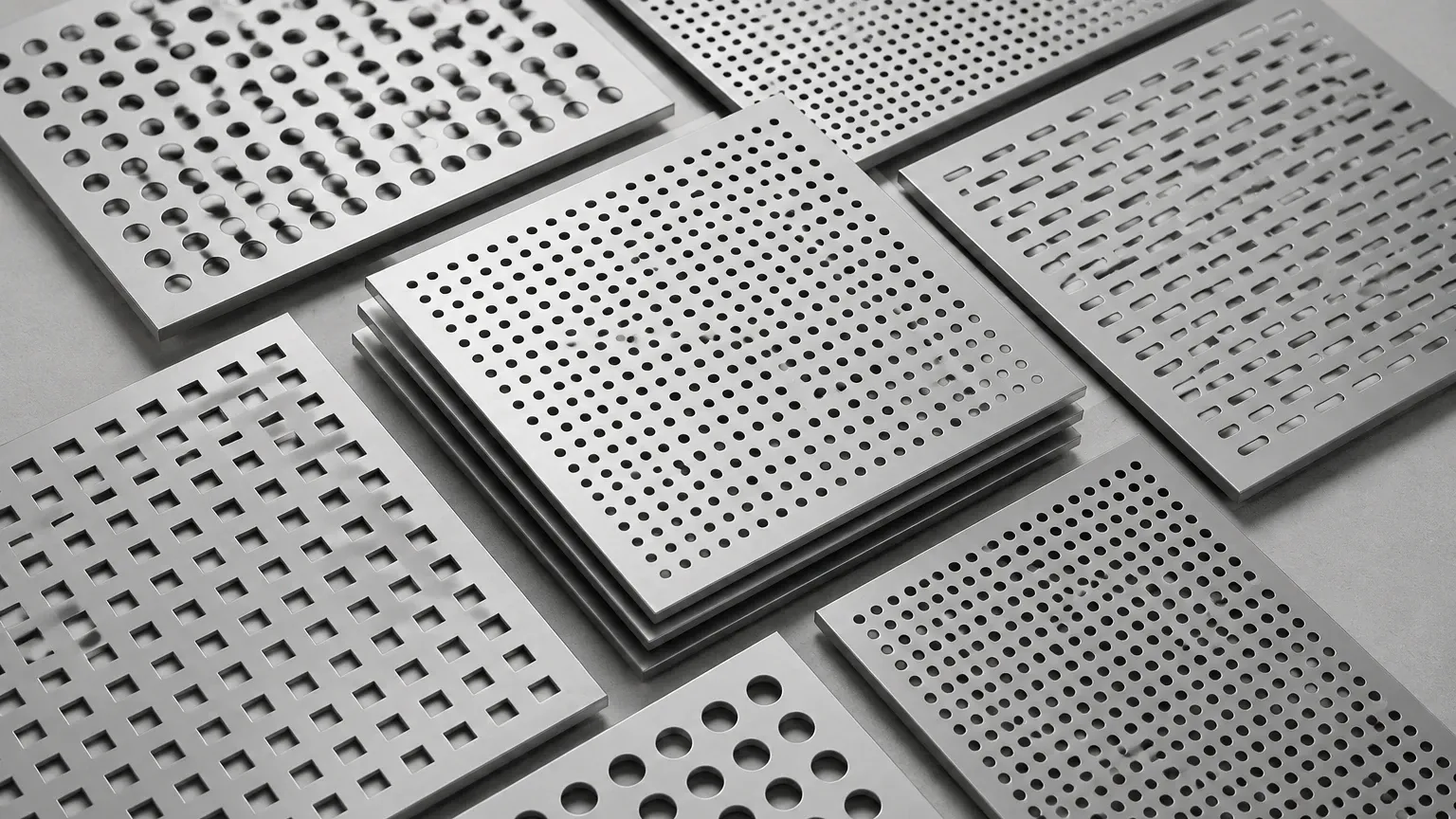
1. Staggered Round Holes: This is the most common configuration, typically set at a 60-degree angle. It provides the best balance of open area and structural strength, ensuring uniform stress distribution across the plate.
2. Straight Row Round Holes: Used primarily for aesthetic or specific mechanical alignment purposes, straight patterns offer lower structural integrity compared to staggered patterns because they create "break lines" along the rows.
3. Square and Slotted Holes: Square holes provide a higher open area but are more prone to stress concentrations at the corners. Slotted holes are frequently used in sieving and sorting applications where the orientation of the particles is a factor.
Calculating Open Area
For a standard 60-degree staggered round hole pattern, the open area (OA) formula is:
`OA = (D² × 90.69) / P²`
Where D is the hole diameter and P is the pitch (the distance from the center of one hole to the center of the adjacent hole). Accurate calculation is vital in filtration systems to ensure that the support tile does not become a bottleneck for the fluid or gas being processed.
Material Selection for Industrial Environments
The longevity of perforated metal tiles is largely determined by the alloy selected. In industrial filtration and processing, the environment often involves corrosive chemicals, high temperatures, or strict hygienic requirements.
Stainless Steel Grades
Stainless steel is the industry standard for most B2B applications due to its corrosion resistance and mechanical properties.
* Grade 304: Suitable for general industrial use, providing good resistance to atmospheric corrosion and many organic and inorganic chemicals. It is widely used in food and beverage processing.
* Grade 316/316L: Contains molybdenum, which provides superior resistance to chlorides and pitting. This is the preferred choice for pharmaceutical manufacturing, marine environments, and aggressive chemical processing.
* Duplex Stainless Steels: For extreme environments involving high pressure and highly corrosive media, duplex grades offer nearly twice the strength of austenitic stainless steels and excellent stress corrosion cracking resistance.
Aluminum and Specialized Alloys
Aluminum perforated tiles are selected for applications where weight reduction is critical, such as in aerospace or mobile filtration units. However, for most industrial filtration support structures, the durability and weldability of stainless steel make it the superior choice. In high-temperature applications exceeding 800°C, nickel-based alloys or specialized heat-resistant steels may be required to prevent oxidation and creep.
The Role of Perforated Tiles in Filtration Systems
In the context of Kaifil’s expertise, perforated metal tiles often function as the "backbone" of complex filtration assemblies. While the fine filtration is performed by wire mesh or sintered metal fibers, the perforated tile provides the necessary mechanical support to withstand differential pressure.
Support for Filter Media
In high-pressure hydraulic systems or large-scale liquid filtration, fine mesh is susceptible to bursting if unsupported. Perforated metal tiles are used as inner or outer support cores in filter cartridges. The smooth surface of the perforated tile prevents the fine mesh from being abraded or torn during pressure pulses.
Primary Screening
In applications such as water intake screens or coarse chemical straining, perforated metal tiles act as the primary filter. Their rigid structure allows them to be cleaned mechanically—via scrapers or back-pulsing—without the risk of deforming the apertures. This makes them ideal for removing large particulates from high-velocity flow streams.
Acoustic and Airflow Management
Beyond liquid filtration, perforated metal tiles are essential in managing industrial environments. In power plants and manufacturing facilities, they are used as acoustic panels to dampen noise from heavy machinery. By selecting specific hole diameters and depths, engineers can tune the tiles to absorb specific sound frequencies, improving workplace safety and compliance with noise regulations.
Engineering Considerations: Load Bearing and Pressure Drop
When integrating perforated metal tiles into a system, two primary engineering challenges must be addressed: mechanical load-bearing capacity and the impact on system pressure.
Structural Integrity
A common mistake in procurement is overestimating the strength of a perforated sheet. The removal of material significantly reduces the moment of inertia and the section modulus of the plate. Engineers must account for the "Equivalent Solid Material" properties when performing FEA (Finite Element Analysis) on perforated components. Factors such as the margin (the unperforated area around the edges) are critical for welding and mounting the tiles without causing stress fractures.
Pressure Drop (ΔP)
Every perforated tile introduces a degree of resistance to flow. This pressure drop is influenced by the fluid velocity, viscosity, and the open area of the tile. In gas filtration, high pressure drops can lead to significant energy losses and increased operational costs. Utilizing tiles with a higher open area can mitigate this, but often at the cost of structural rigidity. Finding the "sweet spot" between these two variables is a core part of the technical support provided by Kaifil.
Custom Fabrication and OEM Integration
Standard off-the-shelf perforated sheets rarely meet the specific needs of specialized industrial equipment. Customization is often necessary to ensure seamless integration into existing systems.
Custom Dimensions and Shapes
Industrial filters often require tiles to be rolled into cylinders, formed into cones, or cut into specific geometric shapes to fit housing units. Kaifil’s manufacturing capabilities allow for the production of perforated metal tiles with custom margins, ensuring that the edges remain solid for high-quality TIG or plasma welding. This is essential for maintaining the integrity of filter cartridges and pressure vessels.
Surface Treatments
Depending on the application, perforated tiles may require additional surface processing:
* Electropolishing: Essential for pharmaceutical and food-grade applications to remove surface impurities and create a microscopically smooth finish that resists bacterial growth.
* Passivation: A chemical process that enhances the protective oxide layer on stainless steel, ensuring maximum corrosion resistance.
* Degreasing: For oxygen-service applications or high-vacuum environments, tiles must be completely free of residual manufacturing oils.
Total Cost of Ownership and Maintenance Best Practices
When evaluating perforated metal tiles, the initial purchase price is only one component of the total cost of ownership (TCO). Durability, cleanability, and replacement cycles play a much larger role in long-term operational efficiency.
Cleaning and Longevity
One of the primary advantages of stainless steel perforated tiles is their ability to be cleaned and reused. In many chemical processes, tiles can be cleaned using ultrasonic baths or chemical CIP (Clean-In-Place) systems. Unlike disposable polymer filters, metal tiles can withstand repeated cleaning cycles, significantly reducing waste and long-term procurement costs.
When to Replace
Engineers should monitor perforated tiles for signs of:
* Erosion: High-velocity flows containing abrasive particles can eventually wear down the hole edges, changing the open area and filtration characteristics.
* Stress Cracking: Particularly in high-vibration environments, the areas between perforations (the bridges) can develop micro-cracks.
* Permanent Deformation: If the system exceeds its design pressure, the tile may "dish" or bow, which can compromise the seals of the filtration unit.
Conclusion
Perforated metal tiles are versatile, robust, and essential components in the modern industrial landscape. Whether serving as a support structure for fine filtration media or acting as a primary screen in harsh chemical environments, their performance is dictated by precise engineering and material selection. By focusing on the technical details—from open area calculations to alloy compatibility—engineers can ensure their systems operate with maximum efficiency and minimal downtime.
For organizations seeking reliable, high-performance filtration components, partnering with an experienced manufacturer is vital. Kaifil offers the technical expertise and manufacturing precision required to deliver customized Perforated & Expanded Metal solutions that meet the most demanding industrial specifications.
