


Perforated Sheet vs Expanded Metal
In the realm of industrial filtration and structural engineering, selecting the right medium is a balance between mechanical integrity, filtration precision, and cost-efficiency. Two of the most prevalent materials used for support structures, primary filtration layers, and protective guards are perforated sheets and expanded metal. While they may appear similar at a glance, their manufacturing processes, physical properties, and performance characteristics differ significantly.
For engineers and procurement specialists, understanding the nuances of perforated sheet vs expanded metal is essential for optimizing system longevity and process efficiency. This guide examines the technical distinctions between these two materials, focusing on their application in demanding industrial environments such as chemical processing, food and beverage production, and hydraulic systems.
Manufacturing Methods and Material Integrity
The fundamental difference between these two products lies in how they are fabricated. This process dictates the material’s final strength, weight, and suitability for specific filtration tasks.
Perforated Metal Production
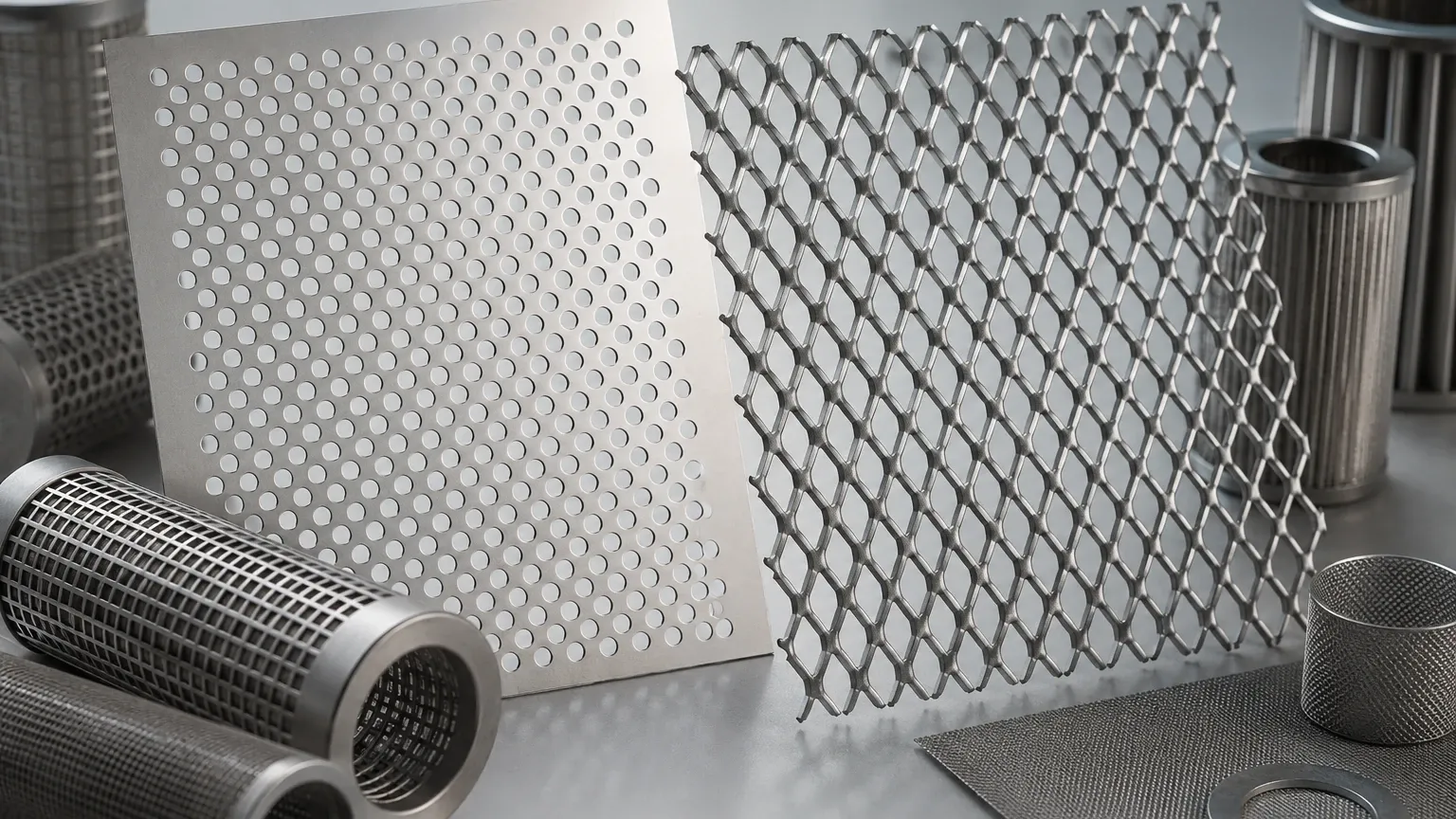
Perforated metal is manufactured through a punching process. A solid metal sheet—typically stainless steel in industrial filtration—is fed through a machine equipped with precision dies. These dies punch out specific shapes (round, square, or slotted) in a predetermined pattern. The material that is removed, known as "slugs," is typically recycled. Because the base sheet remains flat and the integrity of the surrounding metal is largely preserved, perforated sheets offer high dimensional accuracy and a smooth surface finish.
Expanded Metal Production
Expanded metal is produced by simultaneously slitting and stretching a solid sheet of metal. This process creates diamond-shaped openings. Unlike perforation, expansion does not remove any material, meaning there is zero waste. The stretching process creates "strands" and "bonds" that are set at an angle to the original plane of the sheet. This results in a three-dimensional structure that provides inherent rigidity. For applications requiring a flat profile, the expanded metal can undergo a secondary "flattening" process through cold-rolling, though this slightly reduces its structural strength.
Analyzing Open Area and Filtration Efficiency
In filtration applications, the percentage of open area is a critical metric. It determines the flow rate, pressure drop, and the volume of media that can pass through the filter at any given time.
Precision and Consistency
When comparing perforated sheet vs expanded metal for precision filtration, perforated sheets generally offer superior consistency. Because the holes are punched with CNC-controlled dies, the hole size and pitch (the distance between hole centers) are highly uniform. This allows engineers to calculate the exact open area and predict the pressure drop with high mathematical certainty. This is vital in pharmaceutical and food processing, where flow control is non-negotiable.
Flow Dynamics
Expanded metal, due to its angled strands, creates more turbulence in the fluid or gas stream. While this can be beneficial in certain mixing or heat-exchange applications, it may lead to a higher pressure drop compared to a perforated sheet with the same nominal open area. However, expanded metal often provides a larger open-area-to-weight ratio, making it an excellent choice for protective screens or coarse primary filters where high throughput is prioritized over absolute precision.
For those evaluating specific patterns for industrial use, exploring the technical specifications of Perforated & Expanded Metal can provide the necessary data for flow calculations.
Structural Strength and Weight Considerations
The structural behavior of these materials is a key factor when they are used as support cores for wire mesh filters or as standalone strainers.
1. Tensile Strength: Expanded metal is often stronger than a perforated sheet of the same weight. The "truss-like" structure created by the expansion process distributes loads more effectively across the sheet. Because it is a single piece of metal without welds or joints, it maintains excellent structural integrity under tension.
2. Rigidity: Perforated sheets, especially those with smaller hole diameters and wider margins, retain more of the original sheet's stiffness. This makes them easier to roll into precise cylindrical shapes for filter cartridges without the risk of the pattern deforming.
3. Weight Savings: If the goal is to reduce the total weight of a filtration assembly without sacrificing surface area, expanded metal is frequently the preferred option. Its ability to cover a large area with minimal raw material makes it highly efficient for large-scale industrial guards and partitions.
Cost Analysis and Material Sustainability
From a procurement perspective, the cost-benefit analysis of perforated sheet vs expanded metal often hinges on material utilization and tooling requirements.
* Material Yield: Expanded metal is significantly more cost-effective in terms of raw material usage. Since no metal is punched out and discarded, one square foot of raw sheet can produce several square feet of expanded metal. This is particularly relevant when using expensive alloys like 316L stainless steel or Hastelloy.
* Tooling Costs: Perforated sheets offer nearly limitless customization in terms of hole shapes and patterns, but complex or non-standard patterns may require custom die sets, increasing initial costs. Expanded metal patterns are more standardized, though variations in strand width and opening size can still be achieved with existing machinery.
* Secondary Processing: Perforated sheets are generally easier to weld and form into complex components because they have a consistent thickness and a flat surface. Expanded metal, particularly the "raised" variety, may require more intensive labor to weld or frame securely, which can offset the lower initial material cost.
Application-Specific Selection: Perforated Sheet vs Expanded Metal
Choosing between these materials requires a deep dive into the specific operating environment. As a specialist in custom stainless steel filtration, Kaifil often advises clients based on the following industry-specific needs:
Chemical and Petrochemical Processing
In environments involving corrosive fluids, the choice of material grade (e.g., 304 or 316L stainless steel) is as important as the structure. Perforated sheets are often preferred for internal reactor components because their smooth surfaces are easier to clean and less prone to "dead zones" where chemicals can stagnate and cause localized corrosion.
Food and Beverage Industry
Sanitary requirements dictate the use of materials that can be thoroughly sterilized. Perforated stainless steel is the industry standard here. The absence of the overlapping strands found in expanded metal means there are fewer crevices where bacteria or organic matter can accumulate. Perforated tubes are frequently used as the support skeleton for fine mesh sleeves in milk, juice, and syrup filtration.
Hydraulic and Industrial Equipment
Expanded metal is widely used for hydraulic reservoir breathers and suction strainers. Its ability to provide a rigid, high-flow barrier at a low cost makes it ideal for protecting pumps from large debris. In contrast, perforated metal is used for high-pressure hydraulic filters where the support core must withstand significant collapse pressure.
Engineering Specifications for Custom Filtration Solutions
When transitioning from design to procurement, engineers should confirm several technical parameters to ensure the selected material meets the application requirements. At Kaifil, we emphasize the following criteria during the customization process:
* Hole Pattern and Orientation: For perforated sheets, a 60-degree staggered pattern is the most common for filtration as it provides the highest open area and uniform strength. For expanded metal, the orientation of the "long way of design" (LWD) versus the "short way of design" (SWD) affects how the material handles stress.
* Edge Requirements: Do you need "safe edges" (blank margins) for welding, or can the pattern be "cut-to-size" (interrupted)? Perforated sheets allow for precise blank margins, which simplify the assembly of filter end caps.
* Surface Treatment: Depending on the application, materials may require degreasing, pickling, or electropolishing. Electropolishing is particularly effective for perforated stainless steel to enhance corrosion resistance and ensure a burr-free finish.
* Tolerances: Industrial filtration often requires tight tolerances on diameter and length. Perforated sheets typically offer tighter dimensional control than expanded metal, which can exhibit slight "spring-back" after the stretching process.
Conclusion: Making the Informed Choice
The decision between perforated sheet vs expanded metal is rarely about which material is "better," but rather which is more appropriate for the specific engineering challenge. Perforated sheets excel in applications requiring precision, cleanability, and predictable flow characteristics. Expanded metal offers an unbeatable combination of strength, low weight, and cost-efficiency for less sensitive or high-volume applications.
By partnering with a manufacturer that understands the nuances of metal fabrication and industrial filtration, engineering teams can ensure they select the optimal medium for their specific needs. Whether you require a robust support core for a high-pressure hydraulic system or a sanitary strainer for food processing, evaluating the technical trade-offs of each material is the first step toward a successful filtration solution.
