


Perforated Metal Window Screens
In industrial and commercial architecture, window screens serve functions far beyond simple insect exclusion. For facilities such as chemical processing plants, food and beverage factories, and pharmaceutical laboratories, window treatments must provide a balance of security, ventilation, and environmental control. Perforated metal window screens have emerged as a primary solution for these demanding environments due to their structural integrity and customizable filtration properties.
Selecting the correct screen requires a deep understanding of material science, open area calculations, and the specific stressors of the installation environment. This guide explores the technical considerations essential for engineers and purchasing teams when evaluating Perforated & Expanded Metal for industrial window applications.
Engineering Fundamentals of Perforated Screens
The performance of a perforated metal window screen is dictated by its geometric configuration. Unlike woven wire mesh, which is formed by interlacing wires, perforated metal is produced by punching a series of holes into a solid metal sheet. This process allows for precise control over the screen's mechanical properties.
Hole Patterns and Pitch
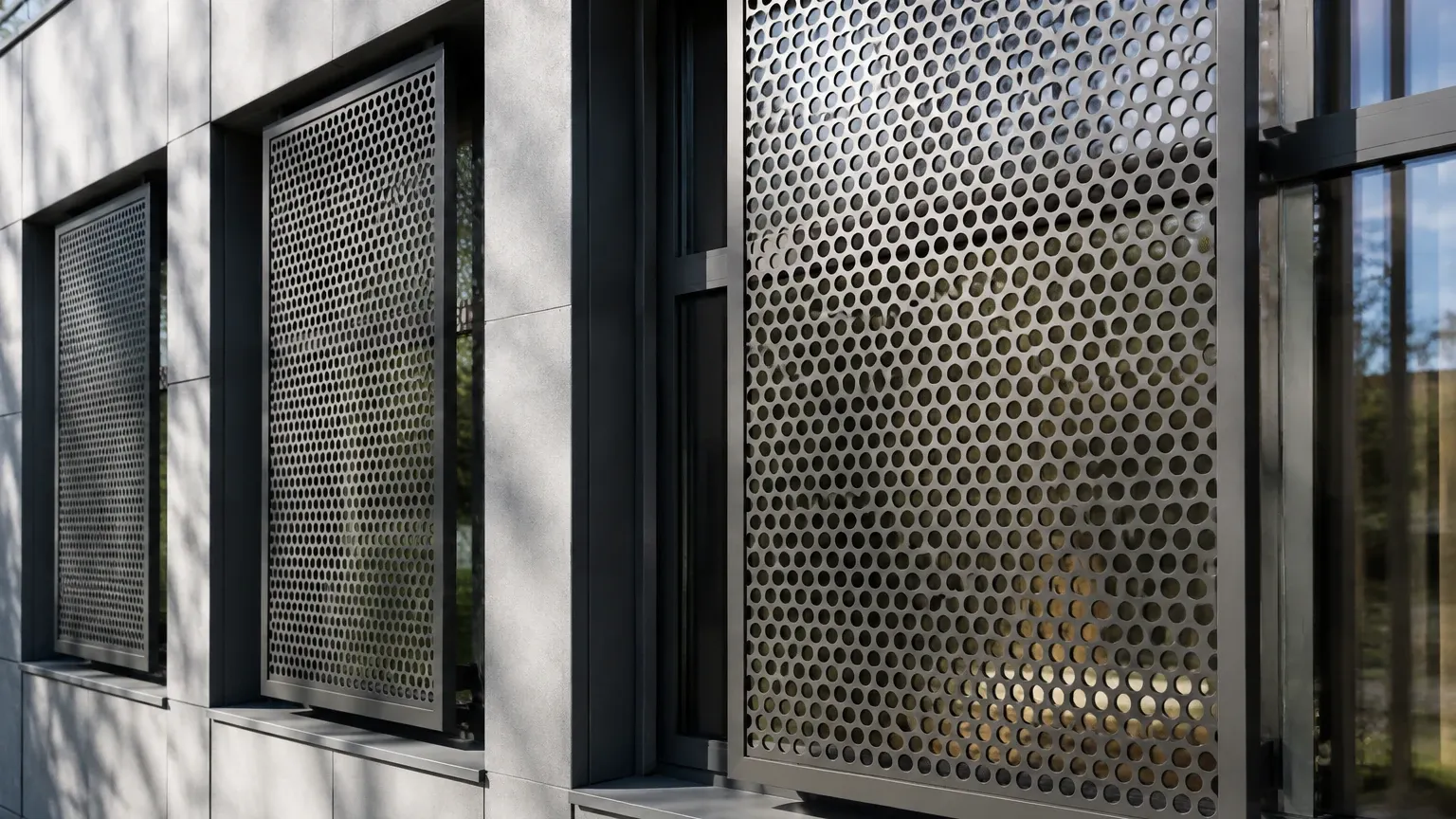
The most common configuration for window screens is the 60-degree staggered round hole pattern. This layout is preferred because it offers the highest degree of structural strength and a uniform open area. Engineers must specify the hole diameter (D) and the center-to-center distance, known as the pitch (P).
* Staggered Patterns: Provide better stress distribution across the sheet, making them ideal for high-security applications.
* Straight Patterns: Often used for aesthetic purposes but may result in lower structural rigidity under wind load or impact.
Calculating Open Area
The open area percentage is the most critical metric for determining airflow and light transmission. For a 60-degree staggered round hole pattern, the formula is:
Open Area % = (D² × 90.69) / P²
In industrial settings, an open area of 40% to 60% is typically targeted. This range provides sufficient ventilation for HVAC systems and natural cooling while maintaining a barrier strong enough to resist forced entry or large debris impact.
Material Selection for Industrial Environments
The longevity of a window screen is directly tied to its material composition. Because these screens are exposed to both internal process emissions and external atmospheric conditions, material selection must prioritize corrosion resistance and tensile strength.
Stainless Steel (304 and 316)
Stainless steel is the industry standard for high-performance perforated screens.
* Grade 304: Suitable for most industrial environments, providing excellent strength and basic corrosion resistance. It is the cost-effective choice for standard commercial facilities.
* Grade 316: Contains molybdenum, which provides superior resistance to chlorides and pitting. This is the mandatory specification for coastal facilities, chemical processing plants, and pharmaceutical cleanrooms where aggressive cleaning agents are used.
Aluminum and Specialized Alloys
Aluminum screens are utilized when weight reduction is a priority. While aluminum naturally forms a protective oxide layer, it lacks the impact resistance of stainless steel. In specific high-heat or highly acidic environments, specialized alloys may be required, though these are typically reserved for internal process filtration rather than external window screens.
Perforated vs. Expanded Metal for Security Screens
When specifying window protection, engineers often compare perforated metal with expanded metal. Both fall under the category of Perforated & Expanded Metal, but they are manufactured differently and offer distinct performance profiles.
Manufacturing Differences
Perforated metal is created by removing material (the "slugs") from a sheet. This results in a flat, smooth surface that is easy to clean and aesthetically consistent. Expanded metal is produced by slitting and stretching the sheet simultaneously. This process creates a diamond-shaped pattern without any material waste.
Functional Comparison
* Visibility: Perforated metal provides superior "one-way" visibility depending on the coating and hole size. When coated in a matte black finish, the human eye focuses through the holes, making the screen nearly transparent from the inside while appearing solid from the outside.
* Structural Rigidity: Expanded metal often has a three-dimensional profile (unless flattened), which provides exceptional grip and strength but can be harder to clean in food-grade environments. Perforated metal is generally preferred for window screens where hygiene and precise airflow control are paramount.
* Security: Both materials offer significantly higher security than traditional mesh. However, perforated stainless steel is more difficult to cut with standard hand tools, making it a formidable barrier against unauthorized access.
Technical Specifications and Customization
Industrial procurement requires precise technical data to ensure the screen integrates seamlessly with existing frames and building systems. Beyond the hole pattern, several secondary specifications must be confirmed.
Gauge and Thickness
The thickness of the metal sheet determines the screen's durability. For industrial window screens, thicknesses typically range from 18 gauge (1.2mm) to 12 gauge (2.6mm). Thicker gauges are used in high-risk areas or where the screen covers a large span without intermediate support.
Margins and Blank Areas
A critical but often overlooked specification is the "margin." This refers to the unperforated area around the edges of the sheet.
* Safe Side Margins: Standard margins produced by the punching process.
* Finished Margins: Custom-engineered blank areas that allow for easier welding or bolting into a frame without compromising the hole pattern.
Surface Finishes and Coatings
For window screens, the finish serves both protective and functional roles.
* Powder Coating: A high-durability polyester powder coating is common. For security screens, a matte black finish is the industry standard to reduce glare and improve through-screen visibility.
* Electropolishing: Often used for stainless steel screens in pharmaceutical or food applications to remove surface impurities and create a mirror-like, ultra-hygienic finish.
Performance Evaluation: Airflow, Visibility, and Protection
When evaluating a perforated metal window screen, engineers must balance three competing factors: airflow, visibility, and protection.
Airflow Resistance
In facilities where natural ventilation is part of the climate control strategy, the static pressure drop across the screen must be calculated. A screen with too small a hole diameter or too low an open area can restrict airflow, forcing HVAC systems to work harder and increasing energy costs.
Debris and Pest Exclusion
In food and beverage processing, the hole size must be small enough to exclude specific pests or airborne contaminants. If the primary goal is insect exclusion, hole diameters must be significantly smaller (often under 1.5mm), which in turn requires a higher density of holes to maintain airflow.
Impact Resistance
For ground-floor windows or facilities in storm-prone regions, the screen must withstand physical impact. Perforated stainless steel is tested for its ability to resist blunt force and shearing. Engineers should request test data regarding the "shear strength" and "yield strength" of the specific perforated configuration being considered.
Installation and Maintenance Considerations
The method of installation significantly impacts the total cost of ownership and the effective lifespan of the screen.
Framing Methods
Perforated screens should be mounted in frames that prevent galvanic corrosion. If a stainless steel screen is mounted in an aluminum frame, an insulating barrier (such as EPDM rubber or specialized coatings) must be used to prevent the two metals from reacting. The frame should also be designed to allow for thermal expansion and contraction.
Cleaning and Maintenance
One of the primary advantages of perforated metal over woven wire is the ease of maintenance. The smooth surface of the perforated sheet does not trap dust and organic matter as easily as the "over-under" junctions of a weave.
* Cleaning Cycles: In industrial environments, screens should be pressure washed or wiped down periodically to prevent the buildup of oils or particulates that can occlude the holes.
* Inspection: Regular inspections should check for any signs of frame movement or coating degradation, particularly at the attachment points.
Information for Project Confirmation
Before moving to the procurement phase, technical professionals should confirm the following data points with their manufacturer to ensure the product meets application requirements:
1. Material Grade: Is 304 sufficient, or does the chemical environment demand 316 stainless steel?
2. Exact Dimensions and Tolerances: What are the length, width, and thickness requirements, and what is the allowable variance?
3. Hole Specification: What is the diameter and pitch? Does the resulting open area meet HVAC and visibility requirements?
4. Margin Requirements: Are specific blank areas needed for mounting or framing?
5. Finish Type: Is a specific RAL color for powder coating required, or is a mill finish acceptable?
6. Quantity and Lead Time: How do batch sizes affect the production timeline and unit cost?
By addressing these technical parameters, engineers can ensure that perforated metal window screens provide a durable, high-performance solution that enhances facility security and operational efficiency. For those seeking specialized configurations, exploring the full range of Perforated & Expanded Metal options is the first step toward a customized filtration and protection strategy.
