


Types of Perforated Metal Sheets
In the landscape of industrial filtration and structural engineering, the selection of materials often dictates the efficiency, longevity, and safety of a system. Perforated metal sheets are foundational components used across a spectrum of industries, from chemical processing and pharmaceuticals to food production and hydraulic systems. Understanding the various types of perforated metal sheets is essential for engineers and procurement professionals who must balance filtration precision with mechanical durability.
At Kaifil, we specialize in custom stainless steel filtration solutions, where Perforated & Expanded Metal serves as both a primary filtration medium and a critical support structure for finer wire mesh elements. This guide examines the technical distinctions between different perforation patterns, material considerations, and the engineering criteria required to optimize industrial performance.
Understanding the Manufacturing Process: Perforated vs. Expanded
Before diving into specific hole patterns, it is important to distinguish between the two primary methods of creating open-area metal sheets. While often grouped together, perforated and expanded metals are manufactured through different processes that result in distinct mechanical properties.
Perforated Metal Sheets
Perforated metal is produced by punching a series of holes into a solid metal sheet using a high-speed CNC press or a rotary pinned perforation roller. This process allows for extreme precision in hole size, shape, and spacing. The primary advantage of perforated metal is its versatility; manufacturers can leave "margins" (unperforated areas) at the edges or in specific sections of the sheet to facilitate welding and assembly into filter cartridges or housings.
Expanded Metal
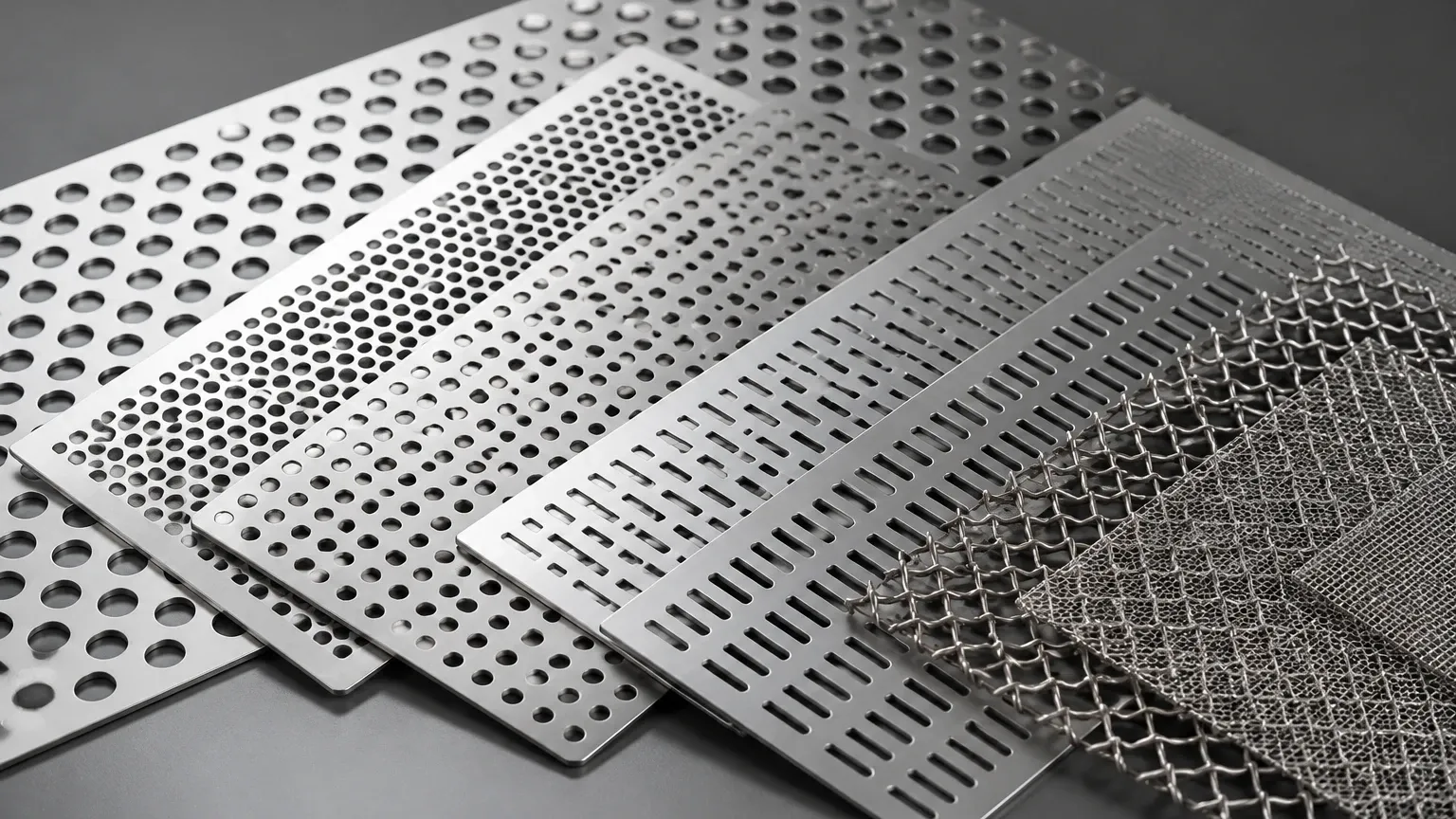
Expanded metal is created by simultaneously slitting and stretching a sheet of metal. This process creates diamond-shaped openings without any material waste. Because the metal is stretched rather than punched, the resulting mesh is often stronger per pound than the original sheet. In filtration, expanded metal is frequently used as a rigid support layer for pleated filter media, providing a high open-area percentage while maintaining structural integrity under pressure.
Primary Types of Perforated Metal Sheets by Hole Pattern
The geometry of the perforation determines the flow characteristics, particle retention, and structural strength of the sheet. Choosing between different types of perforated metal sheets requires an analysis of the specific application's pressure and flow requirements.
1. Round Hole Perforations
Round holes are the most common and cost-effective type of perforation. They offer the best balance of structural strength and open area. In industrial filtration, round hole patterns are typically arranged in two ways:
* 60-Degree Staggered: This is the industry standard. It provides the highest strength-to-weight ratio and ensures uniform flow across the surface. It also allows for the highest possible open area percentage.
* Straight Line: Holes are aligned in rows and columns. While easier to align for certain aesthetic or structural designs, straight-line patterns generally offer lower structural integrity than staggered patterns when subjected to high-pressure differentials.
2. Square Hole Perforations
Square hole sheets provide a significantly higher open area than round holes of the same size. This makes them ideal for applications requiring high flow rates with minimal pressure drop. However, square holes create stress concentration points at the corners, which can lead to material fatigue or cracking in high-vibration or high-pressure environments. They are most commonly used in protective grilles and coarse screening where maximum throughput is prioritized over structural rigidity.
3. Slotted (Oblong) Perforations
Slotted metal sheets feature elongated holes with either square or round ends. These are specifically designed for sorting and screening applications. In filtration, slotted patterns are effective for removing elongated particles or fibers that might pass through a round hole of the same width. Engineers often specify slotted perforations for "solid-liquid separation" in the food processing and pulp industries.
4. Hexagonal (Honeycomb) Perforations
Hexagonal patterns offer a very high open area (often exceeding 80%) while maintaining a high degree of structural stability. The "honeycomb" configuration is frequently used in architectural applications but serves a technical purpose in filtration by providing maximum ventilation and fluid passage with minimal weight. It is often used in specialized air filtration systems and cooling modules.
Material Selection and Engineering Considerations
The performance of Perforated & Expanded Metal is heavily influenced by the base material. For industrial filtration, stainless steel is the gold standard due to its corrosion resistance and mechanical properties.
Stainless Steel (304, 316, 316L)
* Grade 304: Suitable for general industrial use where moderate corrosion resistance is required. It is commonly used in food processing and water treatment.
* Grade 316/316L: Contains molybdenum, which provides superior resistance to chlorides and acids. 316L (low carbon) is preferred for welded filter components to prevent carbide precipitation and ensure the integrity of the weld zones in chemical processing environments.
Specialty Alloys and Carbon Steel
In less demanding environments, galvanized or carbon steel may be used for cost-efficiency. However, in most B2B industrial filtration contexts, the risk of oxidation and subsequent fluid contamination makes stainless steel the more cost-effective long-term investment.
Technical Specifications: Evaluating Open Area and Pitch
When selecting types of perforated metal sheets, engineers must calculate the "Open Area Percentage." This is the ratio of the total area of the holes to the total area of the sheet. This calculation is critical for determining the flow rate and pressure drop across the filter.
* Pitch: This refers to the distance from the center of one hole to the center of the adjacent hole. A smaller pitch results in a higher open area but thinner "bridges" (the metal between the holes).
* Bridge Width: The bridge must be wide enough to withstand the mechanical stresses of the application. If the bridge is too thin, the perforated sheet may deform or fail under hydraulic pressure.
* Gauge (Thickness): The thickness of the metal sheet must be compatible with the hole diameter. A general rule of engineering is that the hole diameter should not be smaller than the material thickness to ensure clean punching and avoid tool breakage during manufacturing.
Applications in Industrial Filtration Systems
Perforated metal is rarely a standalone component in high-precision filtration. Instead, it functions as a critical part of a multi-layered system.
Support Cores for Filter Cartridges
In high-pressure hydraulic and chemical systems, fine wire mesh filters lack the structural strength to resist collapsing. A perforated metal cylinder acts as the internal core, providing the necessary rigidity to support the mesh under inward pressure. Conversely, an outer perforated shroud can protect the delicate mesh from external mechanical damage during installation or backwashing.
Pre-Filtration and Coarse Screening
In water treatment and intake systems, perforated metal sheets act as the first line of defense. They remove large debris (stones, plastic, organic matter) before the fluid reaches more sensitive downstream components like pumps or fine membrane filters.
Diffusers and Flow Distributors
Perforated sheets are used to break up high-velocity fluid streams, ensuring a uniform flow distribution across a larger filter bed or catalyst chamber. This prevents "channeling," where fluid takes the path of least resistance, thereby exhausting the filter media prematurely in specific areas.
Selection Criteria: What Engineers Should Confirm
Before finalizing a purchase or custom order for perforated metal components, technical teams should confirm the following parameters with their manufacturer:
1. Chemical Compatibility: Ensure the alloy (e.g., 316L) is resistant to the specific chemicals and temperatures of the process fluid.
2. Pressure Differential (ΔP): Calculate the maximum expected pressure drop. This determines the required material thickness and the optimal hole pattern to prevent deformation.
3. Filtration Rating: While perforated metal is usually for coarse filtration, the hole size must be precisely matched to the smallest particle size intended for removal (or the support requirements of the secondary mesh).
4. Surface Finish: For food and pharmaceutical applications, the perforated sheet may require electropolishing to remove burrs and ensure a sanitary, easy-to-clean surface.
The Kaifil Advantage in Custom Filtration
As a professional manufacturer, Kaifil understands that standard off-the-shelf perforated sheets often fall short of the rigorous demands of industrial processing. We provide specialized OEM services to develop perforated components tailored to specific engineering requirements. Whether you need a high-strength 316L stainless steel core for a hydraulic filter or a custom-slotted screen for chemical separation, our manufacturing capabilities ensure precise filtration performance and long-term durability.
By focusing on the intersection of material science and mechanical engineering, we help our global partners optimize their filtration cycles and reduce total cost of ownership through reliable, high-quality metal components. Choosing the right types of perforated metal sheets is the first step toward a more efficient and robust industrial filtration system.
