


Perforated Metal Material 3d
In modern industrial engineering, the transition from conceptual design to physical manufacturing requires a high degree of precision. For engineers and procurement specialists sourcing filtration components, the term "perforated metal material 3d" refers not only to the physical three-dimensional characteristics of processed metal but also to the digital modeling assets required to integrate these components into complex systems. Whether you are designing a high-pressure hydraulic filter or a large-scale chemical processing strainer, understanding the interplay between material properties, geometric configurations, and digital design data is essential for optimizing performance.
At Kaifil, we specialize in the manufacturing of high-performance Perforated & Expanded Metal solutions. This guide explores the technical nuances of these materials, the importance of 3D data in the selection process, and the engineering considerations that dictate the success of industrial filtration applications.
The Technical Distinction: Perforated vs. Expanded Metal
Before diving into the digital modeling aspects, it is critical to distinguish between the two primary types of metal components used in industrial filtration and support structures. While both provide open areas for fluid or gas passage, their manufacturing processes and physical 3D structures differ significantly.
Perforated Metal
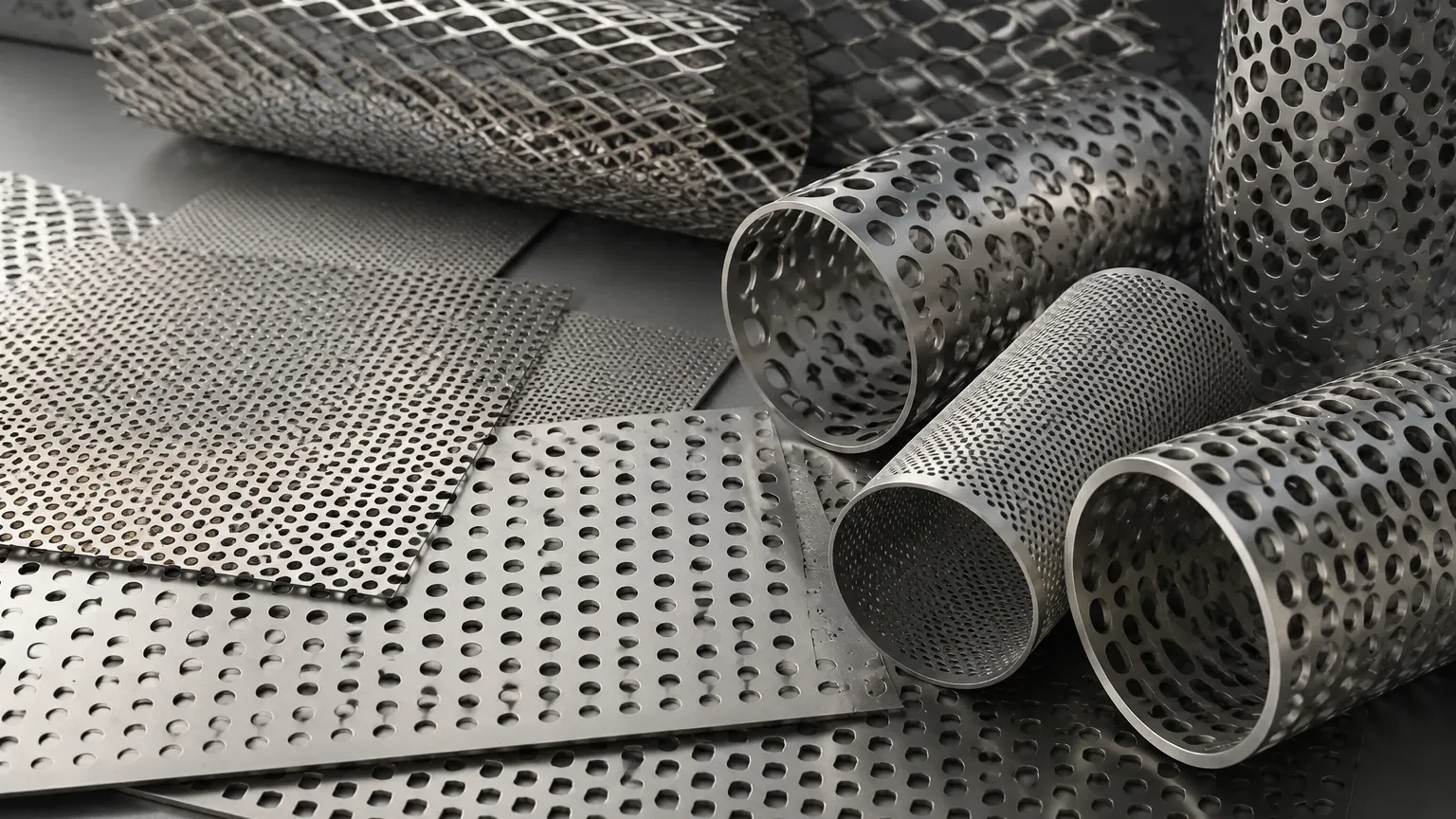
Perforated metal is produced by mechanically punching or laser-cutting holes into a flat sheet of stainless steel or other alloys. The resulting material remains essentially flat (2D) in its primary state, though it is often rolled or welded into 3D cylindrical cartridges. The precision of the hole size and pitch is the primary driver of filtration accuracy. In a perforated metal material 3d context, CAD models for these components focus on the exact placement of apertures to ensure uniform flow distribution across the filter surface.
Expanded Metal
Expanded metal is manufactured by simultaneously slitting and stretching the metal sheet. This process creates a diamond-shaped pattern. Unlike perforated metal, expanded metal has a distinct 3D profile where the strands are set at an angle to the original plane of the sheet. This provides inherent structural rigidity and a larger surface area relative to its weight. In 3D modeling, this geometry is more complex to represent accurately but is vital for calculating turbulence and pressure drop in fluid dynamics simulations.
Engineering Utility of Perforated Metal Material 3D Data
For design engineers, having access to accurate perforated metal material 3d files is a prerequisite for successful system integration. The use of 3D CAD (Computer-Aided Design) and BIM (Building Information Modeling) allows for several critical evaluations before a single physical prototype is manufactured.
1. Spatial Integration and Tolerance Management
Industrial filtration systems often operate within tight spatial constraints. By using 3D models of perforated or expanded metal components, engineers can verify clearances within filter housings, ensure proper seating of gaskets, and manage tolerances for welded assemblies. This reduces the risk of costly design revisions during the production phase.
2. Computational Fluid Dynamics (CFD)
In chemical processing and hydraulic applications, understanding how a fluid moves through a filter is paramount. A detailed 3D representation of the metal material allows for CFD analysis. This simulation helps predict:
* Pressure Drop: How much energy is lost as the fluid passes through the mesh.
* Flow Velocity: Identifying areas of high velocity that might lead to premature erosion of the filter media.
* Particle Trapping Efficiency: Simulating how different hole geometries interact with suspended solids.
3. Structural Integrity Simulations
Filters are often subjected to high differential pressures. 3D modeling allows for Finite Element Analysis (FEA) to determine if the perforated support core or the expanded metal outer wrap can withstand the mechanical loads without collapsing or deforming. This is particularly important when selecting the gauge (thickness) of the stainless steel.
Material Selection for Demanding Environments
The performance of any perforated or expanded metal component is fundamentally limited by its base material. In the B2B industrial sector, stainless steel remains the gold standard due to its durability and resistance to environmental stressors.
Stainless Steel Grades
* Type 304: The standard grade suitable for most water treatment and general industrial applications. It offers excellent formability and good corrosion resistance.
* Type 316/316L: Contains molybdenum, which provides superior resistance to chlorides and acids. This is the preferred choice for pharmaceutical, food and beverage, and marine environments where hygiene and corrosion resistance are non-negotiable.
* Specialty Alloys: For extreme temperatures or highly aggressive chemical environments, materials like Monel, Inconel, or Duplex stainless steel may be specified.
Surface Finishes and Treatments
Beyond the raw material, the 3D surface of the metal can be treated to enhance performance. Electropolishing is frequently used in the pharmaceutical industry to remove microscopic burrs and create a smooth, passive surface that prevents bacterial growth and eases the cleaning process.
Key Evaluation Criteria for Procurement
When evaluating a supplier for perforated metal material 3d components, purchasing teams and engineers should confirm several technical parameters to ensure the product meets the application’s requirements.
Open Area Percentage
The open area is the ratio of the holes to the total area of the sheet. It directly impacts the flow rate and the strength of the material. A higher open area allows for higher flow but reduces the structural rigidity. Finding the "sweet spot" is a core engineering challenge that Kaifil helps clients navigate through precise calculation and customization.
Hole Pattern and Pitch
* Staggered Patterns: Usually 60-degree staggered, these provide the highest open area and uniform strength.
* Straight Patterns: Easier to align with other components but generally offer lower structural integrity.
* Hole Shape: Round holes are the most common and cost-effective, but square or slotted holes may be required for specific particle shapes or aesthetic architectural applications.
Edge Configurations
In many filtration applications, it is necessary to have "margins" (unperforated areas) around the edges of the sheet to facilitate welding or mechanical fastening. Specifying these margins in the 3D design is essential for a seamless assembly process.
Common Risks in Specification and Manufacturing
Inaccurate specifications or a lack of detailed 3D data can lead to several common failures in industrial settings:
1. Blinding and Clogging: If the hole size is incorrectly specified relative to the particle size distribution, the filter will clog rapidly, leading to frequent downtime and increased maintenance costs.
2. Vibration Fatigue: In high-flow environments, thin-gauge perforated metal can vibrate, leading to work hardening and eventual cracking at the hole boundaries.
3. Chemical Incompatibility: Selecting a lower grade of stainless steel to save on initial costs often leads to pitting corrosion, which can contaminate the process fluid and necessitate a total system overhaul.
To mitigate these risks, Kaifil works closely with global customers to provide technical guidance during the design phase, ensuring that the physical product aligns perfectly with the intended 3D engineering specifications.
Total Cost of Ownership (TCO) Considerations
While the initial purchase price is a significant factor, the total cost of ownership for perforated and expanded metal components is driven by durability and maintenance efficiency. A well-designed stainless steel filter cartridge can be cleaned and reused multiple times, whereas a poorly specified or low-quality component may require frequent replacement.
Investing in high-quality Perforated & Expanded Metal ensures that the filtration system operates at peak efficiency with minimal unplanned interventions. Factors such as ease of backwashing, resistance to chemical cleaning agents, and mechanical robustness all contribute to a lower TCO over the life of the equipment.
Conclusion: Moving from Design to Production
The integration of perforated metal material 3d data into the industrial design workflow has revolutionized the way filtration components are developed. By leveraging precise 3D models, engineers can predict performance, optimize material usage, and ensure a perfect fit within complex assemblies.
As a professional manufacturer, Kaifil provides the technical expertise and manufacturing capabilities required to turn these digital designs into high-performance physical components. From material selection and filtration accuracy to customized OEM designs, we support engineers in achieving reliable and cost-effective filtration solutions across the chemical, pharmaceutical, and food and beverage industries.
Before taking the next step in your project, ensure that your material specifications, hole patterns, and structural requirements are fully validated. Partnering with a manufacturer that understands the technical depth of perforated and expanded metal is the most effective way to guarantee the long-term success of your industrial application.
