


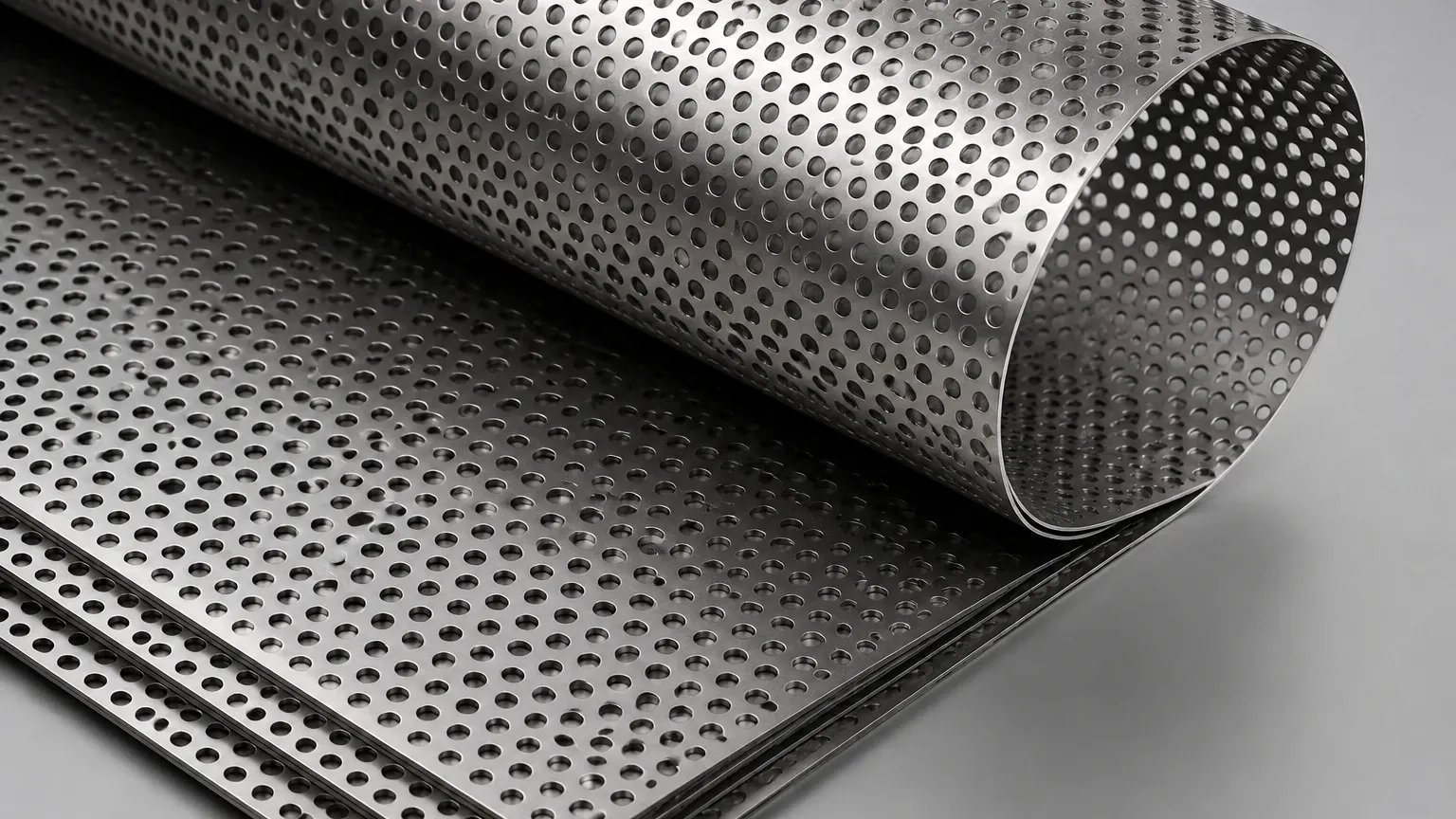
3/16 Perforated Metal
In industrial engineering and filtration design, the selection of perforated materials is dictated by the specific requirements of the application, including particle retention size, flow rate, and structural durability. Among the various specifications available, 3/16 perforated metal—referring to a hole diameter of 3/16 of an inch (approximately 4.76 mm)—serves as a versatile standard for medium-coarse filtration, protective screening, and structural support components.
As a precision manufacturer, Kaifil provides customized Perforated & Expanded Metal solutions designed to meet the rigorous demands of chemical processing, food and beverage production, and hydraulic systems. Understanding the technical nuances of 3/16 perforated metal is essential for engineers and procurement teams to ensure optimal performance and longevity in industrial environments.
Technical Specifications and Geometry
The performance of 3/16 perforated metal is defined by more than just its hole diameter. Engineers must evaluate the hole pattern, the pitch (center-to-center distance), and the resulting open area percentage to determine if the material is suitable for a specific fluid or gas dynamics application.
Hole Patterns
The most common configuration for 3/16 perforated metal is the 60-degree staggered pattern. This arrangement provides the highest level of structural integrity and uniform stress distribution across the sheet. By staggering the holes, the "bridges" (the metal remaining between the holes) are oriented to resist deformation under pressure. Alternatively, straight-row patterns are used when precise alignment is required for aesthetic or specific mechanical tracking, though they typically offer lower structural strength than staggered designs.
Open Area Calculations
The open area is the percentage of the sheet that is comprised of holes, which directly influences the flow rate and pressure drop. For a standard 3/16-inch hole on a 1/4-inch staggered center, the open area is approximately 51%. If the centers are widened to 5/16 of an inch, the open area drops significantly. Designers must balance the need for high flow (high open area) with the requirement for mechanical strength (wider bridges).
Material Selection for Industrial Environments
The choice of alloy for 3/16 perforated metal is critical for ensuring chemical compatibility and resisting environmental degradation. While carbon steel and aluminum are used in less demanding applications, stainless steel remains the industry standard for high-performance filtration and processing equipment.
Stainless Steel 304 vs. 316
For most industrial applications, Stainless Steel 304 provides excellent durability and basic corrosion resistance. However, in environments involving chlorides, high salinity, or acidic chemical processing, Stainless Steel 316 is preferred. The addition of molybdenum in 316 stainless steel enhances its resistance to pitting and crevice corrosion, making it the authoritative choice for marine and pharmaceutical applications.
Specialty Alloys
In extreme conditions involving high temperatures or highly aggressive chemicals, Kaifil can manufacture perforated components using specialty alloys such as Duplex stainless steel or Monel. These materials maintain their structural properties where standard steels might fail, ensuring the safety and reliability of the filtration system.
Engineering Performance Factors
When integrating 3/16 perforated metal into a system, engineers must account for several mechanical and hydraulic factors to avoid premature failure or system inefficiency.
Pressure Drop (Delta P)
Every perforated plate introduces a degree of resistance to flow. The 3/16-inch aperture is large enough to allow high volumes of liquid or gas to pass while retaining larger debris. However, as the holes become partially blinded by captured particles, the pressure differential across the plate increases. Engineers must calculate the maximum allowable pressure drop to determine the necessary surface area of the perforated component.
Structural Load and Gauge
The thickness of the metal, or gauge, is a primary factor in the component's ability to withstand hydraulic shock or mechanical load. A 3/16 perforated metal sheet in a 20-gauge thickness will behave differently than one in a 11-gauge thickness. Thicker gauges are often used as support cores for finer wire mesh filters, providing the necessary rigidity to prevent the mesh from collapsing under high-pressure flow.
Edge Margins and Flatness
In many OEM applications, the perforated sheet must be welded into a frame or housing. Specifying "margins"—the unperforated areas along the edges of the sheet—is vital for successful integration. Furthermore, the perforation process can introduce internal stresses that cause the metal to curl. Precision leveling is required to ensure the final product meets flatness tolerances required for automated assembly or tight-tolerance housings.
Applications in Filtration and Industrial Systems
3/16 perforated metal is utilized across a broad spectrum of industries due to its balance of aperture size and material strength. Its primary roles include coarse filtration, mechanical protection, and as a substrate for multi-layered filtration media.
Pre-Filtration and Strainers
In water treatment and chemical processing, 3/16 perforated metal often serves as the first line of defense. It acts as a pre-filter or "trash strainer," removing large debris, stones, or scale that could damage downstream pumps, valves, and finer filter cartridges. Its robust nature allows it to be cleaned and reused multiple times, reducing the total cost of ownership compared to disposable filter elements.
Support Cores for Filter Cartridges
High-pressure hydraulic and liquid filtration systems often require fine mesh or synthetic media to achieve micronic filtration. These delicate materials cannot withstand high differential pressures on their own. 3/16 perforated metal is frequently rolled into cylinders to serve as the inner or outer support core, providing the structural backbone for the entire filter assembly.
Food and Beverage Processing
In the food industry, 3/16 perforated metal is used in sorting, drying, and scalping operations. The 3/16-inch hole size is ideal for certain grain processing and fruit pulp separation tasks. Because stainless steel is non-reactive and easy to sanitize, it meets the stringent hygiene standards required for food-contact surfaces.
Acoustic and Ventilation Solutions
Beyond filtration, the 51% open area typical of 3/16 perforated metal makes it an excellent choice for acoustic damping and ventilation. It allows for significant airflow or sound wave penetration while providing a protective barrier for internal components in industrial machinery cabinets or HVAC systems.
Manufacturing Customization and Quality Control
As a professional manufacturer, Kaifil emphasizes the importance of precision in the production of 3/16 perforated metal. Standard off-the-shelf sheets often fail to meet the specific tolerances required for high-end industrial equipment.
Custom Hole Densities
While standard pitches are available, many applications require custom hole densities to achieve a specific flow coefficient. Kaifil works with engineering teams to design perforation patterns that optimize the ratio between open area and mechanical strength for unique operating conditions.
Deburring and Surface Finishing
The punching process naturally creates burrs on the exit side of the hole. In filtration applications, these burrs can trap fibers, cause turbulence, or even break off and contaminate the downstream fluid. Kaifil employs advanced deburring techniques and surface finishes, such as electropolishing or pickling, to ensure a smooth, clean, and burr-free surface. This is particularly critical in pharmaceutical and food-grade applications where "clean-in-place" (CIP) protocols are used.
Fabrication and OEM Integration
3/16 perforated metal is rarely used as a flat sheet in industrial settings. It is typically formed, rolled, or welded into complex shapes. Kaifil’s manufacturing capabilities include the production of custom baskets, cones, and cylinders. By managing the process from material selection to final fabrication, we ensure that the finished component maintains its dimensional accuracy and structural integrity.
Evaluation Criteria for Procurement
When requesting a quote or specifying 3/16 perforated metal for a project, purchasing teams should confirm the following technical details to ensure the product is fit for purpose:
1. Material Grade: Specify AISI 304, 316L, or other alloys based on the chemical environment.
2. Gauge/Thickness: Determine the required thickness based on the expected pressure and mechanical load.
3. Hole Center/Pitch: Confirm if a 60-degree staggered or straight-row pattern is needed.
4. Margins: Define the width of the solid borders required for welding or mounting.
5. Finish Requirements: Specify if the part requires degreasing, deburring, or specialized polishing.
By addressing these factors, engineers can avoid common pitfalls such as material fatigue, excessive pressure drop, or corrosion-related failures. 3/16 perforated metal remains a foundational component in industrial design, offering a reliable solution for a wide array of separation and protection challenges.
For more information on material compatibility or to discuss a custom filtration design, engineers are encouraged to consult with technical specialists who understand the intersection of material science and fluid dynamics.
