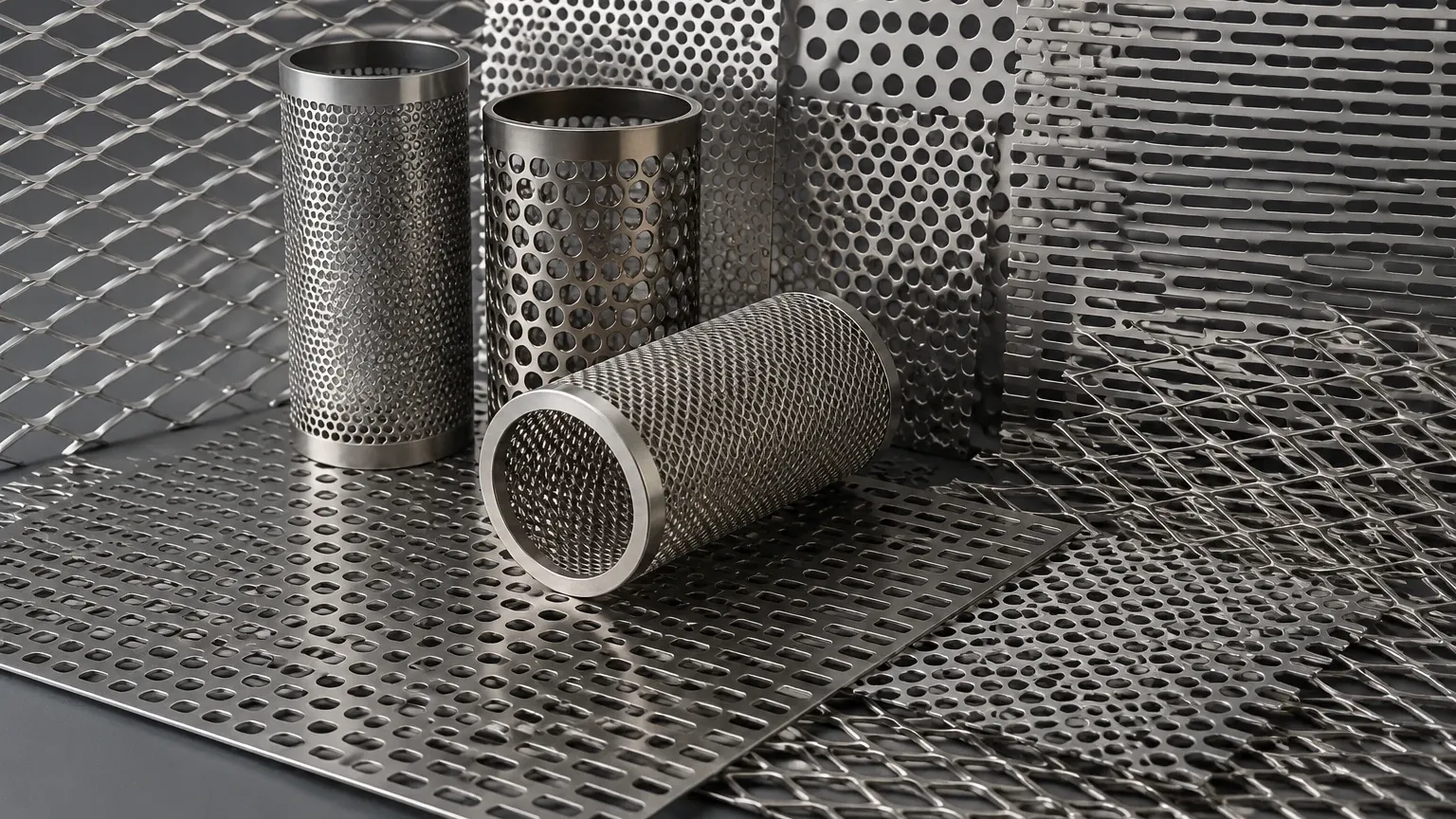
Metal Perforated Material
In industrial filtration and structural engineering, metal perforated material serves as a foundational component for fluid dynamics, particle separation, and mechanical support. Selecting the correct specification involves more than choosing a hole pattern; it requires a deep understanding of material science, mechanical loads, and flow characteristics. For engineers and procurement teams, the performance of a filtration system often depends on the precision and durability of the perforated or expanded metal used as the primary media or the structural skeleton.
Technical Specifications of Metal Perforated Material
Metal perforated material is produced through a mechanical punching or stamping process that creates a specific pattern of holes, slots, or decorative shapes in metal sheets or coils. The geometric configuration of these perforations directly influences the material’s mechanical properties and its behavior in industrial applications.
Hole Patterns and Arrangements
The arrangement of holes is a primary factor in determining both the strength and the open area of the material. The most common configurations include:
* 60-Degree Staggered: This is the most popular arrangement because it provides the highest open area and uniform strength across the sheet. It allows for efficient flow and is the standard for most filtration applications.
* 45-Degree Staggered: An alternative to the 60-degree pattern, often used when specific aesthetic or directional flow requirements are needed.
* Straight Line: Holes are aligned in both horizontal and vertical rows. While simpler to manufacture, straight patterns generally offer lower structural integrity compared to staggered patterns under high-pressure loads.
Understanding Open Area
The "open area" is the percentage of the total area of the sheet that is occupied by the holes. This is a critical calculation for engineers designing filtration systems, as it dictates the pressure drop and flow rate. The formula for a 60-degree staggered round hole pattern is:
Open Area % = (D² × 90.69) / R²
*(Where D is the hole diameter and R is the center-to-center distance, or pitch)*
A higher open area reduces resistance to flow but can compromise the material's ability to withstand hydrostatic pressure or mechanical impact.
Material Selection for Industrial Environments
The choice of alloy for metal perforated material is determined by the chemical and thermal conditions of the operating environment. At Kaifil, we prioritize materials that offer long-term reliability in demanding B2B sectors.
* Stainless Steel 304/304L: The industry standard for general-purpose filtration. It offers excellent corrosion resistance and is suitable for food and beverage applications where hygiene is paramount.
* Stainless Steel 316/316L: Contains molybdenum, which provides superior resistance to chlorides and pitting. This is the preferred choice for marine environments, chemical processing, and pharmaceutical manufacturing.
* Carbon Steel: Used in applications where corrosion is not a primary concern or where the material will be coated/galvanized. It provides high tensile strength at a lower cost point.
* Specialty Alloys: For high-temperature or highly aggressive chemical environments, materials such as Monel, Inconel, or Hastelloy may be required to prevent premature failure of the filtration component.
Engineering Considerations for Perforated & Expanded Metal
When evaluating Perforated & Expanded Metal, it is essential to distinguish between the two manufacturing methods and how they impact the final application.
Perforated Metal
Perforated metal is created by removing material (slugs) from a solid sheet. This allows for extreme precision in hole size and placement. In filtration, this precision is vital for maintaining consistent micronic ratings and ensuring that support cores for filter cartridges provide uniform resistance to collapse.
Expanded Metal
Unlike perforated metal, expanded metal is produced by slitting and stretching the material simultaneously. This process creates diamond-shaped openings and involves no material waste. From an engineering perspective, expanded metal offers a high strength-to-weight ratio. The strands and bonds of expanded metal are set at a sharp angle to the plane of the sheet, which can be advantageous for breaking up laminar flow or providing additional grip in structural walkways.
Manufacturing Precision and Customization
Standard off-the-shelf perforated sheets rarely meet the exacting requirements of specialized industrial filtration. Customization is necessary to ensure the component integrates seamlessly into the larger system.
Margins and Unperforated Areas
In many OEM applications, the metal perforated material must have specific "margins"—areas around the edges of the sheet where no holes are punched. These margins are critical for welding the material into a cylinder or mounting it into a frame. Providing precise technical drawings with margin requirements prevents alignment issues during the final assembly of filter cartridges or strainers.
Flatness and Leveling
The punching process introduces internal stresses into the metal, which can cause the sheet to curl or bow. For precision filtration components, secondary leveling processes are required to ensure the material remains flat. This is particularly important when the perforated sheet is used as a support layer for fine wire mesh, as any irregularity can lead to gaps or weak points in the filter media.
Forming and Fabrication
Perforated materials are often fabricated into complex shapes, such as conical strainers, cylindrical filter cores, or pleated inserts. Engineers must consider the "minimum bend radius" of the material to avoid cracking the ligaments (the metal between the holes) during the forming process.
Applications in Industrial Filtration
Metal perforated material is a versatile component used across various stages of the filtration process. Its primary roles include:
1. Support Cores: In high-pressure hydraulic or liquid filtration, perforated tubes provide the structural backbone for pleated paper or wire mesh media. They prevent the media from collapsing under the force of the fluid flow.
2. Outer Guards: Perforated metal acts as a protective shield for delicate filter elements, preventing damage during handling or from large debris in the flow stream.
3. Pre-Filtration: In water treatment and coarse chemical processing, perforated plates serve as the primary filter to remove large particulates before the fluid reaches finer filtration stages.
4. Diffusers: Perforated sheets are used to distribute flow evenly across a larger surface area, preventing "channeling" and ensuring the entire volume of the filter media is utilized effectively.
Quality Evaluation and Procurement Checklist
Before finalizing a purchase order for industrial perforated components, technical teams should confirm several key factors to ensure the total cost of ownership is optimized and the risk of failure is minimized.
* Dimensional Tolerances: Confirm that the manufacturer can meet the required tolerances for hole diameter, pitch, and sheet thickness. Even minor deviations can significantly alter the open area and flow performance.
* Burr Removal: The punching process can leave sharp edges or burrs. In filtration, these burrs can trap contaminants or damage secondary filter layers. Specify whether the material needs to be de-burred or polished.
* Chemical Compatibility: Ensure the selected alloy is compatible with the process fluid, including any cleaning agents or chemicals used during maintenance cycles.
* Load Requirements: Calculate the maximum differential pressure the material will encounter. This determines the required thickness and the maximum allowable open area.
* Certification: For pharmaceutical and food-grade applications, verify that the material comes with mill test reports (MTRs) to confirm the chemical composition of the alloy.
By focusing on these technical parameters, engineers can select a metal perforated material that provides the necessary balance of filtration efficiency, structural integrity, and long-term durability. Whether used as a simple screen or a complex support component, the precision of the perforation remains a critical factor in industrial system performance.