


Strainers
In industrial fluid handling systems, the presence of unwanted solids can lead to catastrophic equipment failure, unscheduled downtime, and significant financial loss. Industrial strainers serve as the primary line of defense, acting as mechanical filters that remove large particles, debris, and contaminants from liquids and gases. Unlike fine filtration systems designed for sub-micron removal, strainers are typically used for "coarse" filtration to protect sensitive downstream components such as pumps, control valves, flow meters, and heat exchangers.
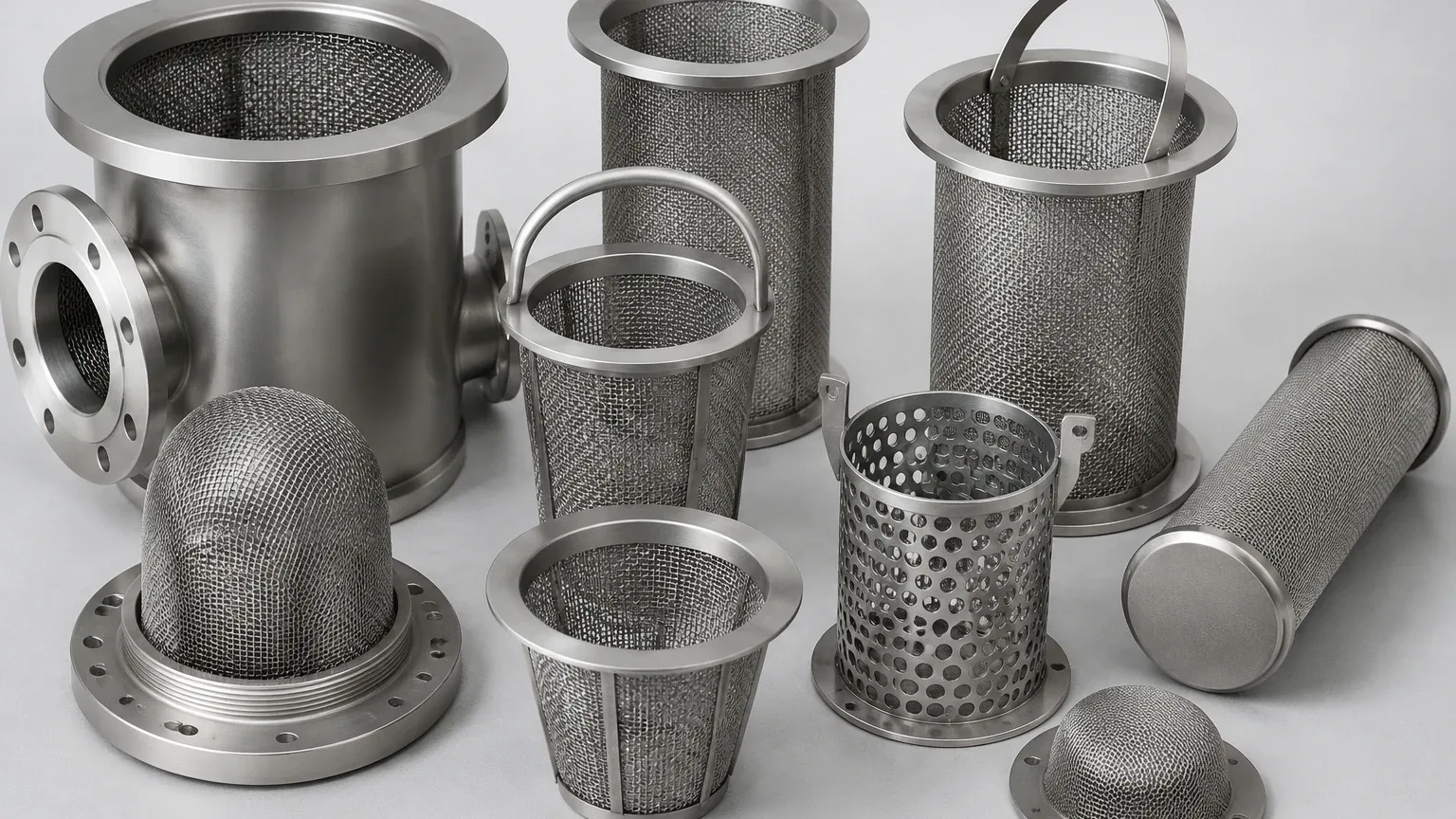
Selecting the correct strainer requires a deep understanding of the process fluid, flow dynamics, and the specific mechanical requirements of the application. For engineers and procurement professionals, the goal is to balance filtration efficiency with system pressure requirements to ensure long-term reliability. High-quality Strainers & Baskets are engineered to withstand the rigors of industrial environments while providing ease of maintenance and consistent performance.
The Role of Industrial Strainers in Fluid Management
The fundamental purpose of a strainer is to intercept solids through mechanical impingement. As fluid passes through a perforated plate or wire mesh element, particles larger than the opening size are trapped while the clean fluid continues through the system. While this sounds simple, the engineering behind it involves managing the "Open Area Ratio" (OAR). The OAR is the relationship between the internal cross-sectional area of the pipe and the total open area of the strainer element. A well-designed strainer typically offers an OAR of at least 6:1, ensuring that the pressure drop across the unit remains manageable even as the basket begins to fill with debris.
Without effective strainers, industrial systems face several risks:
* Erosion and Abrasion: High-velocity particles can erode valve seats and pump impellers, leading to leaks and loss of efficiency.
* Clogging: Small orifices in spray nozzles or heat exchanger tubes can quickly become blocked by scale or weld slag.
* Product Contamination: In food, beverage, and pharmaceutical processing, the presence of foreign solids can compromise batch integrity and safety.
Comparing Strainer Configurations: Y, T, and Basket Types
The physical configuration of a strainer is largely determined by the piping layout and the expected volume of debris. Each design offers specific advantages depending on whether the system is handling liquid, steam, or gas.
Y-Strainers
Named for their shape, Y-strainers are the most common choice for high-pressure lines and systems where the amount of debris is relatively low. They are compact and can be installed in either horizontal or vertical orientations (provided the "leg" points downward to collect debris). Because they have a smaller holding capacity than basket types, they are frequently used in steam, air, and gas applications where solids are intermittent.
Basket Strainers (Simplex and Duplex)
Basket strainers are designed for liquid applications where a larger holding capacity is required. The vertical cylinder (the basket) allows for a greater surface area, which results in a lower initial pressure drop.
* Simplex Strainers: These are used in batch processes where the system can be shut down periodically to clean the basket.
* Duplex Strainers: For continuous processes that cannot be interrupted, duplex strainers feature two separate basket chambers connected by a diverter valve. When one basket becomes full, the flow is switched to the clean chamber, allowing the operator to service the dirty basket without stopping the flow.
T-Strainers
T-strainers are often used in large-diameter piping where space is a constraint. They offer a straight-through flow path and are easier to service in certain configurations than Y-strainers, though they typically have a higher pressure drop than basket types.
Material Engineering and Corrosion Resistance
In industrial filtration, material selection is the most critical factor in determining the service life of the strainer. Stainless steel is the industry standard due to its mechanical strength and resistance to a wide range of corrosive agents.
Stainless Steel 304 vs. 316L
* Type 304: This is the most common grade, providing excellent durability and resistance to oxidation. It is suitable for most water treatment, hydraulic, and general industrial applications.
* Type 316L: Containing molybdenum, 316L offers superior resistance to chlorides and pitting. This makes it the preferred choice for chemical processing, marine environments, and pharmaceutical applications where aggressive cleaning agents or corrosive fluids are present.
Beyond the housing, the internal mesh or perforated element must also be carefully selected. Engineering teams must ensure that the material of the strainer element is galvanically compatible with the housing to prevent accelerated corrosion. Kaifil specializes in manufacturing custom stainless steel components that ensure the structural integrity of the filter element under high-pressure differentials.
Understanding Filtration Accuracy and Open Area Ratios
Specifying the "mesh size" or "perforation size" is a balancing act between protection and flow. If the openings are too small, the strainer will clog rapidly, causing frequent maintenance and high pressure drops. If the openings are too large, damaging particles will pass through.
Perforated Metal vs. Wire Mesh
* Perforated Plate: These are used for heavy-duty applications where the primary goal is removing large debris like stones, bolts, or scale. Common hole sizes range from 1/32" to 1/2". Perforated metal provides the structural "skeleton" for many strainer baskets.
* Wire Mesh: For finer filtration (down to 5 microns), a stainless steel wire mesh is layered over or inside a perforated metal support. This provides the necessary filtration accuracy while maintaining the mechanical strength to resist collapsing under pressure.
Engineers must also consider the "clean pressure drop." Every strainer introduces some resistance to flow. By maximizing the surface area of the strainers, manufacturers can keep this resistance to a minimum, ensuring that the pump does not have to work harder than necessary, which reduces energy consumption and wear.
Operational Considerations: Pressure Drop and Maintenance
The performance of a strainer is monitored through the differential pressure (ΔP)—the difference in pressure between the inlet and the outlet. As the strainer collects debris, the open area decreases, and the ΔP increases.
Monitoring and Cleaning
It is highly recommended to install differential pressure gauges across the strainer. A common rule of thumb is to clean or replace the strainer element when the pressure drop reaches 5-10 psi above the clean pressure drop. Waiting too long can result in a "burst" or "collapsed" basket if the pressure differential exceeds the structural limits of the mesh.
Maintenance Features
To simplify maintenance, many industrial strainers include:
* Blow-off Connections: A drain plug or valve at the bottom of the strainer leg or basket chamber allows for the flushing of loose debris without opening the unit.
* Quick-Opening Covers: Instead of bolted flanges, some strainers use swing bolts or knob covers to allow for tool-free access to the internal basket, significantly reducing downtime during cleaning cycles.
Customization for Specialized Industrial Applications
Standard off-the-shelf strainers often fail to meet the specific demands of specialized industrial processes. Customization is frequently required to address unique flow rates, unconventional piping geometries, or extreme temperature and pressure conditions.
OEM and Customized Solutions
Manufacturers like Kaifil provide OEM services to develop filtration components tailored to specific equipment. This includes:
* Custom Dimensions: Tailoring the height and diameter of the basket to fit existing housings or restricted spaces.
* Reinforced Structures: Adding internal supports or heavier gauge perforated plate for high-viscosity fluids or high-velocity flows that would otherwise deform standard mesh.
* Multi-Stage Filtration: Designing baskets with multiple layers of different mesh counts to provide graduated filtration, extending the life of the finest mesh layer.
In industries such as food and beverage, customization also involves ensuring "sanitary" design standards, where welds are ground smooth and there are no "dead spots" where bacteria can accumulate.
Selection Criteria for Engineering and Procurement Teams
Before finalizing a purchase order for industrial strainers, technical teams should confirm the following data points to ensure the product is fit for purpose:
1. Fluid Characteristics: What is the viscosity, temperature, and chemical composition of the fluid? High-viscosity fluids require larger surface areas to maintain flow.
2. Flow Rate: What is the maximum and minimum flow rate (GPM or m³/h)? The strainer must be sized for the maximum flow to avoid excessive pressure drop.
3. Contaminant Load: Is the debris loading continuous or slug-loading? This determines whether a simplex or duplex design is necessary.
4. Target Particle Size: What is the smallest particle that must be removed to protect downstream equipment? This dictates the mesh or perforation size.
5. Pressure Rating: Does the strainer housing meet the ASME or equivalent pressure rating for the system?
6. Seal Compatibility: Are the gaskets or O-rings (EPDM, Viton, PTFE) compatible with the process fluid and temperature?
By addressing these technical variables during the design phase, companies can optimize their filtration performance and achieve a lower total cost of ownership through reduced maintenance and protected equipment. Whether for a new installation or a system upgrade, selecting high-performance Strainers & Baskets is a critical step in maintaining industrial process integrity.
