


Alta Strainers
In the landscape of industrial fluid management, the term "Alta strainers" refers to high-capacity, high-performance filtration components designed to handle significant flow rates while maintaining low pressure drops. These systems are critical for protecting downstream equipment—such as pumps, meters, and valves—from damage caused by particulate matter. For engineers and procurement specialists, selecting the right strainer involves a deep dive into material compatibility, mechanical design, and the specific demands of the process environment.
As a specialized manufacturer, Kaifil provides a comprehensive range of Strainers & Baskets tailored to meet these rigorous industrial standards. Understanding the technical nuances of these components is essential for optimizing system uptime and reducing the total cost of ownership.
Understanding the Role of Alta Strainers in Industrial Filtration
Alta strainers are primarily utilized in applications where fluid cleanliness is paramount, but where the system cannot afford frequent shutdowns for cleaning. Unlike simple Y-strainers, which are often used for smaller lines or lower debris loads, these high-capacity basket-style strainers offer a much larger surface area. This increased area translates directly into longer service intervals and more stable flow dynamics.
In industrial sectors such as chemical processing, water treatment, and food and beverage production, the reliability of a strainer is measured by its ability to capture contaminants without significantly impeding the process flow. The "Alta" designation often implies a design optimized for high-volume throughput, utilizing advanced internal geometries to minimize turbulence and maximize the effective filtration area (EFA).
Technical Specifications and Material Selection
The performance of any industrial strainer is fundamentally tied to the materials used in its construction. Stainless steel remains the industry standard due to its exceptional strength-to-weight ratio and resistance to various forms of corrosion. When specifying Alta strainers, engineers typically choose between several grades of stainless steel based on the chemical composition of the fluid being processed.
Grade 304 Stainless Steel
304 stainless steel is the most common material for general industrial use. It offers excellent durability and resistance to oxidation. It is suitable for water treatment, cooling systems, and many food-grade applications where the environment is not excessively corrosive.
Grade 316 and 316L Stainless Steel
For more demanding environments, such as those involving chlorides or acidic solutions, Grade 316 stainless steel is preferred. The addition of molybdenum enhances its resistance to pitting and crevice corrosion. Grade 316L (low carbon) is often specified for components that require extensive welding, as it minimizes the risk of carbide precipitation which can lead to intergranular corrosion.
Specialized Alloys
In extreme cases involving highly aggressive chemicals or high temperatures, exotic alloys like Monel, Hastelloy, or Duplex stainless steel may be required. These materials ensure that the strainer housing and the internal basket maintain their structural integrity over years of continuous service.
Engineering Considerations for High-Flow Applications
When designing or selecting Alta strainers for a high-flow system, several engineering factors must be evaluated to ensure the component performs as expected under operational stress.
Open Area Ratio (OAR)
One of the most critical metrics in strainer design is the Open Area Ratio. This is the ratio of the total open area of the strainer basket to the internal cross-sectional area of the inlet pipe. A high-quality industrial strainer should ideally provide an OAR of at least 6:1 or 8:1. A higher OAR ensures that even as the basket begins to fill with debris, the pressure drop across the unit remains within acceptable limits, preventing cavitation in downstream pumps.
Burst Pressure and Structural Integrity
Industrial strainers are often subject to pressure surges and heavy debris loads. The internal basket must be engineered to withstand the maximum differential pressure ($ΔP$) that the system can generate. This is achieved through the use of reinforced mesh, perforated metal backups, and precision-welded seams. At Kaifil, we focus on ensuring that every basket is structurally sound enough to prevent collapse under "blinded" conditions (where the mesh is completely covered by debris).
Sealing Mechanisms
To prevent bypass—where unfiltered fluid escapes around the edges of the basket—high-performance strainers utilize precision-engineered seals. Depending on the temperature and chemical nature of the fluid, seals may be made from EPDM, Viton (FKM), PTFE, or metallic gaskets. A secure seal is vital for maintaining the integrity of the filtration process.
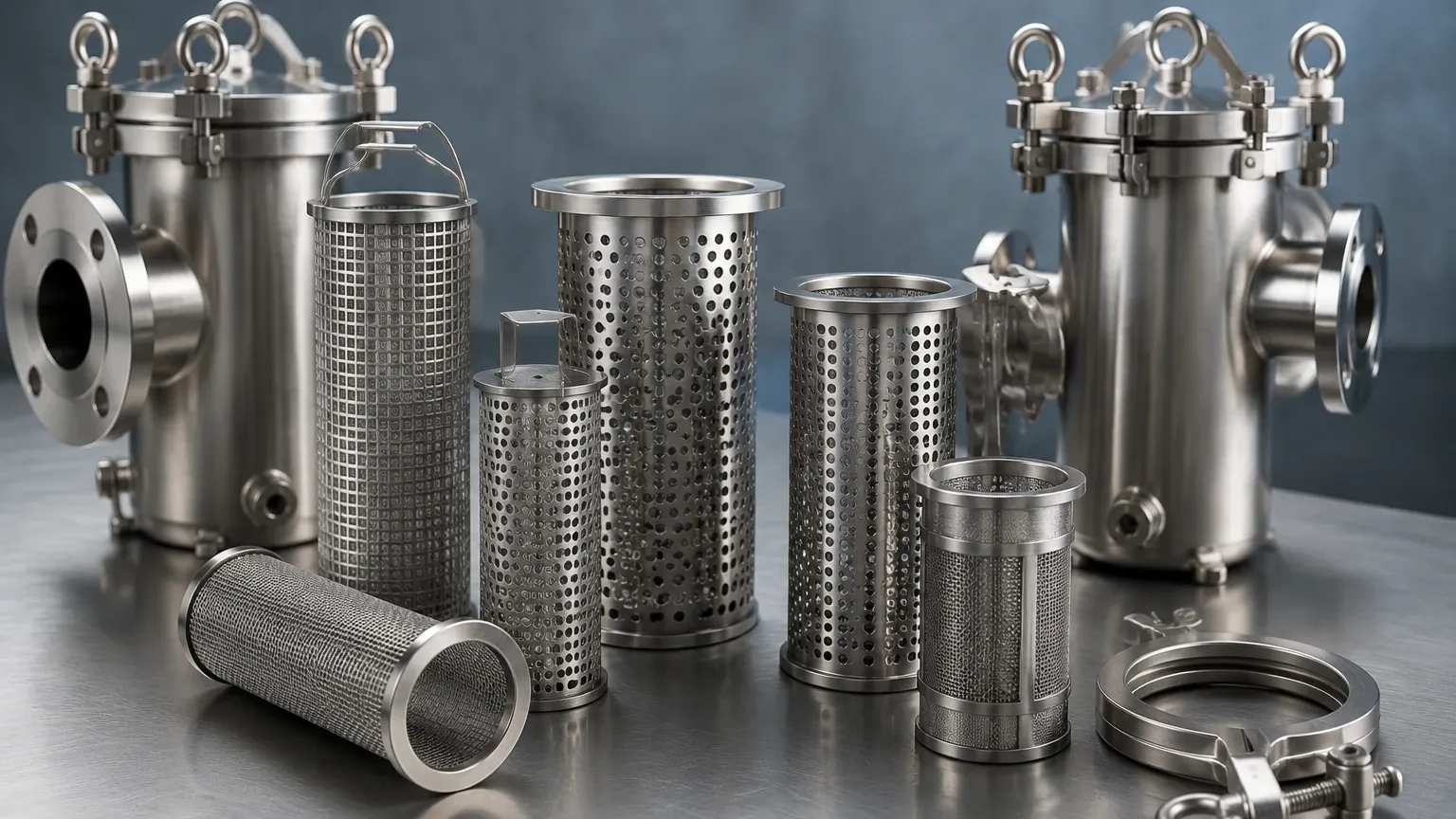
Performance Evaluation: Pressure Drop and Filtration Efficiency
For an engineer, the two most important performance indicators are how well the strainer filters (efficiency) and how much it slows down the flow (pressure drop).
Calculating Pressure Drop
The initial pressure drop of a clean strainer is a function of the fluid's viscosity, density, and flow velocity. As the strainer captures particles, the effective open area decreases, and the pressure drop increases. It is standard practice to install differential pressure gauges across the strainer to monitor this change. When the $ΔP$ reaches a predetermined limit (usually 5-10 psi depending on the system), the basket must be cleaned or replaced.
Micron Ratings and Mesh Selection
The level of filtration is determined by the mesh or perforation size of the internal basket.
- Perforated Plate: Typically used for coarse filtration (removing large stones, scale, or debris). Hole sizes usually range from 1/32" to 1/2".
- Wire Mesh: Used for finer filtration, ranging from 20 mesh down to 400 mesh (approx. 37 microns).
- Sintered Metal: For even finer requirements, multi-layer sintered mesh can provide high-strength filtration down to the single-digit micron range.
Choosing the correct micron rating is a balance: a mesh that is too coarse will allow harmful particles to pass, while a mesh that is too fine will clog prematurely, leading to excessive maintenance costs.
Maintenance and Operational Longevity
The total cost of ownership for Alta strainers is heavily influenced by how easily they can be maintained. In many industrial settings, downtime is the single largest expense. Therefore, design features that facilitate rapid cleaning are highly valued.
Quick-Opening Covers
For applications requiring frequent cleaning, strainers should be equipped with quick-opening covers, such as swing bolts or T-bolt closures. These allow operators to access the basket without the need for specialized tools, significantly reducing the time required for a maintenance cycle.
Cleaning Protocols
Depending on the process, baskets can be cleaned via backwashing, ultrasonic cleaning, or manual pressure washing. Stainless steel Strainers & Baskets are particularly advantageous here because they can withstand aggressive cleaning agents and high-temperature sterilization (SIP/CIP) without degrading.
Replacement Cycles
While high-quality stainless steel baskets are designed for longevity, they are considered wear parts. Factors such as erosion from high-velocity particles, chemical thinning, or mechanical fatigue from pressure cycling will eventually necessitate replacement. Keeping a stock of precision-matched replacement baskets is essential for operational continuity.
Customization and OEM Capabilities for Strainers & Baskets
Every industrial facility has unique requirements based on its piping layout, flow rates, and the nature of its contaminants. Off-the-shelf solutions often fall short of meeting these specific engineering challenges. This is where custom manufacturing becomes a strategic advantage.
Tailored Geometry
Custom Alta strainers can be designed with offset inlets and outlets, special floor stands, or unique basket shapes to fit into tight footprints or existing piping configurations. This flexibility allows engineers to integrate high-performance filtration into older plants where space is at a premium.
Specialized Coatings and Treatments
Beyond material selection, stainless steel components can undergo secondary treatments such as electropolishing to improve surface finish and reduce bacterial adhesion (critical in pharmaceutical and food applications) or passivating to maximize corrosion resistance.
Why Partner with Kaifil?
Kaifil specializes in the production of high-precision stainless steel filtration solutions. Our expertise lies in understanding the intersection of fluid dynamics and metallurgy. By working closely with global customers, we develop Strainers & Baskets that are not only durable but also optimized for the specific filtration accuracy required by the application.
From the initial material selection to the final quality inspection, our manufacturing process is focused on reliability. Whether you are dealing with high-viscosity chemicals or high-velocity water lines, our engineering team provides the technical support needed to select the right filtration components. We assist in calculating the necessary filtration area, selecting the appropriate mesh grade, and ensuring that the final product meets all relevant industrial standards.
In conclusion, Alta strainers are a vital component in the protection and efficiency of industrial fluid systems. By focusing on technical specifications—such as the open area ratio, material grade, and pressure drop—engineers can ensure they are implementing a solution that provides long-term value and operational stability. Investing in high-quality, customized filtration components is a proactive step toward minimizing maintenance and maximizing the lifespan of expensive industrial machinery.
