


Downspout Strainers
In industrial and commercial facility management, the integrity of the drainage system is a critical factor in maintaining operational continuity. Downspout strainers serve as the primary defensive barrier, preventing debris from entering subsurface piping where blockages can lead to structural damage, foundation erosion, and costly downtime. Unlike residential alternatives, industrial-grade downspout strainers must withstand significant hydraulic loads, environmental stressors, and chemical exposures while maintaining consistent filtration performance.
As a specialized component within the broader category of Strainers & Baskets, these units are engineered to balance the conflicting requirements of high-volume flow and effective particulate retention. For engineers and facility managers, selecting the appropriate downspout filtration solution requires a technical understanding of material properties, structural design, and the specific debris profile of the site.
Engineering Principles of Industrial Downspout Filtration
The primary function of a downspout strainer is to intercept solids—such as leaves, twigs, gravel, and airborne industrial particulates—before they enter the vertical piping of a building’s drainage system. However, the engineering challenge lies in the "open area" ratio. A strainer that is too fine will clog rapidly, causing water to back up onto the roof or into the gutter system, which increases the structural load on the building. Conversely, a strainer with openings that are too large allows debris to pass through, potentially causing a subterranean blockage that is significantly more expensive to remediate than a surface-level cleaning.
When specifying downspout strainers, engineers must calculate the peak rainfall intensity for the geographic region and compare it against the effective open area of the strainer. This ensures that even when the strainer is partially occluded by debris, it can still handle the required hydraulic volume without causing an overflow.
Material Selection: The Case for Stainless Steel
In industrial environments, material selection is the most significant factor in determining the total cost of ownership (TCO) for filtration components. While plastic or aluminum strainers may suffice for light commercial use, they frequently fail under the rigors of industrial applications due to UV degradation, mechanical impact, or thermal expansion and contraction.
304 vs. 316 Stainless Steel
Stainless steel is the preferred material for industrial downspout strainers due to its high strength-to-weight ratio and superior corrosion resistance.
* Grade 304: This is the standard industrial grade, offering excellent resistance to atmospheric corrosion. It is suitable for most inland facilities where the primary concern is durability and physical impact resistance.
* Grade 316: For facilities located in coastal regions or those involved in chemical processing where acidic or saline vapors are present, Grade 316 is essential. The addition of molybdenum provides enhanced resistance to pitting and crevice corrosion, ensuring the strainer maintains its structural integrity over decades of service.
By utilizing stainless steel, Kaifil ensures that the strainers do not become brittle over time, a common failure mode in polymer-based products that leads to debris bypassing the filtration layer.
Design Variations in Strainers & Baskets
Not all industrial downspouts are identical, and the design of the strainer must reflect the specific geometry of the drainage outlet and the nature of the debris. Within the category of Strainers & Baskets, several design archetypes are commonly employed:
Wire Mesh Baskets
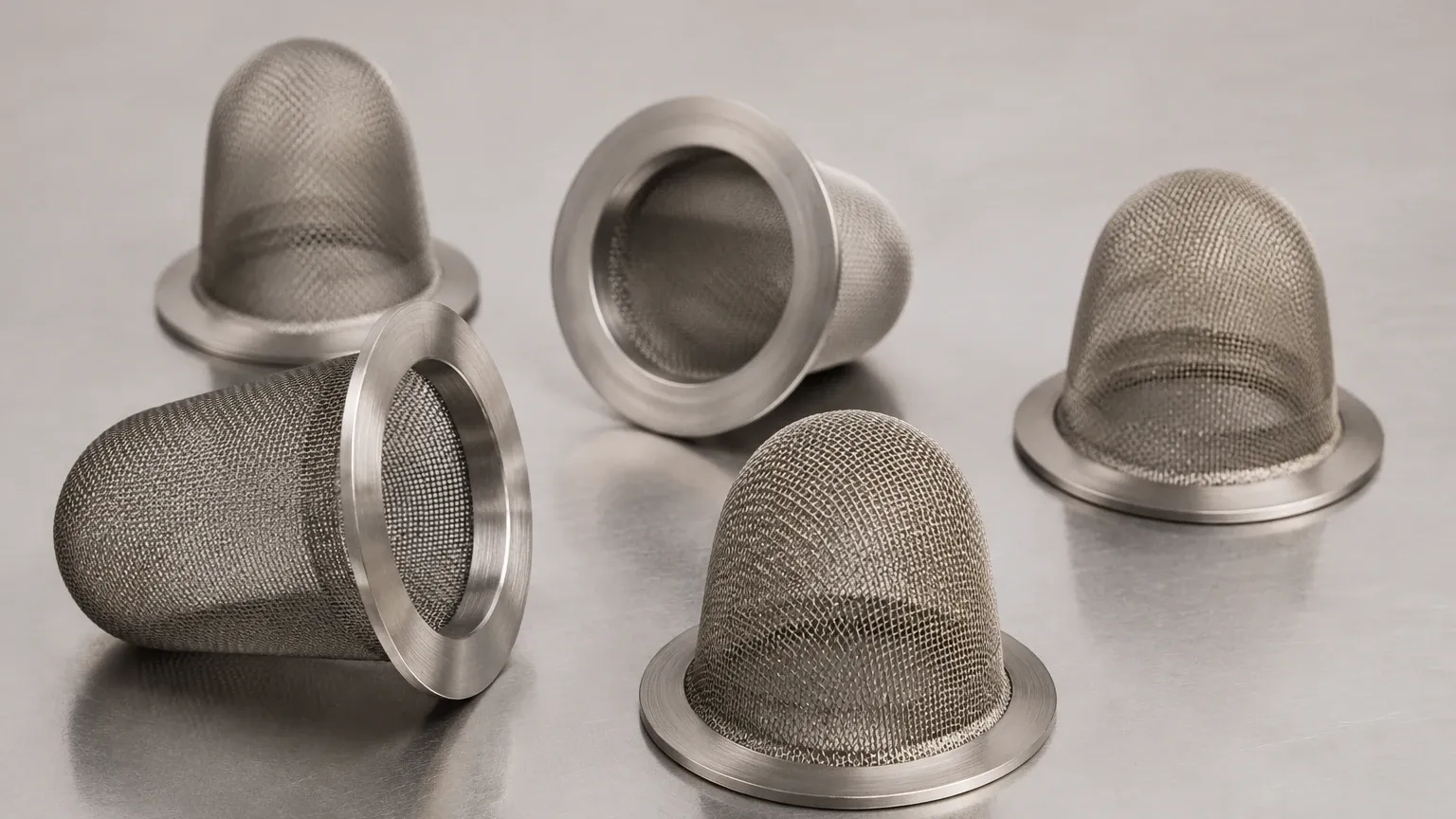
Wire mesh designs offer the highest percentage of open area. These are typically constructed from woven stainless steel wire, providing a flexible yet robust structure. Wire mesh is ideal for applications where fine filtration is required, such as preventing small gravel or roofing granules from entering the system. The weave pattern can be customized to achieve specific micron ratings depending on the sensitivity of the downstream drainage infrastructure.
Perforated Metal Strainers
Perforated metal strainers are fabricated from solid stainless steel sheets with punched holes. These units offer superior mechanical strength and are less likely to be deformed by heavy debris or high-pressure water flow. They are often used in "high-traffic" drainage areas where maintenance personnel may inadvertently step on the units or where heavy ice accumulation is expected during winter months.
Wedge Wire Designs
For applications requiring non-clogging characteristics, wedge wire (V-wire) technology is utilized. The triangular profile of the wire ensures that any particle that passes through the surface opening will not get stuck in the throat of the strainer. This design is particularly effective in environments with high organic matter or sticky industrial waste.
Evaluating Performance and Debris Capacity
When evaluating downspout strainers, engineers must look beyond the initial filtration accuracy and consider the debris capacity. A flat strainer at the bottom of a gutter will be covered by a single layer of leaves, immediately reducing its flow capacity.
To counter this, industrial designs often utilize a "beehive" or "tower" geometry. By extending the strainer vertically into the gutter or downspout head, the filtration surface remains functional even as debris accumulates around the base. This three-dimensional approach to filtration ensures that the system maintains a high flow rate during the entirety of a storm event, reducing the frequency of emergency maintenance.
Key evaluation criteria include:
* Structural Integrity: Ability to withstand the weight of accumulated debris and ice.
* Bypass Prevention: A secure fit between the strainer and the downspout opening to ensure no water or debris flows around the edges.
* Ease of Access: The ability for maintenance teams to quickly remove, clean, and reinstall the unit without specialized tools.
Customization and OEM Solutions for Industrial Facilities
Standard off-the-shelf downspout strainers often fail to meet the specific requirements of complex industrial architectures. Customization is frequently necessary to accommodate non-standard downspout diameters, square-to-round transitions, or specific chemical resistance needs.
As a manufacturer specializing in custom stainless steel filtration, Kaifil provides OEM solutions that allow engineers to specify exact dimensions, material grades, and filtration levels. Customization options include:
* Variable Mounting Systems: Including friction-fit, bolt-down, or hinged designs for different installation environments.
* Reinforced Frames: For high-load areas where the strainer must support significant weight.
* Integrated Sensors: In advanced facility management systems, strainers can be designed to accommodate flow or pressure sensors to alert maintenance teams when a cleaning cycle is required.
These tailored solutions ensure that the filtration component integrates seamlessly with the existing facility infrastructure, rather than forcing a compromise on performance.
Installation and Maintenance Best Practices
The effectiveness of downspout strainers is heavily dependent on proper installation and a consistent maintenance schedule. In industrial settings, the following practices are recommended:
1. Secure Fitment: Ensure the strainer is properly seated. Any gap between the strainer body and the downspout wall creates a bypass point where debris can enter the system, rendering the filtration useless.
2. Regular Inspection Cycles: Depending on the surrounding environment (e.g., proximity to trees or industrial exhaust), strainers should be inspected quarterly. Facilities with high particulate output may require monthly checks.
3. Cleaning Protocols: Stainless steel strainers should be cleaned with high-pressure water or soft brushes. Avoid using carbon steel brushes, as they can leave behind particles that lead to surface rusting (contamination) on the stainless steel.
4. Verification of Flow: After cleaning, maintenance teams should verify that the downspout is clear and that water flows freely through the strainer and into the drain pipe.
Common Risks and Failure Points in Drainage Filtration
Failure to specify the correct downspout strainers can lead to several systemic risks. One of the most common is "blindage," where the strainer surface is completely covered by fine debris, causing water to back up. This is often the result of choosing a mesh that is too fine for the environment.
Another risk is material degradation. In many industrial zones, the rainwater is slightly acidic due to atmospheric pollutants. Over time, this acidity can corrode inferior metals or weaken plastic strainers. If a strainer fails and collapses into the downspout, it creates a massive blockage that is difficult to locate and remove.
By investing in high-quality stainless steel Strainers & Baskets, facility managers mitigate these risks. The initial capital expenditure is offset by the reduction in emergency plumbing costs and the extension of the overall drainage system’s lifespan.
Conclusion: Selecting the Right Filtration Partner
Downspout strainers are a small but vital component of industrial infrastructure. Selecting the right unit involves a detailed analysis of the facility's environmental conditions, hydraulic requirements, and maintenance capabilities. For engineers seeking reliable, high-performance filtration, the focus should remain on material quality and structural design.
Kaifil’s expertise in stainless steel fabrication and custom filtration solutions allows for the development of downspout strainers that meet the most demanding industrial standards. By prioritizing durability and precise engineering, these components ensure that the first line of defense in a building’s drainage system is also the most dependable. Whether through standard designs or custom OEM projects, the goal is always to provide efficient, durable, and cost-effective filtration performance that protects the facility's long-term assets.
