


Strainers for Cocktails
In the professional beverage and hospitality industry, the precision of filtration components is often the determining factor in the quality of the final product. While frequently viewed as simple bar tools, strainers for cocktails are specialized filtration devices engineered to manage fluid dynamics and solid-liquid separation under specific conditions. For engineers and procurement professionals sourcing high-quality metal components, understanding the technical specifications of these tools is essential for ensuring durability, hygiene, and performance in high-volume commercial environments.
At its core, the process of straining a cocktail is a mechanical filtration task. It involves the removal of ice crystals, fruit pulp, herbs, and other botanical solids from a liquid medium. When viewed through the lens of industrial manufacturing, these tools fall under the broader category of Strainers & Baskets, requiring the same attention to material science and structural integrity as heavy-duty industrial filters.
Technical Classifications of Cocktail Filtration Systems
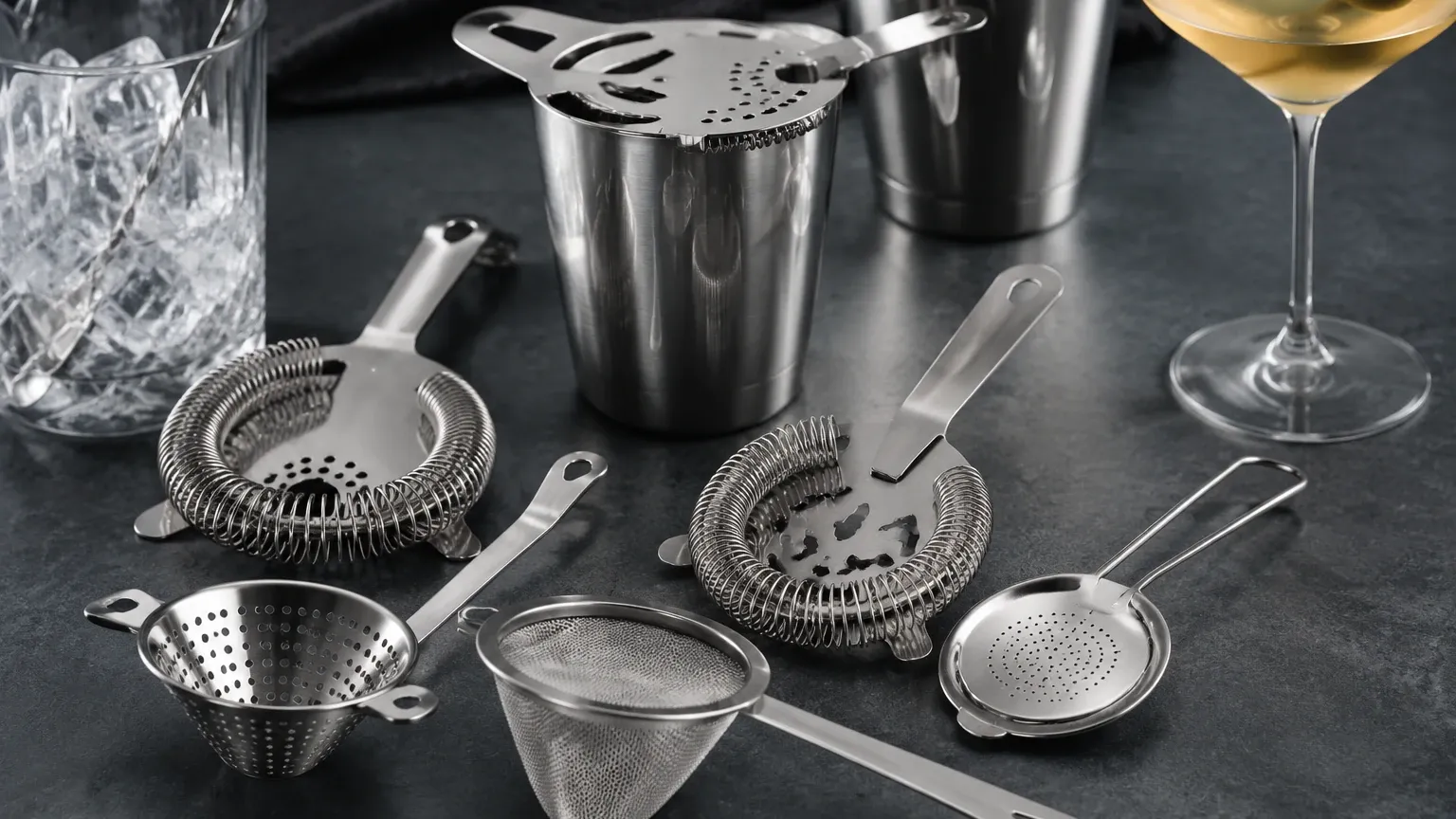
To select the appropriate filtration tool, one must first categorize the three primary designs used in professional environments. Each design utilizes different mechanical principles to achieve varying levels of filtration fineness.
1. The Hawthorne Strainer: Variable Aperture Filtration
The Hawthorne strainer is characterized by its signature tightly wound coil spring. From an engineering perspective, this spring acts as a flexible filtration element. The spacing between the coils determines the size of the particles allowed to pass through.
One of the primary advantages of this design is its adaptability. By applying pressure to the finger tab, a user can compress the spring, effectively narrowing the filtration gaps to catch smaller ice shards or fruit fragments. High-quality Hawthorne strainers utilize 304-grade stainless steel springs with a high coil count to ensure consistent tension and corrosion resistance against acidic citrus juices.
2. The Julep Strainer: Perforated Plate Separation
The Julep strainer is a perforated metal disc, typically bowl-shaped, featuring a series of uniform holes. Unlike the Hawthorne, the Julep strainer provides a fixed filtration area. It is primarily used for drinks stirred with large ice cubes, where the goal is to prevent large solids from entering the glass while allowing for a faster flow rate. The hole diameter and pattern density are critical specifications that dictate the flow coefficient (Cv) of the device.
3. Fine Mesh Strainers: Secondary Precision Filtration
When a primary strainer is insufficient for removing micro-particulates—such as fine mint leaves or tiny ice splinters—a fine mesh strainer is employed. These are typically conical or hemispherical baskets made from woven wire mesh. In industrial terms, these are secondary filters that provide a high degree of filtration accuracy, often utilizing mesh counts ranging from 30 to 60 mesh, depending on the desired clarity of the liquid.
Material Engineering and Corrosion Resistance
For any component used in food and beverage processing, material selection is the most critical factor in determining the product's lifespan and safety. Strainers for cocktails are constantly exposed to highly corrosive environments, including high acidity (from citrus), high sugar content, and rapid temperature fluctuations.
The Superiority of 304 and 316 Stainless Steel
Most commercial-grade strainers are manufactured from 304-grade stainless steel. This alloy provides an excellent balance of formability and resistance to oxidation. However, in environments where the tools are frequently exposed to harsh sanitizing chemicals or high-salinity ingredients, 316-grade stainless steel may be specified. The addition of molybdenum in 316 stainless steel significantly enhances its resistance to pitting and crevice corrosion.
Surface Finish and Passivation
Beyond the alloy itself, the surface finish of the metal plays a vital role in hygiene. Industrial-grade strainers undergo electropolishing or mechanical polishing to achieve a smooth surface finish. This process removes microscopic burrs and reduces the surface roughness (Ra), making it difficult for bacteria or organic residue to adhere to the metal. Furthermore, chemical passivation ensures that a protective chromium oxide layer is uniform across the entire component, preventing rust even after years of heavy use.
Engineering Considerations for High-Volume Use
When evaluating Strainers & Baskets for commercial applications, purchasing teams should look beyond aesthetics and focus on structural engineering. A failure in a filtration component during peak operating hours can lead to service delays and potential safety hazards.
Weld Integrity and Structural Points
The junction where the handle meets the strainer head is the most common point of mechanical failure. In professional-grade manufacturing, spot welding or full-seam TIG (Tungsten Inert Gas) welding is used to ensure a permanent, sanitary bond. Poorly executed welds can create crevices where organic matter can accumulate, leading to microbial growth and non-compliance with health standards.
Spring Tension and Fatigue Resistance
In Hawthorne-style strainers, the spring is subject to constant compression and expansion. High-quality springs are engineered for fatigue resistance, ensuring they return to their original shape after thousands of cycles. If a spring loses its tension, the filtration efficiency drops, as the gaps between the coils become uneven and unpredictable.
Wire Mesh Durability
For fine mesh strainers, the weave must be tight and the wire diameter sufficient to prevent sagging or tearing. Double-layered mesh designs are often preferred in industrial-grade barware to provide additional structural support without significantly impeding the flow rate. The rim of the mesh basket should be securely crimped or welded to a solid steel frame to prevent the mesh from fraying.
The Role of Customization and OEM Manufacturing
As the global hospitality market becomes increasingly competitive, many brands and equipment distributors seek customized filtration solutions. OEM (Original Equipment Manufacturer) capabilities allow for the development of strainers that meet specific ergonomic or performance requirements.
Customization options often include:
* Specific Filtration Ratings: Adjusting the coil density or mesh count to achieve a specific liquid clarity.
* Ergonomic Modifications: Designing handle lengths and weights to reduce repetitive strain for high-volume operators.
* Branding and Aesthetics: Utilizing PVD (Physical Vapor Deposition) coatings to apply durable, food-safe colors like gold, copper, or gunmetal without compromising the underlying stainless steel properties.
* Hybrid Designs: Creating integrated systems that combine the features of multiple strainer types into a single, efficient tool.
Maintenance and Longevity in Commercial Environments
To maintain the performance of stainless steel strainers, a strict maintenance protocol is required. While stainless steel is inherently durable, it is not indestructible. Engineers recommend the following practices to maximize the lifecycle of these filtration components:
1. Immediate Rinsing: Removing acidic residues and sugars immediately after use prevents the initiation of localized corrosion.
2. Proper Sanitization: Using pH-neutral detergents. Excessive exposure to chlorine-based bleaches can lead to stress corrosion cracking in stainless steel components.
3. Regular Inspection: Periodically checking the integrity of the spring and the mesh for signs of wear or deformation. In industrial settings, a damaged filter is replaced immediately to prevent bypass—the same principle applies to commercial beverage preparation.
4. Ultrasonic Cleaning: For fine mesh strainers that have become clogged with organic oils or micro-particulates, ultrasonic cleaning can effectively restore the original flow rate by dislodging trapped solids from the weave.
Conclusion: Selecting the Right Filtration Partner
Whether sourcing standard Strainers & Baskets or developing specialized strainers for cocktails, the focus must remain on technical excellence. A strainer is more than just a bar tool; it is a precision-engineered component designed to perform a specific separation task under demanding conditions.
For procurement professionals and engineers, the key is to partner with manufacturers who understand the nuances of stainless steel fabrication. A manufacturer like Kaifil, with extensive experience in industrial wire mesh and custom filtration solutions, provides the technical foundation necessary to produce tools that meet the highest standards of durability and performance. By prioritizing material grade, weld quality, and precise filtration specifications, businesses can ensure they are providing their teams with the best possible equipment for consistent, high-quality results.
