


Engineering Guide to Woven Wire Mesh Filter Selection and Application
In industrial process engineering, the efficiency of a filtration system is often the deciding factor in product purity, equipment longevity, and overall operational costs. Among the various media available, the woven wire mesh filter remains a primary choice for high-precision, high-durability applications. Unlike disposable synthetic media, woven metal mesh provides a stable, cleanable, and heat-resistant barrier capable of performing under extreme mechanical stress.
Selecting the correct filtration component requires a deep understanding of fluid dynamics, material science, and the specific geometries required for integration into industrial housings. This guide examines the technical nuances of woven wire mesh, focusing on its application in Wire Mesh Filter Cylinders & Tubes and the critical engineering parameters that buyers must evaluate before procurement.
1. Operating Principles of Woven Wire Mesh
A woven wire mesh filter operates primarily on the principle of surface filtration. The mesh is created by weaving individual metallic wires—typically stainless steel—on industrial looms to create a precise grid of apertures. Unlike depth filtration, where particles are trapped within a thick matrix of fibers, surface filtration captures particles on the upstream side of the mesh.
Pore Geometry and Filtration Accuracy
The accuracy of a woven mesh is defined by its pore size, often referred to as the micron rating. Engineers must distinguish between absolute and nominal ratings:
* Absolute Rating: The diameter of the largest hard spherical particle that will pass through the filter under specified test conditions. This is critical for applications where no bypass of oversized particles can be tolerated.
* Nominal Rating: An arbitrary micron value indicated by the manufacturer, often based on a percentage retention (e.g., 90% or 98%).
Because the wires in a woven mesh are fixed in position, the pore size remains stable even under fluctuating pressures, preventing the "unloading" of captured contaminants that often occurs with non-rigid media.
2. Weave Patterns and Their Engineering Implications
The performance characteristics of a woven wire mesh filter are largely determined by the weave pattern. Selecting the right weave is a balance between filtration fineness, flow resistance, and mechanical strength.
Plain Weave
This is the most common and straightforward weave, where each warp wire crosses over and under each weft wire. It provides high flow rates and is easy to clean, making it suitable for coarse filtration and straining. However, it is limited in its ability to achieve very fine micron ratings without sacrificing structural integrity.
Twill Weave
In a twill weave, each weft wire passes over and under two warp wires. This allows for the use of heavier wires for a given mesh count, resulting in a more robust mesh that can handle higher pressures. It is often used when a combination of fine filtration and high mechanical strength is required.
Dutch Weave (Plain and Twilled)
Dutch weaves utilize different diameters for warp and weft wires. The warp wires are heavier and spaced further apart, while the weft wires are thinner and driven closely together. This creates a "tortuous path" for the fluid, providing much finer filtration (down to 5-10 microns) than plain weaves. Twilled Dutch weaves offer the highest density and smallest pore sizes, making them ideal for high-pressure hydraulic systems and fine chemical processing.
3. Structural Configurations: Wire Mesh Filter Cylinders & Tubes
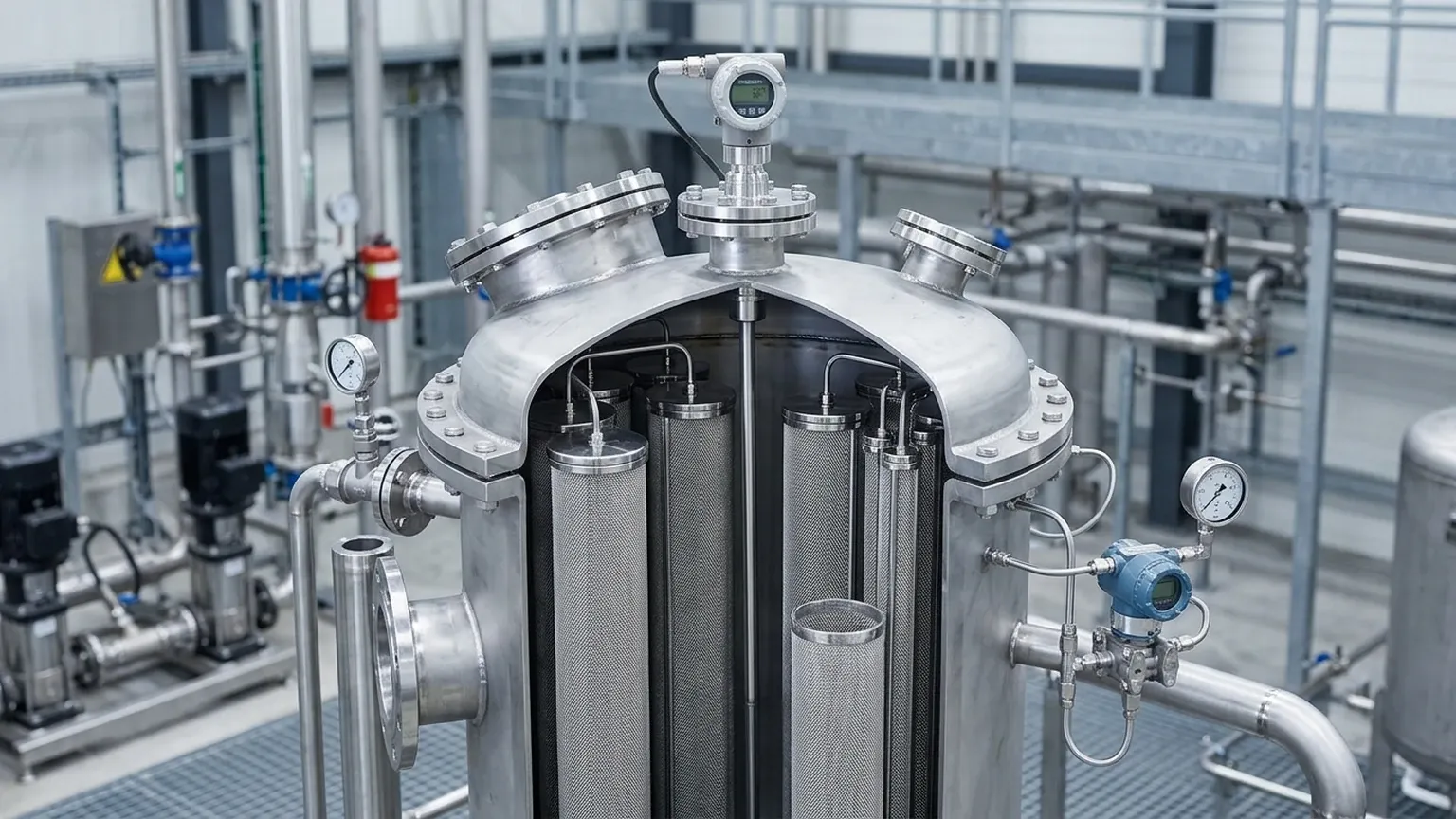
While flat mesh sheets are used in some applications, most industrial processes require the mesh to be formed into three-dimensional structures. Wire Mesh Filter Cylinders & Tubes are the standard configuration for inline filtration systems.
Cylindrical Geometry Advantages
The cylindrical shape provides an optimal ratio of surface area to volume. By forming the mesh into a tube, engineers can maximize the filtration area within a compact housing, thereby reducing the flux (flow per unit area) and extending the time between cleaning cycles.
Reinforcement and Support
On their own, fine woven meshes lack the structural rigidity to withstand high differential pressures. To prevent collapsing or bursting, these filters are often engineered with multiple layers:
1. Filtration Layer: The primary woven wire mesh filter that determines the micron rating.
2. Support Layer: A coarser mesh or perforated metal core that provides mechanical strength.
3. Drainage Layer: Placed between the filtration and support layers to ensure even flow distribution across the entire surface.
For high-pressure applications, the mesh is often sintered—a process of diffusion bonding the wires at their contact points—to create a monolithic structure that cannot migrate or fray.
4. Material Selection for Industrial Environments
The chemical and thermal environment of the application dictates the material choice. While stainless steel is the industry standard, different grades offer varying levels of protection.
* AISI 304: The most common grade, offering good corrosion resistance and mechanical properties for water treatment and general food and beverage applications.
* AISI 316L: Contains molybdenum, providing superior resistance to chlorides and acids. It is the preferred choice for marine environments, pharmaceutical production, and aggressive chemical processing.
* Specialty Alloys: For extreme temperatures or highly corrosive fluids, materials such as Monel, Inconel, or Hastelloy may be used. These alloys maintain their structural integrity in environments where stainless steel would suffer from pitting or stress-corrosion cracking.
5. Engineering Selection Criteria and Pressure Drop
When specifying a woven wire mesh filter, the pressure drop ($ΔP$) across the clean filter is a critical design parameter. An excessive initial pressure drop limits the available "head room" for contaminant loading, leading to short service lives.
Factors Influencing $ΔP$:
* Fluid Viscosity: Higher viscosity fluids require larger surface areas or coarser meshes to maintain acceptable flow rates.
* Flow Velocity: Pressure drop increases exponentially with flow velocity. Sizing the filter to operate at lower velocities can significantly improve efficiency.
* Open Area Percentage: This is the ratio of the total area of the apertures to the total area of the mesh. A higher open area reduces resistance but may compromise the strength of the mesh.
Engineers must calculate the total cost of ownership by balancing the initial cost of a larger filter against the reduced energy costs and longer maintenance intervals provided by a lower pressure drop.
6. Installation Constraints and Sealing Methods
A filter is only as effective as its seal. Any bypass of fluid around the filter element renders the entire system ineffective. When integrating Wire Mesh Filter Cylinders & Tubes, the following installation factors must be considered:
* End Fittings: Filters can be supplied with various end configurations, including DOE (Double Open End), SOE (Single Open End) with O-rings, NPT threads, or flange mounts. The choice depends on the housing design and the required ease of replacement.
* Sealing Materials: Gaskets and O-rings must be chemically compatible with the process fluid. Common materials include EPDM, Viton (FKM), PTFE, and Silicone.
* Alignment: In long cylindrical housings, internal guides or tie rods may be necessary to ensure the filter remains centered and the seals are properly compressed.
7. Maintenance, Cleaning, and Replacement Cycles
One of the primary advantages of a stainless steel woven wire mesh filter is its cleanability. Unlike polymer filters that must be discarded once fouled, metal mesh can be restored to near-original condition through several methods:
* Backwashing: Reversing the flow of fluid to dislodge particles from the surface. This can often be automated for continuous operation.
* Ultrasonic Cleaning: Using high-frequency sound waves in a cleaning solvent to remove fine particles trapped deep within the weave.
* Chemical Cleaning: Using acids or alkalis to dissolve organic or mineral scaling, provided the mesh material is resistant to the cleaning agent.
* Burn-off/Pyrolysis: For polymer or organic contaminants, controlled heating can be used to carbonize and remove the fouling.
Determining Replacement
While cleanable, metal filters have a finite lifespan. Repeated cleaning and mechanical stress can eventually lead to fatigue or wire displacement. Engineers should monitor the "dirty" pressure drop after each cleaning cycle; once the recovered pressure drop exceeds a certain threshold (typically 20-30% higher than the original clean $ΔP$), the element should be replaced to maintain process efficiency.
8. Procurement Checklist for International Buyers
To ensure the delivery of a high-performance filtration solution, technical buyers should confirm the following specifications with the manufacturer:
1. Micron Rating: Specify whether absolute or nominal is required.
2. Flow Conditions: Provide maximum flow rate, operating pressure, and allowable pressure drop.
3. Fluid Properties: Detail the chemical composition, temperature, and viscosity of the fluid.
4. Contaminant Profile: Describe the type of solids being removed (e.g., hard particles, gelatinous matter, fibrous debris).
5. Mechanical Interface: Confirm exact dimensions (OD, ID, Length) and end fitting types for Wire Mesh Filter Cylinders & Tubes.
6. Compliance Standards: Specify if the filter must meet FDA, 3A, or other industry-specific sanitary or quality standards.
By addressing these factors during the design and procurement phase, industrial operators can ensure they select a woven wire mesh filter that provides reliable, long-term performance in demanding environments. Customization remains a hallmark of this technology, allowing for the engineering of bespoke solutions that meet the exact requirements of modern industrial processes.
