


Honey Strainers
In the commercial honey processing industry, the transition from raw extraction to a shelf-ready product requires precise mechanical separation. Honey strainers serve as the primary defense against physical contaminants, ensuring that the final product meets clarity standards while maintaining its nutritional integrity. Unlike fine filtration, which may remove beneficial pollen, industrial straining focuses on the removal of wax cappings, bee fragments, propolis, and other large particulates.
For engineers and procurement professionals, selecting the appropriate Strainers & Baskets involves understanding the interplay between material science, mesh geometry, and the unique rheological properties of honey.
Understanding the Role of Honey Strainers in Industrial Processing
Honey is a highly viscous, non-Newtonian fluid. Its flow characteristics change based on temperature, moisture content, and floral source. In an industrial setting, honey strainers are integrated into the production line immediately after the uncapping and extraction phases. The primary goal is to achieve a specific level of clarity without stripping the honey of its natural characteristics.
Industrial honey strainers are typically categorized by their mechanical structure and the size of the particles they are designed to capture. Because honey is naturally acidic (with a pH ranging from 3.4 to 6.1), the choice of equipment must prioritize corrosion resistance and food safety. Standard industrial configurations often utilize a multi-stage approach, starting with a coarse strainer to remove large debris, followed by finer mesh stages to achieve the desired aesthetic finish.
Material Selection and Food Safety Compliance
When specifying honey strainers for B2B applications, material composition is the most critical factor. Stainless steel is the industry standard due to its durability, ease of sterilization, and resistance to the organic acids found in honey.
Stainless Steel 304 vs. 316
* Type 304 Stainless Steel: This is the most common material for honey processing. It offers excellent corrosion resistance and is cost-effective for most honey-handling environments.
* Type 316 Stainless Steel: For facilities that utilize aggressive Clean-in-Place (CIP) chemicals or process honey with higher acidity levels, Type 316 is preferred. The addition of molybdenum enhances its resistance to pitting and chloride-induced stress corrosion cracking.
Using high-grade stainless steel ensures that the honey strainers do not leach metallic ions into the product, which could alter the flavor profile or violate food safety regulations such as FDA or EU food contact standards. Furthermore, stainless steel mesh provides the structural rigidity required to withstand the pressure generated by high-viscosity fluids moving through a fine aperture.
Technical Specifications: Mesh Count and Micron Ratings
The performance of honey strainers is defined by their mesh count and micron rating. In the context of honey, "straining" usually refers to apertures ranging from 200 to 1000 microns, whereas "filtering" often goes below 100 microns.
Common Micron Benchmarks for Honey
1. Coarse Straining (800–1000 microns): Used for the initial pass to remove large wax chunks and bee parts. This stage prevents the downstream fine strainers from clogging prematurely.
2. Medium Straining (400–600 microns): Removes smaller particles of propolis and wax crystals. This is often the final stage for "raw" honey products.
3. Fine Straining (200–300 microns): Produces a very clear, translucent product. At this level, some larger pollen grains may be retained, but most standard honey remains unaffected.
Engineers must calculate the open area percentage of the mesh. A higher open area reduces the pressure drop across the strainer, allowing for faster throughput. However, the wire diameter must be sufficient to maintain the mesh's dimensional stability under the weight of the honey.
Comparison of Strainer Configurations: Baskets vs. Cones
The physical housing of the honey strainers dictates how the equipment is integrated into the piping system and how easily it can be maintained.
Basket Strainers
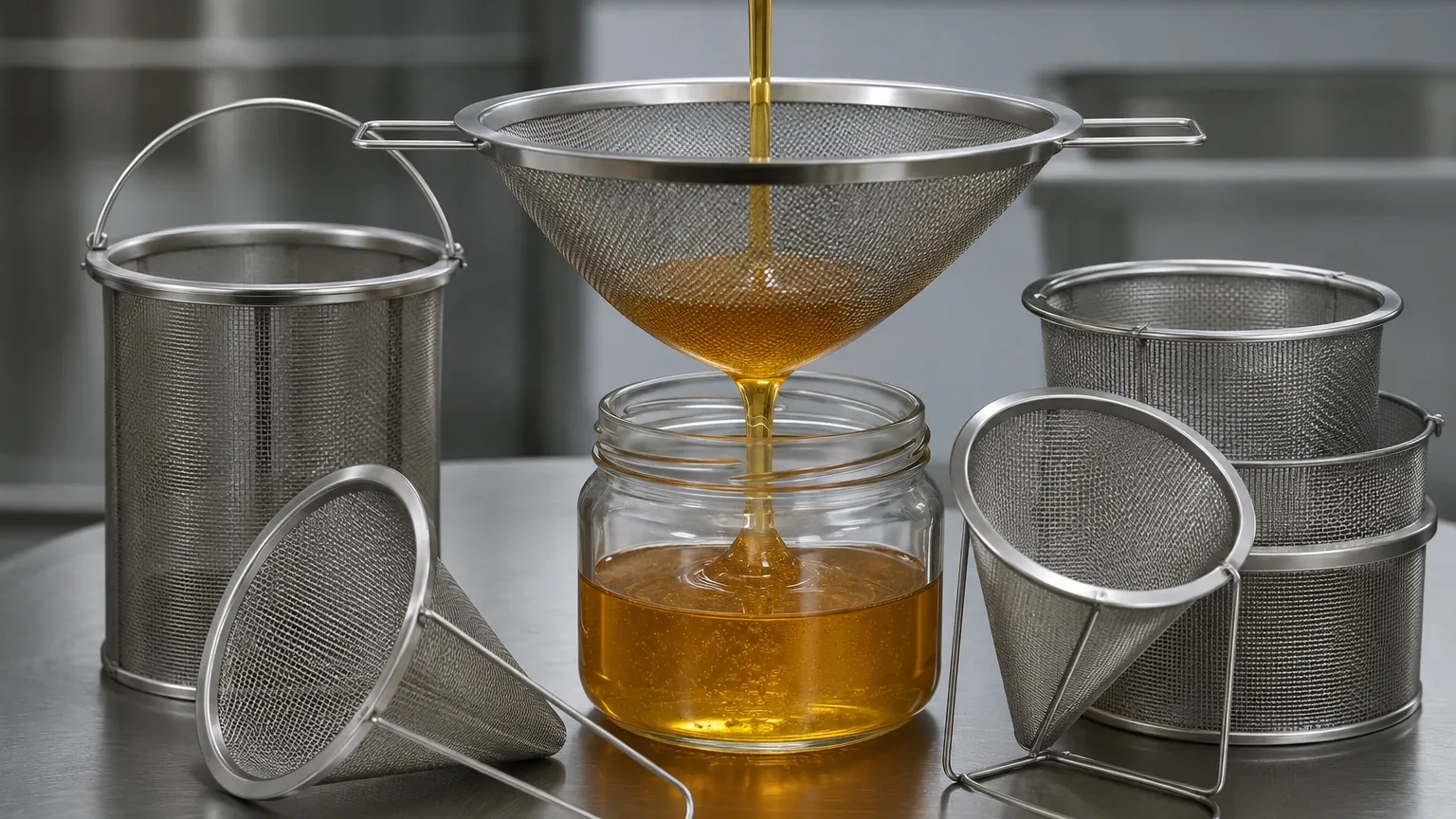
Basket strainers are designed for high-volume applications where downtime must be minimized. They feature a large surface area, which allows for a significant accumulation of solids before cleaning is required. In many industrial honey lines, a duplex basket strainer configuration is used. This allows the flow to be diverted to a second basket while the first is being cleaned, ensuring continuous operation.
Cone and Hat Strainers
Cone-shaped honey strainers (often referred to as "witches' hats") are typically used for batch processing or as redundant safety filters in a pipeline. While they offer a simpler design, they generally have less holding capacity than basket strainers. They are ideal for smaller-scale artisanal producers or as a final polish before the bottling tank.
Engineering for Viscosity: Flow Rate and Temperature Management
The efficiency of honey strainers is inextricably linked to the temperature of the honey. At room temperature (20°C), honey is extremely thick, making gravity-fed straining slow and inefficient.
The Impact of Heat
To optimize flow rates, commercial processors often gently warm the honey to between 35°C and 45°C. This temperature range significantly reduces viscosity without damaging the enzymes or darkening the color (HMF increase).
* Pressure Considerations: If honey is pumped through strainers at high pressure to compensate for viscosity, there is a risk of forcing soft wax particles through the mesh, which compromises the straining quality.
* Differential Pressure Monitoring: Industrial systems should include pressure gauges before and after the strainer. A significant increase in differential pressure indicates that the mesh is blinded by wax or debris and requires cleaning.
Maintenance and Cleaning of Stainless Steel Strainers
One of the primary advantages of stainless steel honey strainers is their ability to be cleaned and reused indefinitely. However, honey and wax present specific cleaning challenges. Wax, in particular, can become embedded in the wire intersections of the mesh.
Cleaning Protocols
1. Hot Water Rinse: Since beeswax melts at approximately 62–64°C, rinsing with hot water is the most effective way to clear a blinded strainer.
2. Ultrasonic Cleaning: For fine mesh strainers where wax has hardened, ultrasonic cleaning can dislodge microscopic particles without damaging the wire structure.
3. Avoidance of Abrasives: Mechanical scrubbing with wire brushes should be avoided, as it can displace the mesh wires, leading to inconsistent micron ratings.
Regular inspection of the mesh is vital. Over time, the constant pressure and cleaning cycles can lead to fatigue in the wire, resulting in small tears. In a B2B environment, maintaining a schedule for mesh replacement or refurbishment is essential for quality assurance.
Customization Options for Commercial Honey Production
Every honey processing facility has unique requirements based on their specific floral sources and production volumes. Customization of honey strainers allows for optimized performance that off-the-shelf solutions may not provide.
Customization options often include:
* Reinforced Baskets: For high-pressure pump systems, the mesh can be backed by a perforated metal sheet to prevent deformation.
* Variable Mesh Layers: Some strainers utilize a multi-layer sintered mesh, combining a fine filtration layer with a coarse protective layer for added durability.
* Specific Connection Types: Custom flanges (ANSI, DIN, or SMS) ensure the strainer fits seamlessly into existing food-grade piping manifolds.
By collaborating with a specialized manufacturer like Kaifil, engineers can specify the exact dimensions and tolerances required for their specific Strainers & Baskets applications. This ensures that the equipment can handle the peak loads of the harvest season without failure.
Conclusion: Selecting the Right Solution
The selection of honey strainers is a balance between throughput requirements, desired product clarity, and long-term durability. For industrial B2B operations, investing in high-quality stainless steel components is a prerequisite for maintaining food safety and operational efficiency. By understanding the technical nuances of micron ratings, material grades, and the effects of temperature on viscosity, procurement teams can secure filtration solutions that provide a consistent, high-quality honey product for the global market.
