


Ifc Strainers
In industrial fluid handling and piping systems, the protection of downstream equipment is a primary engineering concern. Mechanical components such as pumps, control valves, meters, and heat exchangers are highly susceptible to damage from particulate matter, scale, and debris. Ifc strainers—referring to high-performance industrial filtration components often utilized in complex piping networks—serve as the first line of defense in maintaining system integrity. These components are designed to mechanically remove solids from flowing liquids or gases through a perforated or wire mesh straining element.
Selecting the appropriate Strainers & Baskets requires a deep understanding of fluid dynamics, material science, and the specific operational parameters of the application. Whether the system is handling high-pressure steam, corrosive chemicals, or food-grade liquids, the choice of strainer configuration and filtration media directly impacts the total cost of ownership and the longevity of the entire process line.
Technical Configurations of Industrial Strainers
Industrial strainers are categorized by their physical geometry and how they are integrated into the piping system. Each configuration offers distinct advantages depending on the flow rate, solids loading, and maintenance requirements.
Y-Strainers
Y-strainers are perhaps the most common configuration in industrial settings. Their name is derived from their shape, where the straining element is housed in a leg that branches off the main flow path at an angle. These are typically used in applications where the amount of solids to be removed is relatively small, or where frequent cleaning is not required. Because of their compact design, they are ideal for high-pressure systems and can be installed in either horizontal or vertical orientations.
Basket Strainers
Basket strainers, or Simplex strainers, feature a vertical chamber that houses a removable basket-shaped element. These units generally offer a larger surface area than Y-strainers, allowing for a greater dirt-holding capacity and a lower pressure drop. They are preferred in liquid applications where particulate loading is higher. The vertical orientation requires horizontal piping, and the top-entry design allows for easier access during cleaning cycles.
Duplex Strainers
For processes that cannot be shut down for maintenance, duplex strainers are essential. These systems consist of two separate strainer chambers connected by a diverted valve. When one chamber becomes clogged, the flow is diverted to the second chamber, allowing the operator to clean the first basket without interrupting the process. This is a critical requirement in chemical processing and power generation where continuous flow is mandatory.
Material Science and Chemical Compatibility
The durability of ifc strainers is largely determined by the materials used in the construction of the housing and the internal elements. In industrial filtration, stainless steel is the gold standard due to its mechanical strength and resistance to various forms of corrosion.
1. 304 Stainless Steel: Suitable for general-purpose applications, including water treatment and less corrosive industrial fluids. It provides excellent strength and good oxidation resistance.
2. 316/316L Stainless Steel: For more demanding environments, such as pharmaceutical or chemical processing, 316 stainless steel is preferred. The addition of molybdenum enhances resistance to pitting and crevice corrosion, particularly in chloride-rich environments.
3. Specialty Alloys: In extreme cases involving highly acidic or high-temperature media, alloys like Monel, Hastelloy, or Duplex stainless steel may be specified to ensure the structural integrity of the strainer housing and the precision of the mesh.
Beyond the metal components, engineers must also specify the correct gasket and seal materials. Common options include EPDM for water applications, Viton for high temperatures and chemicals, and PTFE for maximum chemical inertness.
Engineering Considerations: Pressure Drop and Flow Velocity
One of the most critical factors in strainer selection is the pressure drop ($ΔP$) across the unit. Every strainer introduces some resistance to flow. If the pressure drop is too high, it can lead to cavitation in pumps, reduced flow rates, and increased energy consumption.
The Cv Factor
The flow coefficient (Cv) is a standard measure used to indicate the flow capacity of a strainer. It represents the volume of water (in GPM) that will flow through the strainer with a pressure drop of 1 psi. A higher Cv value indicates lower resistance to flow. When sizing ifc strainers, engineers must calculate the clean pressure drop based on the fluid's viscosity and specific gravity.
Open Area Ratio (OAR)
The efficiency of a strainer is also defined by its Open Area Ratio. This is the ratio of the total open area of the holes in the straining element to the internal cross-sectional area of the inlet pipe. A common engineering standard is a 4:1 ratio, which ensures that the strainer can accumulate a significant amount of debris before the pressure drop becomes critical. For high-viscosity fluids, an even higher ratio may be required to maintain system performance.
Filtration Precision: Perforated Plates vs. Wire Mesh
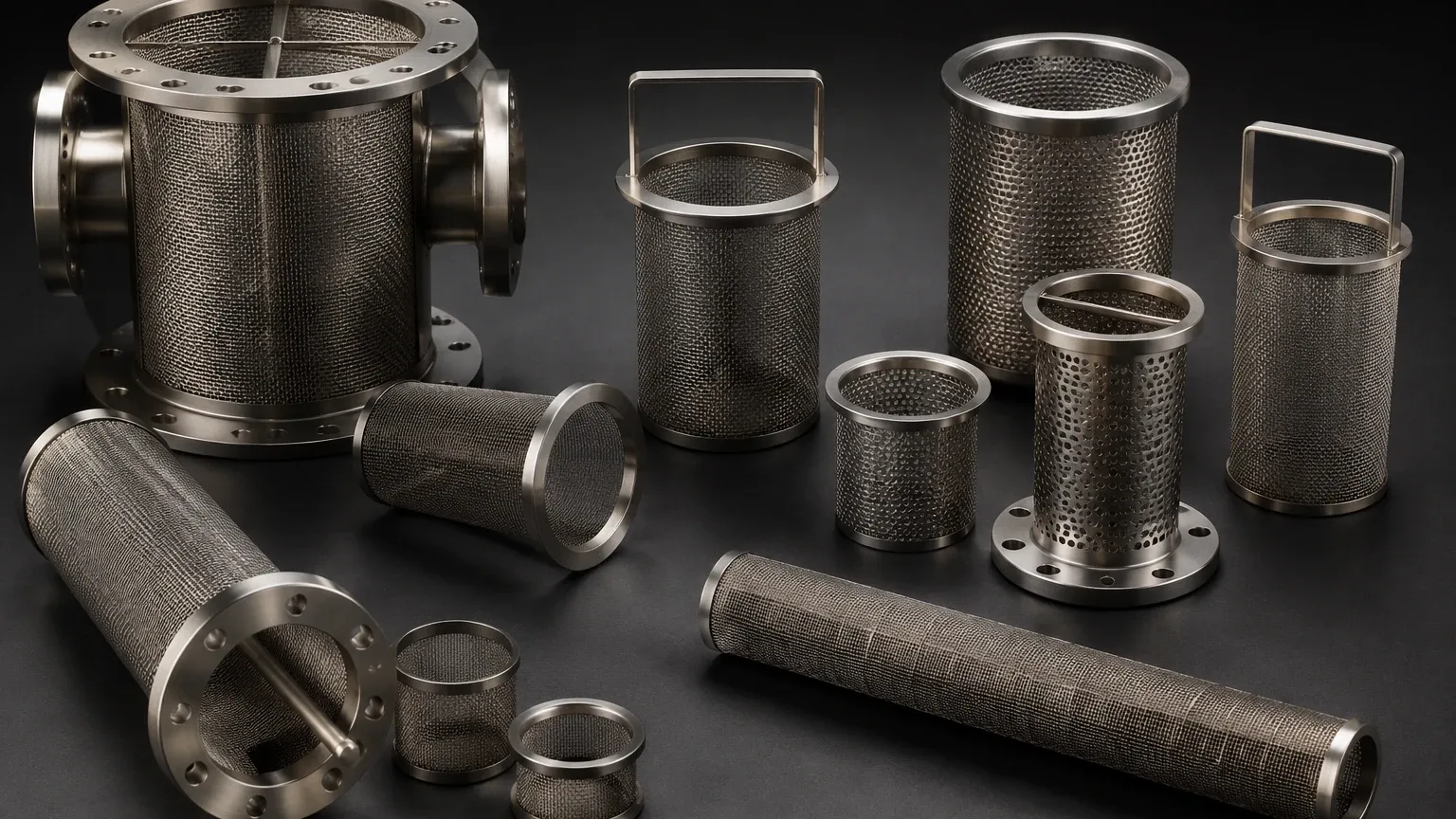
The internal element of Strainers & Baskets is what determines the filtration accuracy. Depending on the size of the particles to be removed, engineers choose between perforated metal and woven wire mesh.
* Perforated Metal: This serves as the primary support or the coarse filter. It is a sheet of metal with punched holes. Common hole sizes range from 1/32" to 1/4". Perforated elements are robust and can withstand significant differential pressure.
* Woven Wire Mesh: For finer filtration (down to the micron level), a wire mesh lining is added to the perforated basket. Mesh is defined by the number of openings per linear inch. For example, a 100-mesh screen has 100 openings per inch.
When specifying mesh, it is important to distinguish between "mesh count" and "micron rating." The micron rating provides a more precise measurement of the largest particle that can pass through the screen. In many industrial applications, a multi-layered sintered mesh is used to combine fine filtration with the structural strength needed to resist collapsing under pressure.
Maintenance and Operational Safety
Proper maintenance of ifc strainers is vital for preventing system failure. As debris accumulates, the differential pressure across the element increases. If left uncleaned, the pressure can reach a point where the straining element deforms or "blows through," allowing all the captured contaminants to rush downstream.
Differential Pressure Monitoring
Installing differential pressure gauges upstream and downstream of the strainer is the most effective way to monitor its condition. Most industrial standards recommend cleaning or replacing the basket when the pressure drop reaches 5-10 psi above the clean pressure drop.
Cleaning Procedures
In Y-strainers, a "blow-down" valve can be installed on the strainer cap, allowing the operator to flush out debris without removing the cap. For basket strainers, the process involves isolating the unit, venting the pressure, and manually removing the basket for cleaning. It is essential to inspect the gaskets during every cleaning cycle to prevent leaks upon reassembly.
Customization in Industrial Filtration
Standard off-the-shelf strainers may not meet the requirements of specialized industrial processes. Customization allows engineers to tailor the filtration solution to the specific nuances of their application. Customization options often include:
* Custom Flange Connections: Matching existing piping standards such as ANSI, DIN, or JIS.
* Specialized Coatings: Applying epoxy or rubber linings for added corrosion resistance in water treatment plants.
* Reinforced Baskets: Designing elements to withstand high differential pressures in high-viscosity applications.
* Magnetic Inserts: Adding magnets to the basket to capture fine iron or steel particles that might otherwise pass through a standard mesh.
Kaifil specializes in these custom stainless steel filtration solutions, providing the engineering expertise required to design elements that balance flow efficiency with rigorous particle retention.
Selection Checklist for Engineers and Purchasing Teams
To ensure the correct procurement of ifc strainers, the following technical data points should be confirmed:
1. Fluid Characteristics: What is the fluid type, viscosity, and specific gravity? Is it corrosive or abrasive?
2. Operating Conditions: What are the maximum operating pressures and temperatures?
3. Filtration Requirement: What is the smallest particle size that must be removed? Does the application require a specific micron rating?
4. Flow Rate: What is the normal and maximum flow rate (GPM or m³/h)?
5. Allowable Pressure Drop: What is the maximum permissible pressure drop when the strainer is clean and when it is dirty?
6. Connection Type: Are flanged, threaded, or socket-weld connections required?
7. Space Constraints: Is there enough clearance for basket removal or Y-strainer blow-down?
By addressing these factors during the design and procurement phase, facilities can avoid costly downtime and ensure that their downstream equipment remains protected from the damaging effects of particulate contamination.
In conclusion, while often viewed as simple mechanical components, ifc strainers are engineered tools that require precise specification. From the selection of 316L stainless steel for chemical compatibility to the calculation of Cv factors for hydraulic efficiency, every detail contributes to the reliability of the industrial process. For those seeking high-performance, customized Strainers & Baskets, focusing on material quality and engineering precision is the only way to achieve long-term operational success.
