


Industrial Water Strainers
In industrial fluid management, the integrity of downstream equipment—such as pumps, heat exchangers, spray nozzles, and sensitive instrumentation—depends heavily on the efficiency of primary filtration. Industrial water strainers serve as the first line of defense, mechanically removing solids and debris from process water, cooling loops, and intake systems. Unlike fine membrane filters, these components are designed to handle high flow rates and significant solids loading while maintaining a low pressure drop.
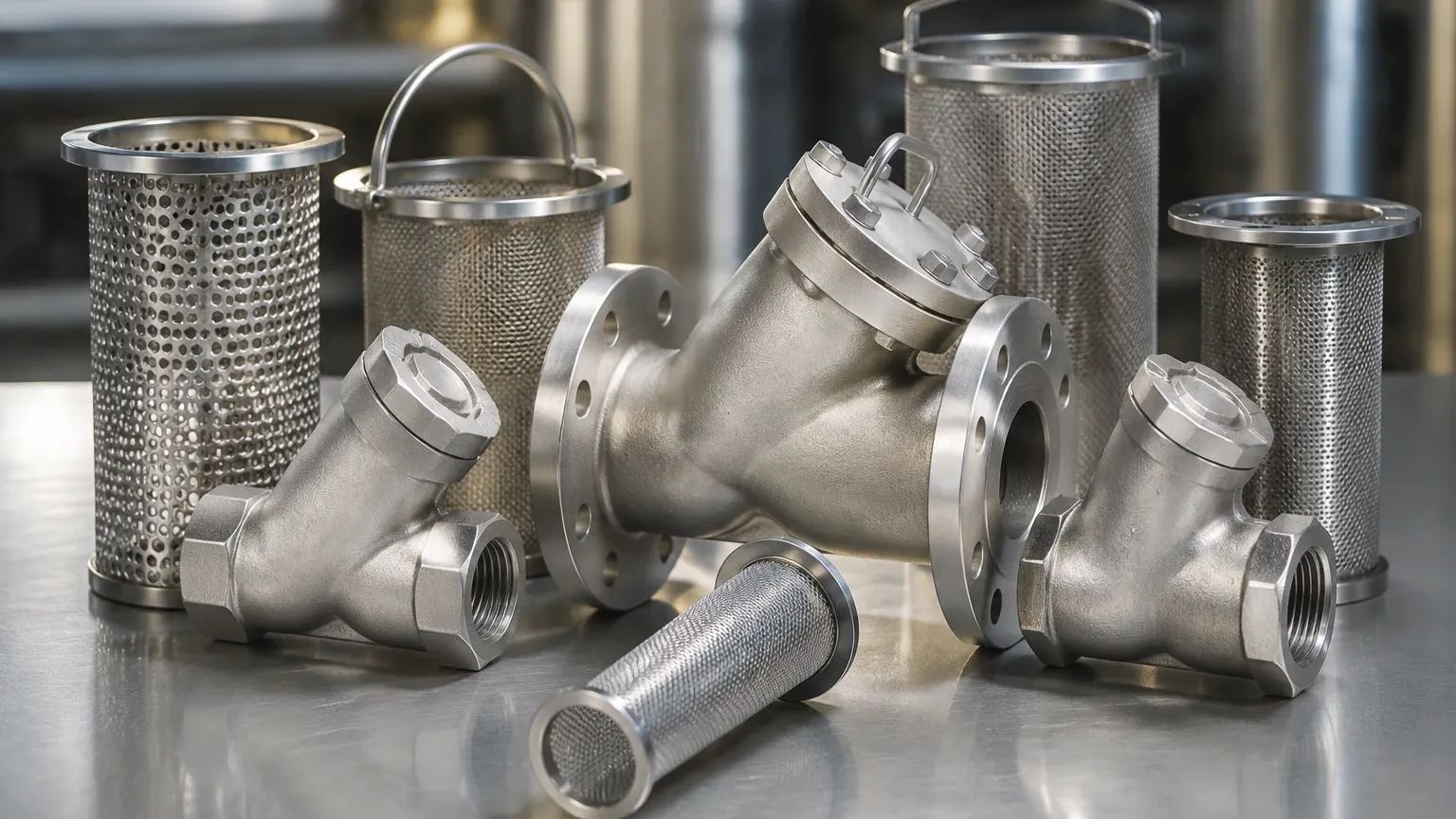
For engineering and procurement teams, selecting the appropriate Strainers & Baskets requires a deep understanding of fluid dynamics, material science, and the specific mechanical requirements of the application. This guide examines the technical considerations, design variations, and performance metrics essential for optimizing industrial water filtration.
The Role of Mechanical Filtration in Industrial Systems
Industrial water strainers are closed-vessel systems that remove particulate matter via a perforated plate or wire mesh screen. The primary objective is protection. In cooling water systems, for example, debris such as pipe scale, sand, or biological growth can clog heat exchanger tubes, leading to reduced thermal efficiency and potential system failure.
In chemical processing and pharmaceutical manufacturing, industrial water strainers ensure that process water meets the required clarity before entering more refined filtration stages or reactors. The choice of strainer impacts not only the cleanliness of the fluid but also the operational uptime of the entire facility. A poorly specified strainer can lead to frequent clogging, excessive pressure drops, and premature wear on the filter media itself.
Key Design Configurations: Simplex, Duplex, and Y-Strainers
The physical configuration of a strainer is determined by the flow requirements and the necessity for continuous operation.
Simplex Strainers
Simplex designs are used in systems where the flow can be intermittently shut down for cleaning. These consist of a single basket chamber. They are cost-effective and ideal for batch processes or systems with standby equipment. When the differential pressure reaches a predetermined limit, the system is paused, the basket is removed, cleaned, and reinstalled.
Duplex Strainers
For critical infrastructure where downtime is not an option, duplex strainers are the standard. These units feature two separate basket chambers connected by a diverter valve. When one basket becomes loaded with debris, the flow is switched to the clean chamber without interrupting the process. This allows for continuous operation in cooling towers, lubrication systems, and continuous chemical lines.
Y-Strainers
Y-strainers are typically utilized in applications with low concentrations of solids. Their compact design makes them suitable for space-constrained installations. While they offer less holding capacity than basket-style strainers, they are highly effective for protecting steam traps and meters in high-pressure water lines.
Material Engineering: Why Stainless Steel is Standard
In the context of industrial water strainers, material selection is the most critical factor in determining the service life and chemical compatibility of the component. While cast iron or plastic may suffice for low-stakes domestic applications, industrial environments demand the resilience of stainless steel.
1. 304 Stainless Steel: This is the most common grade used for general industrial water applications. It provides excellent strength and good corrosion resistance against standard process water.
2. 316/316L Stainless Steel: For applications involving brackish water, high-chloride environments, or aggressive chemicals, 316 stainless steel is preferred. The addition of molybdenum enhances resistance to pitting and crevice corrosion, which is vital for the longevity of the mesh and the housing.
3. Structural Integrity: Stainless steel allows for thinner wire diameters in mesh screens while maintaining high burst strength. This maximizes the available filtration area without compromising the structural stability of the basket under high differential pressure.
Technical Specifications: Mesh Size, Perforation, and Open Area Ratio
When specifying industrial water strainers, engineers must balance the level of filtration (the size of particles removed) with the flow capacity of the system. This is defined by two primary factors: the filtration media and the open area ratio.
Perforation vs. Mesh
* Perforated Plate: These are heavy-duty screens with punched holes, typically ranging from 1/32" to 1/2". They are used for removing large debris and provide the primary structural support for finer mesh linings.
* Wire Mesh: For finer filtration (measured in microns or mesh count), a woven wire mesh is layered over the perforated plate. Mesh counts can range from 20 mesh (approx. 840 microns) to 400 mesh (approx. 37 microns) or finer, depending on the application requirements.
The Open Area Ratio (OAR)
The OAR is the relationship between the total area of the openings in the strainer basket and the cross-sectional area of the inlet pipe. A high-performance industrial water strainer should ideally have an OAR of at least 6:1 or 8:1. A higher OAR ensures that as the basket begins to collect debris, there is still enough free area to maintain flow without a significant increase in velocity or pressure drop. This extends the time between cleaning cycles and reduces the mechanical stress on the system.
Evaluating Pressure Drop and Flow Efficiency
Pressure drop (ΔP) is the loss of fluid pressure as it passes through the strainer. In any industrial system, minimizing ΔP is essential for reducing energy consumption and preventing pump cavitation.
Several factors contribute to the initial pressure drop:
* Viscosity of the Fluid: While water has low viscosity, temperature fluctuations can affect flow dynamics.
* Velocity: Higher flow velocities through the strainer housing increase turbulence and pressure loss.
* Mesh Density: Finer mesh provides better filtration but creates higher resistance.
Engineers should calculate the "clean pressure drop" and establish a "dirty pressure drop" limit (usually around 5-10 psi) at which the strainer must be cleaned. Utilizing high-quality Strainers & Baskets with optimized internal geometries can significantly reduce turbulence and improve overall system efficiency.
Customization and OEM Considerations for Complex Systems
Standard off-the-shelf strainers often fail to meet the specific spatial or performance constraints of specialized industrial equipment. This is where OEM and customized filtration solutions become necessary. Customization options typically include:
* Custom Dimensions: Tailoring the basket height and diameter to fit existing housings or to increase the dirt-holding capacity within a limited footprint.
* Connection Types: Beyond standard NPT or ANSI flanges, custom strainers can be designed with specialized sanitary fittings for food and beverage applications or high-pressure socket weld connections.
* Reinforced Construction: For high-pressure or high-viscosity applications, baskets can be reinforced with external cages or internal supports to prevent collapsing.
* Handle and Lifting Options: In large-scale industrial water strainers, the weight of a loaded basket can be significant. Custom handles, slanted tops, or lifting eyes facilitate safer and faster maintenance.
As a professional manufacturer, Kaifil specializes in these customized configurations, ensuring that the filtration component integrates seamlessly with the broader industrial system.
Maintenance Protocols and Service Life Optimization
The longevity of industrial water strainers is directly tied to maintenance practices. Neglecting a clogged strainer not only reduces flow but can also lead to "blow-by," where the pressure forces debris through the mesh or causes the basket to deform, allowing unfiltered water to pass downstream.
Cleaning Procedures
For stainless steel baskets, cleaning usually involves backwashing with high-pressure water or ultrasonic cleaning for fine mesh that has become blinded by sticky particulates. It is crucial to inspect the mesh for signs of fraying or broken wires during every cleaning cycle.
Monitoring Differential Pressure
Installing differential pressure gauges across the inlet and outlet of the strainer is the most effective way to monitor performance. Automated systems can trigger an alarm or switch the diverter valve in duplex systems when the ΔP reaches the critical threshold.
Gasket and Seal Replacement
Frequent opening of the strainer housing for cleaning can wear out O-rings and gaskets. Keeping a stock of compatible seals (EPDM, Viton, or PTFE) is essential to prevent leaks and ensure the pressure-tight integrity of the vessel.
Conclusion
Industrial water strainers are vital components that ensure the reliability and efficiency of complex fluid systems. By focusing on high-grade stainless steel construction, optimized open area ratios, and precise mesh selection, engineers can protect their equipment from the damaging effects of particulate contamination. Whether the application involves simple cooling water or complex chemical processing, the selection of robust Strainers & Baskets is a strategic investment in operational stability.
When evaluating suppliers, technical expertise in material selection and the ability to provide customized OEM designs are paramount. A well-engineered strainer does more than just filter water; it reduces the total cost of ownership by extending equipment life and minimizing unscheduled downtime.
