


Inlet Strainers
In industrial fluid handling systems, the protection of downstream equipment is a primary engineering concern. Inlet strainers serve as the critical first line of defense, designed to remove large particulate matter, debris, and suspended solids from a process stream before they can reach sensitive components such as pumps, valves, flow meters, and spray nozzles. By intercepting these contaminants at the intake point, inlet strainers prevent mechanical wear, clogging, and catastrophic equipment failure.
Selecting the appropriate strainer requires a deep understanding of fluid dynamics, material science, and the specific operational parameters of the application. For engineers and procurement teams, the decision-making process involves balancing filtration efficiency with system pressure requirements and long-term maintenance costs.
The Role of Inlet Strainers in Process Protection
Inlet strainers are typically installed on the suction side of a pump. Their primary function is to protect the pump’s internal components—such as impellers, seals, and wear rings—from damage caused by solids. In many industrial environments, process fluids may contain welding slag, pipe scale, or external debris introduced during maintenance or raw material handling.
Without adequate protection, these particles can cause cavitation, erosion, or total seizure of rotating equipment. While fine filtration is often handled later in the process, the role of Strainers & Baskets at the inlet is to manage the "coarse" load, ensuring that the fluid entering the system meets the minimum cleanliness standards required for safe mechanical operation.
Engineering Parameters for Strainer Selection
When specifying inlet strainers, several technical variables must be evaluated to ensure the component performs reliably under operational stress. Failure to account for these factors can lead to excessive pressure drops or insufficient protection.
1. Micron Rating and Mesh Size
The filtration degree is determined by the size of the openings in the strainer media. In B2B industrial contexts, this is usually defined by mesh count (the number of openings per linear inch) or micron rating. For inlet protection, the goal is typically to remove particles that are larger than the internal clearances of the downstream equipment. Engineers must select a mesh that is fine enough to protect the system but coarse enough to avoid rapid clogging, which would starve the pump of fluid.
2. Flow Rate and Velocity
Fluid velocity significantly impacts the efficiency of an inlet strainer. High-velocity flows can force soft contaminants through the mesh or cause excessive turbulence. Designers must calculate the "open area ratio" (OAR)—the ratio of the total area of the holes in the strainer to the cross-sectional area of the inlet pipe. A common industry standard is an OAR of at least 4:1 to ensure that the pressure drop remains within acceptable limits even as the strainer begins to collect debris.
3. Pressure Drop ($ΔP$)
The differential pressure across the strainer is a key indicator of its performance and condition. A high initial pressure drop suggests that the strainer is undersized for the flow rate or that the mesh is too fine. Monitoring $ΔP$ is essential for determining cleaning cycles; once the pressure drop reaches a predetermined threshold, the strainer must be serviced to prevent pump cavitation.
Material Selection and Structural Integrity
Industrial environments demand materials that can withstand corrosive fluids, high temperatures, and mechanical vibrations. Stainless steel is the preferred material for high-performance inlet strainers due to its durability and chemical resistance.
* SS304: Suitable for general industrial applications, including water treatment and non-corrosive chemical processing. It offers excellent strength and basic corrosion resistance.
* SS316/SS316L: Required for more aggressive environments, such as marine applications, pharmaceutical production, and acidic chemical processing. The addition of molybdenum enhances resistance to pitting and crevice corrosion.
Beyond the alloy, the construction of the strainer media is vital. For heavy-duty applications, a perforated metal basket may serve as the primary support, with a fine wire mesh liner bonded to the interior. This "dual-layer" approach ensures that the strainer can withstand high differential pressures without collapsing or deforming.
Comparison of Strainer Configurations
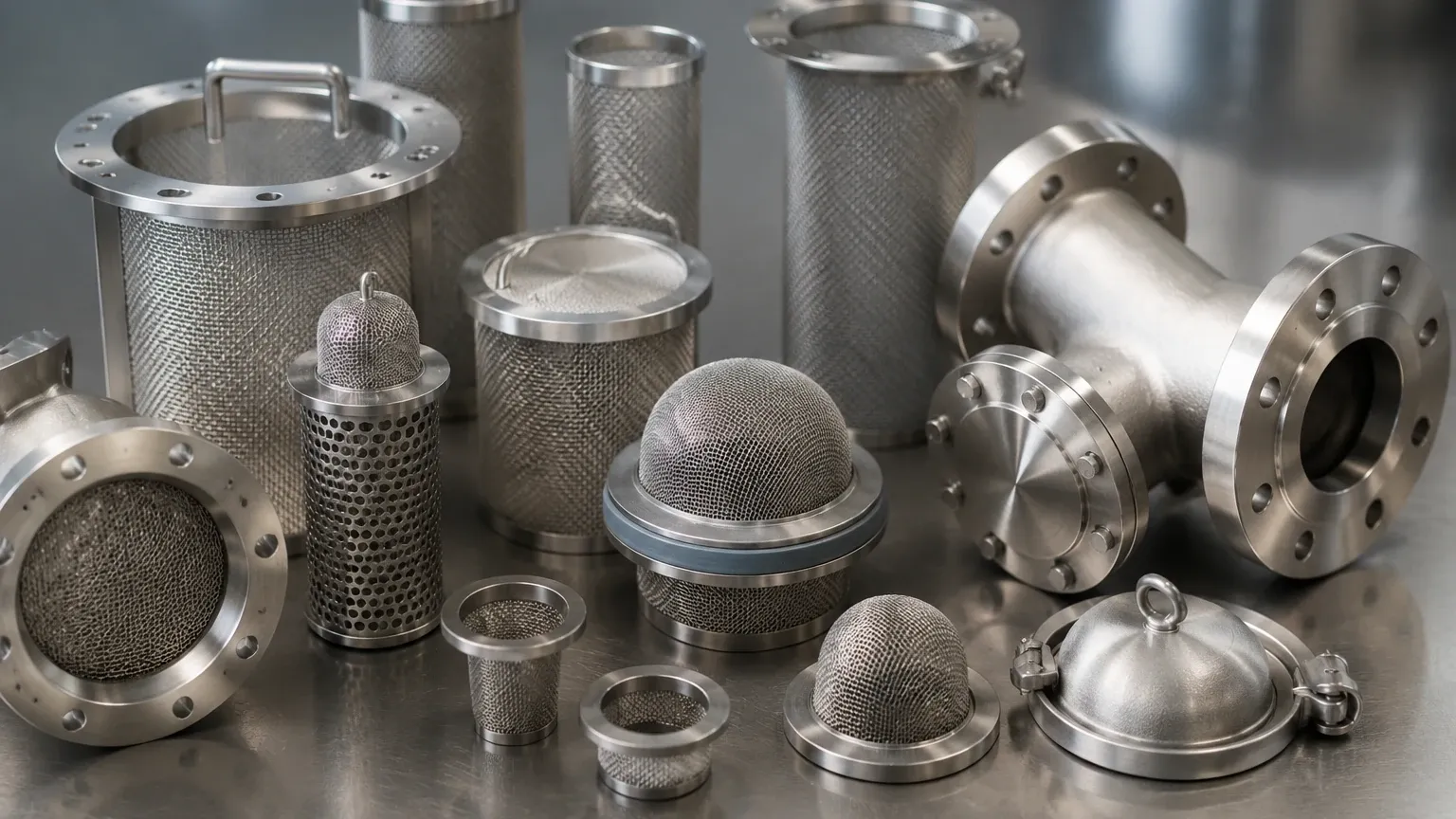
Inlet strainers come in various geometries, each suited to specific installation constraints and maintenance requirements. Understanding these differences is essential for optimizing system layout.
Y-Strainers
Y-strainers are compact and ideal for systems where the amount of debris is relatively low. They can be installed horizontally or vertically, making them versatile for tight piping configurations. However, they generally have a smaller dirt-holding capacity compared to basket designs.
Basket Strainers
Basket strainers feature a larger surface area and are designed for systems with higher contaminant loads. Because the "basket" can be easily removed from the top of the housing, they are preferred for applications that require frequent cleaning. In continuous processes, duplex basket strainers allow for maintenance without shutting down the system by diverting flow to a secondary chamber.
Suction Strainers
Directly attached to the end of a suction pipe in a tank or sump, these strainers prevent large objects from entering the intake line. They are often used in hydraulic reservoirs and water intake systems from open sources.
Application-Specific Considerations
Different industries impose unique demands on filtration hardware. A standard industrial strainer may not be suitable for a specialized process line.
* Food and Beverage: Requires sanitary designs with smooth surface finishes (Ra < 0.8 μm) and crevice-free welding to prevent bacterial growth. Materials must be FDA-compliant.
* Chemical Processing: Focuses on chemical compatibility. Engineers must ensure that the gaskets, seals, and the metal itself will not react with the process fluid, which could lead to contamination or structural failure.
* Hydraulic Systems: These systems operate under high pressure and require inlet strainers that can handle high-viscosity fluids without causing significant suction line restriction, which could lead to pump noise and wear.
Maintenance and Total Cost of Ownership (TCO)
While the initial purchase price of an inlet strainer is a factor, the total cost of ownership is driven by maintenance efficiency and the protection of downstream assets. A poorly designed strainer that clogs frequently increases labor costs and system downtime.
Cleaning Cycles
Establishing a regular cleaning schedule is vital. In many modern facilities, differential pressure sensors are integrated into the control system to provide real-time alerts. Manual inspection of the mesh for signs of fatigue, corrosion, or bypass is also recommended during scheduled outages.
Replacement vs. Cleaning
Stainless steel inlet strainers are typically designed to be cleaned and reused. However, if the wire mesh becomes frayed or the support structure is compromised, the entire basket or element should be replaced. Using high-quality OEM components ensures that the replacement fits perfectly and maintains the original filtration specifications.
Customization and Engineering Support
In many industrial scenarios, off-the-shelf strainers do not meet the exact requirements of a complex system. Custom-engineered solutions allow for the optimization of dimensions, connection types (flanged, NPT, or sanitary), and filtration media.
Kaifil specializes in the manufacture of custom stainless steel filtration solutions, providing the technical expertise necessary to design inlet strainers that meet specific flow and pressure requirements. By working closely with engineering teams, Kaifil ensures that every component is built to withstand the rigors of the intended application, from material selection to the final precision welding.
When evaluating a supplier for inlet strainers, engineers should confirm the following:
1. Manufacturing Standards: Does the supplier follow recognized quality management systems?
2. Material Traceability: Can the supplier provide material certifications (MTRs) for the stainless steel used?
3. Technical Documentation: Is there support for calculating pressure drops and flow capacities?
4. Customization Capability: Can the supplier modify the design to fit existing piping or unique fluid characteristics?
By addressing these questions early in the procurement phase, organizations can ensure they are investing in a filtration solution that enhances system reliability and reduces long-term operational risks.
