


Kitchen Sink Strainers Amazon
When sourcing components for facility management, commercial food service, or industrial laboratory environments, the convenience of retail platforms often leads procurement teams to search for "kitchen sink strainers amazon." While these consumer-facing platforms offer a vast array of options for residential use, the requirements of industrial and high-volume commercial applications often exceed the specifications of standard household hardware. Understanding the technical distinctions between consumer-grade products and industrial-grade Strainers & Baskets is essential for ensuring long-term durability, hygiene compliance, and operational efficiency.
For engineers and facility managers, a sink strainer is more than a simple drainage accessory; it is a primary filtration component designed to protect plumbing infrastructure from debris, prevent clogs, and, in many cases, recover valuable solids or manage waste in a controlled manner. This guide explores the engineering considerations, material science, and performance metrics that differentiate professional-grade filtration solutions from generic retail offerings.
The Limitations of Consumer-Grade Sink Strainers
Searching for kitchen sink strainers on Amazon typically yields products designed for the average household. These products are optimized for low cost and aesthetic appeal rather than rigorous industrial performance. For a B2B buyer, several limitations become apparent when evaluating these retail options:
Material Composition and Grade
Most consumer strainers use thin-gauge stainless steel, often labeled generically as "stainless steel" without specifying the grade. In industrial environments, the difference between 304-grade and 316-grade stainless steel is critical. 304 stainless steel is suitable for general use, but in environments involving high salinity, acidic cleaning agents, or chemical processing, 316 stainless steel is required due to its superior corrosion resistance. Retail products often lack the material certifications necessary for regulated industries like pharmaceuticals or food processing.
Structural Integrity and Gauge
Industrial strainers are subject to mechanical stress, high-pressure water flow, and frequent cleaning cycles. Consumer-grade strainers are often stamped from thin sheets (low gauge), making them prone to warping, denting, or edge-cracking over time. A warped strainer fails to create a proper seal, allowing debris to bypass the filter and enter the drainage system, which can lead to costly plumbing maintenance.
Filtration Precision
Generic strainers often feature large, punched holes that are inconsistent in size. While sufficient for catching large food scraps, they are ineffective at capturing fine particulates. Industrial applications often require specific micron ratings or precise mesh openings to meet environmental discharge standards or process requirements. Custom-manufactured strainers and baskets allow for the selection of specific mesh sizes tailored to the application.
Engineering Specifications for Industrial Strainers & Baskets
To move beyond the limitations of retail products, engineers must evaluate strainers based on technical specifications that impact the total cost of ownership. Professional filtration manufacturers like Kaifil focus on several key engineering pillars:
Mesh and Perforation Patterns
The performance of a strainer is largely determined by its open area percentage. This is the ratio of the area of the holes to the total area of the material. A higher open area reduces pressure drop and allows for higher flow rates, which is essential in commercial kitchens or industrial wash stations where high volumes of water are processed. Industrial baskets may utilize woven wire mesh, perforated metal, or wedge wire, depending on the required strength and filtration fineness.
Welding and Fabrication Techniques
Unlike mass-produced consumer items that may use adhesives or light spot welding, industrial strainers utilize advanced welding techniques such as TIG (Tungsten Inert Gas) welding or resistance welding. These methods ensure that the seams of the basket can withstand thermal expansion and contraction without failing. Furthermore, industrial fabrication ensures there are no sharp edges or "dead zones" where bacteria can accumulate, a critical factor for food and beverage safety.
Flow Rate and Pressure Drop
In a professional setting, the rate at which water exits the sink is a productivity factor. A poorly designed strainer creates a bottleneck. Engineers calculate the expected flow rate and ensure the strainer’s effective filtration area is sufficient to handle the load without causing backup. This is a level of technical detail rarely found in the product descriptions of kitchen sink strainers on Amazon.
Applications in Commercial and Industrial Environments
While the term "kitchen sink" implies a domestic setting, the need for robust strainers extends into various professional sectors where retail products would fail prematurely.
Commercial Food Service and Hospitality
In large-scale kitchens, strainers are exposed to high temperatures, fats, oils, and greases (FOG), and aggressive dishwashing chemicals. Industrial-grade baskets are designed to be easily removed, emptied, and sanitized in commercial dishwashers without degrading. They often feature reinforced handles and heavy-duty rims to withstand the physical abuse of a fast-paced kitchen.
Pharmaceutical and Laboratory Settings
Laboratories require high-purity materials to prevent cross-contamination. 316L stainless steel strainers with electropolished finishes are often specified to ensure that the surface is microscopically smooth, reducing the risk of particulate adhesion and making sterilization more effective.
Chemical and Industrial Processing
In facilities where chemicals are handled, strainers must be resistant to a wide range of pH levels. Custom-engineered strainers can be fabricated from specialized alloys if standard stainless steel is insufficient for the specific chemical environment. These are often used as pre-filters in drainage systems to protect downstream treatment equipment.
Key Evaluation Criteria for Purchasing Teams
When transitioning from a retail mindset to a professional procurement strategy, purchasing teams should confirm the following information before selecting a filtration solution:
1. Chemical Compatibility: Will the strainer be exposed to chlorine, acids, or high-alkaline cleaners? This determines the necessary grade of stainless steel.
2. Debris Profile: What is the size and nature of the solids being filtered? This dictates the mesh size or perforation diameter.
3. Flow Requirements: What is the maximum gallons-per-minute (GPM) the drain must handle? This ensures the strainer does not become a flow restriction.
4. Cleaning Protocol: How often will the strainer be cleaned, and by what method? Manual cleaning requires ergonomic handles, while automated cleaning requires structural rigidity.
5. Regulatory Compliance: Does the component need to meet NSF, FDA, or other industry-specific standards for material safety and hygiene?
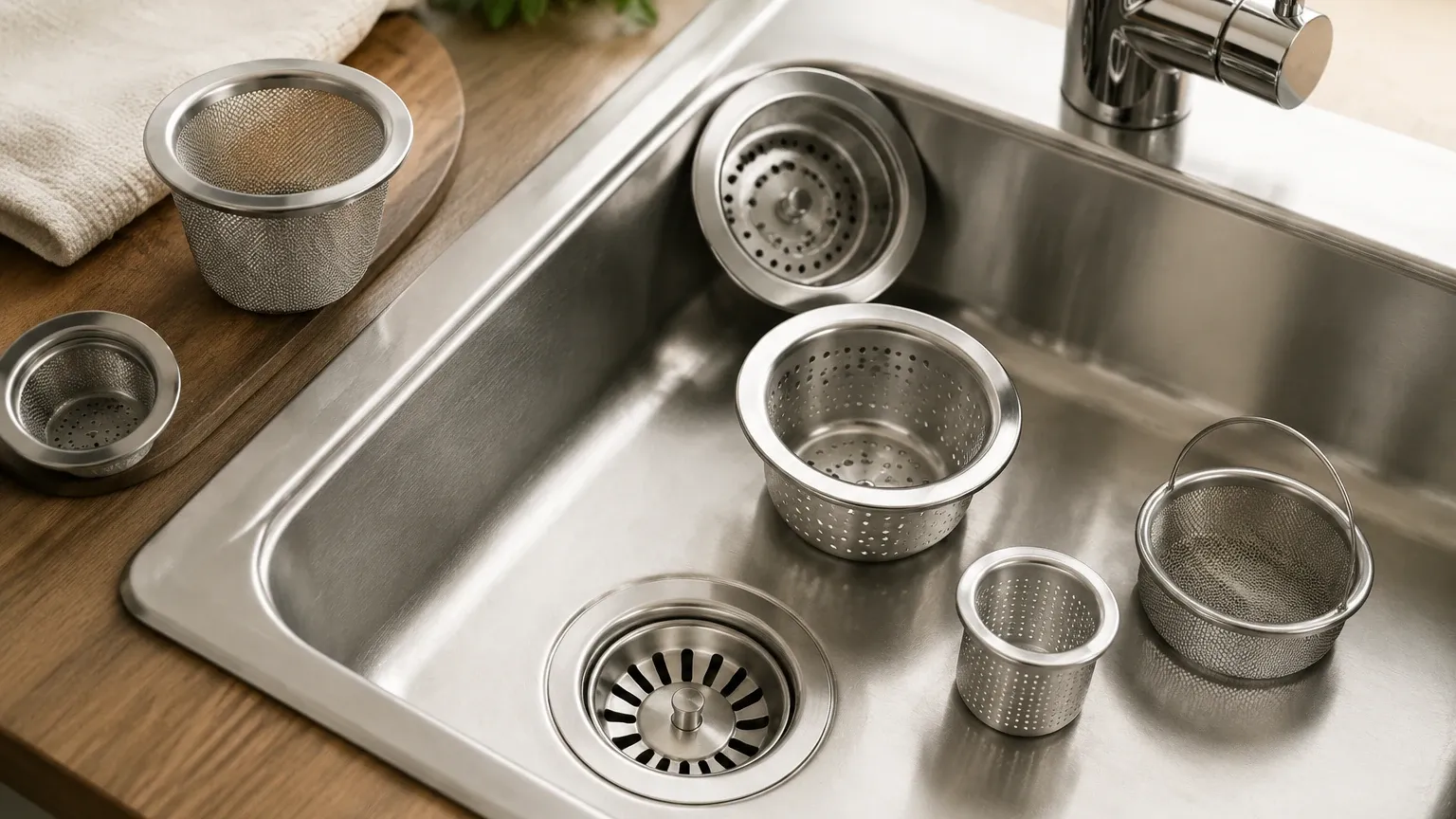
Customization: The Advantage of OEM Solutions
One of the primary reasons B2B buyers move away from searching for "kitchen sink strainers amazon" is the need for customization. Standard retail sizes (typically 3.5 inches for US sinks) do not account for the wide variety of custom-built industrial sinks and drainage troughs found in manufacturing plants.
OEM manufacturers like Kaifil provide the ability to customize every aspect of the strainer or basket, including:
* Dimensions: Custom diameters, depths, and flange widths to fit non-standard openings.
* Handle Configurations: Fixed, folding, or recessed handles for ease of removal in deep sinks.
* Multi-Stage Filtration: Baskets that incorporate multiple layers of mesh to capture different sizes of debris in a single pass.
* Reinforcement: Adding support ribs or double-bottoms for heavy-duty applications where the weight of the captured solids is significant.
Maintenance and Total Cost of Ownership
While a retail strainer might cost significantly less upfront than a custom industrial component, the total cost of ownership (TCO) often tells a different story. Low-quality strainers require frequent replacement due to corrosion or mechanical failure. More importantly, a failed strainer can lead to clogged pipes, which results in facility downtime and expensive emergency plumbing repairs.
Investing in high-quality Strainers & Baskets ensures that the filtration system remains operational for years. Stainless steel’s inherent longevity, combined with professional-grade fabrication, means these components can be refurbished or deep-cleaned repeatedly, maintaining their original performance levels.
Conclusion
For the casual consumer, the variety of kitchen sink strainers on Amazon provides a quick and easy solution for home maintenance. However, for the industrial professional, these products often represent a risk to operational continuity and hygiene standards. By focusing on material grade, engineering precision, and application-specific design, procurement teams can select filtration solutions that offer superior performance and long-term value.
When the requirements move beyond the standard, partnering with a specialized manufacturer ensures that the filtration components are not just accessories, but engineered assets that protect the facility's infrastructure. Whether you are managing a commercial kitchen, a chemical plant, or a food processing line, the right strainer is a critical link in your operational chain. For those seeking reliable, high-performance filtration components, it is essential to review product options and application support to find a solution that meets the rigorous demands of the professional environment.
