


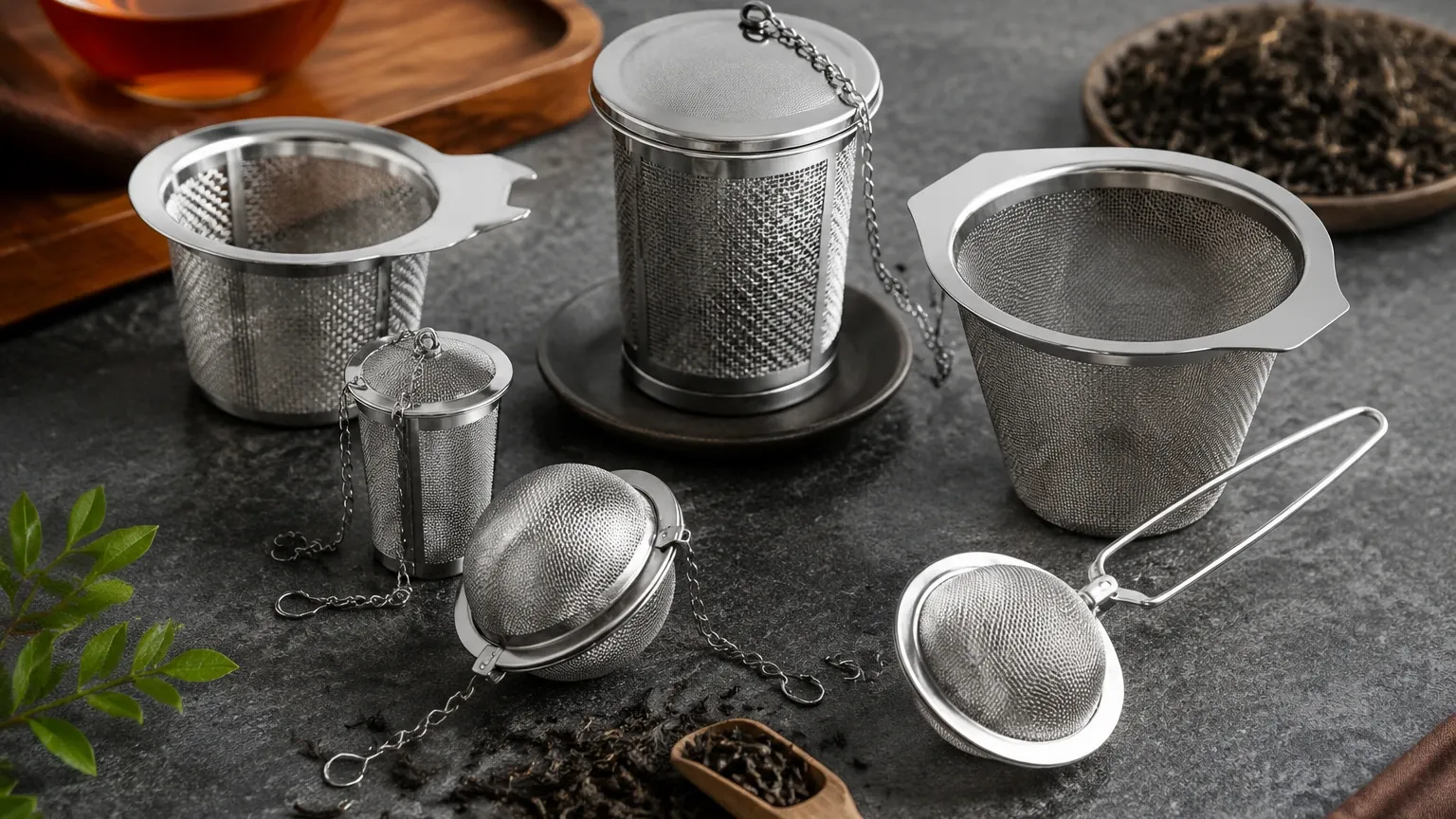
Loose Tea Strainers
In the industrial food and beverage sector, the extraction of flavor and bioactive compounds from botanicals requires high-precision equipment. While a consumer might view a tea strainer as a simple kitchen tool, engineers and production managers recognize loose tea strainers as critical filtration components that dictate the clarity, taste profile, and consistency of large-scale beverage production. For industrial brewing, botanical extraction, and commercial bottling lines, selecting the correct filtration media is essential to maintaining throughput while ensuring the final product is free of unwanted particulates.
Industrial filtration for tea involves more than just separating leaves from liquid. It requires an understanding of fluid dynamics, material science, and the specific morphology of the tea leaves being processed. Whether managing fine fannings or whole-leaf premium teas, the choice of Strainers & Baskets impacts the entire production cycle, from extraction efficiency to the frequency of maintenance shutdowns.
The Role of Precision Filtration in Commercial Tea Processing
Commercial tea production—ranging from ready-to-drink (RTD) bottled teas to large-scale concentrate manufacturing—relies on multistage filtration. Loose tea strainers serve as the primary or secondary barrier in these systems. Their primary function is to retain the tea solids after the infusion process, allowing the liquid extract to pass through for further refinement or packaging.
From an engineering perspective, the performance of these strainers is measured by three primary factors:
1. Filtration Accuracy: The ability to capture specific particle sizes (measured in microns or mesh count) without clogging.
2. Flow Rate: Maintaining a consistent volume of liquid passage to meet production targets.
3. Mechanical Strength: Withstanding the pressure differentials and temperatures inherent in industrial brewing environments.
In high-volume environments, a failure in any of these areas can lead to "turbidity" in the final product or, worse, downstream equipment damage if tea particles bypass the filter and enter sensitive pumps or valves.
Material Selection: Why Stainless Steel is the Standard
When specifying loose tea strainers for industrial use, material selection is the first critical decision. While plastic or low-grade metals might suffice for domestic use, industrial applications demand the durability and hygiene of stainless steel.
Stainless Steel 304 vs. 316L
Most industrial tea filtration components are manufactured from Grade 304 or 316L stainless steel.
* Grade 304: Offers excellent strength and general corrosion resistance. It is suitable for most standard tea brewing applications where the pH levels are relatively neutral.
* Grade 316L: Contains molybdenum, providing superior resistance to chlorides and organic acids. This is often the preferred choice for botanical extractions that involve more aggressive cleaning cycles (CIP) or for teas with higher acidity levels.
Stainless steel is non-reactive, ensuring that the delicate organoleptic properties of the tea—its aroma and flavor—are not compromised by metallic leaching. Furthermore, the smooth surface finish of stainless steel prevents the buildup of tannins and biofilms, which is essential for meeting food safety standards.
Engineering Considerations for Industrial Strainers & Baskets
In an industrial setting, the "strainer" is often part of a larger assembly, typically consisting of a housing and a removable basket. The design of these Strainers & Baskets must account for the physical behavior of tea leaves when saturated. Unlike sand or inorganic debris, tea leaves expand when wet and can form a dense "filter cake" that significantly increases pressure drop.
Structural Integrity
Industrial baskets must be reinforced to prevent collapsing under pressure. This is often achieved through a multi-layer design, where a fine filtration mesh is supported by a coarser, heavier-duty perforated metal backing. This ensures that the fine mesh maintains its shape and aperture size even when the basket is full of heavy, wet tea leaves.
Sealing and Bypass Prevention
A common point of failure in loose tea strainers is the bypass. If the strainer basket does not seat perfectly within its housing, liquid will take the path of least resistance, carrying solids around the filter rather than through it. Precision-engineered flanges and O-ring seals are necessary to ensure 100% of the fluid passes through the filtration media.
Micron Ratings and Mesh Sizes for Different Tea Varieties
The choice of mesh size for loose tea strainers depends entirely on the grade of tea being processed. Tea is categorized by leaf size, ranging from "Dust" and "Fannings" to "Broken Orange Pekoe" and "Full Leaf."
* Fine Fannings and Dust: These require high-density wire mesh, often in the range of 100 to 200 microns. If the mesh is too coarse, the resulting tea will be cloudy and have a gritty mouthfeel.
* Medium Broken Leaves: Typically filtered using 300 to 500-micron mesh. This allows for a higher flow rate while still capturing the majority of the solids.
* Whole Leaf Teas: Can be managed with coarser strainers or even perforated metal baskets with 1mm to 2mm apertures.
Engineers must balance the desire for "crystal clear" tea with the operational reality of "blinding." A mesh that is too fine will clog (blind) quickly, requiring frequent manual cleaning or backwashing, which reduces overall equipment effectiveness (OEE).
Design Features for Optimal Extraction and Flow Control
Beyond the mesh itself, the geometry of the loose tea strainers plays a role in how effectively the tea is brewed. In some extraction systems, the strainer basket is designed to allow for "agitation" or fluidization of the leaves.
Open Area Calculation
The "percentage of open area" is a vital metric. It refers to the total area of the holes divided by the total area of the sheet. A higher open area results in a lower pressure drop and higher flow rates but may compromise the structural strength of the basket. Custom-designed baskets allow engineers to optimize this ratio based on the specific pump head and flow requirements of the facility.
Conical vs. Flat Bottom Baskets
Conical baskets are often used in systems where the solids need to be concentrated at a single point for removal. Flat-bottom baskets provide a larger surface area for filtration, which is generally preferred for high-volume tea brewing to extend the time between cleaning cycles.
Maintenance, Cleaning, and Operational Longevity
In the food and beverage industry, Clean-in-Place (CIP) compatibility is a non-negotiable requirement for loose tea strainers. Tea tannins are notorious for staining and creating a sticky residue that can harbor bacteria if not properly removed.
Cleaning Protocols
Stainless steel strainers can withstand high-temperature caustic washes and acid rinses. For deep cleaning, ultrasonic cleaning is often used to remove fine particles trapped within the wire mesh weaves that standard CIP cycles might miss.
Replacement Cycles
While stainless steel strainers are durable, they are not infinite. The mesh can eventually suffer from "metal fatigue" due to repeated pressure pulses or mechanical cleaning. Regular inspection for wire shifting or broken welds is necessary to prevent catastrophic failure. Using high-quality, precision-welded Strainers & Baskets ensures a longer service life and more predictable replacement schedules.
Customization Options for OEM and Industrial Equipment
Every industrial tea processing line has unique constraints, from the footprint of the machinery to the specific viscosity of the extract. Off-the-shelf solutions rarely provide the optimal balance of flow and filtration.
Customization options for loose tea strainers include:
* Custom Dimensions: Tailoring the height and diameter of the basket to fit existing housings.
* Handle Designs: Ergonomic handles or lifting lugs for easy removal during manual cleaning.
* Reinforcement Bands: Adding structural rings to the basket to handle high-viscosity concentrates.
* Surface Treatments: Electropolishing to create an ultra-smooth surface that resists tannin buildup and improves cleanability.
For engineers and purchasing teams, the goal is to source filtration components that provide the lowest total cost of ownership. This is achieved by selecting strainers that are durable, easy to clean, and perfectly matched to the specific particle size distribution of the tea variety in use. By focusing on technical specifications and material quality, facilities can ensure consistent beverage quality and optimized production efficiency.
