


Line Strainers
In industrial fluid handling systems, the integrity of downstream equipment—such as pumps, flow meters, control valves, and heat exchangers—is paramount to operational efficiency and safety. Line strainers serve as the primary defense mechanism against particulate contamination, scale, and debris. By mechanically removing solids from flowing liquids or gases, these components prevent mechanical wear, clogging, and catastrophic system failure.
Selecting the appropriate line strainers requires a comprehensive understanding of fluid dynamics, material compatibility, and the specific filtration requirements of the process. For engineers and procurement teams, the decision-making process involves balancing initial capital expenditure with long-term maintenance costs and system uptime. As a specialized manufacturer of Strainers & Baskets, Kaifil provides the technical expertise necessary to navigate these complex engineering variables.
The Role and Function of Line Strainers
Line strainers are closed vessels with a cleanable screen or element designed to remove and retain foreign particles. Unlike disposable filters, which are often designed for fine filtration (sub-micron levels) and are replaced when clogged, strainers are typically used for coarser filtration and are designed to be cleaned and reused.
The primary function of line strainers is to protect expensive machinery. For example, in a hydraulic system, even small metal shavings can cause significant damage to precision-machined pump components. In chemical processing, pipe scale can interfere with the accurate reading of flow meters or obstruct the narrow passages in a plate heat exchanger. By installing a strainer upstream, operators ensure that only clean fluid reaches sensitive components.
Primary Configurations: Y-Type vs. Basket Strainers
Choosing between different configurations of line strainers depends largely on the installation environment, the expected debris load, and the allowable pressure drop.
Y-Strainers
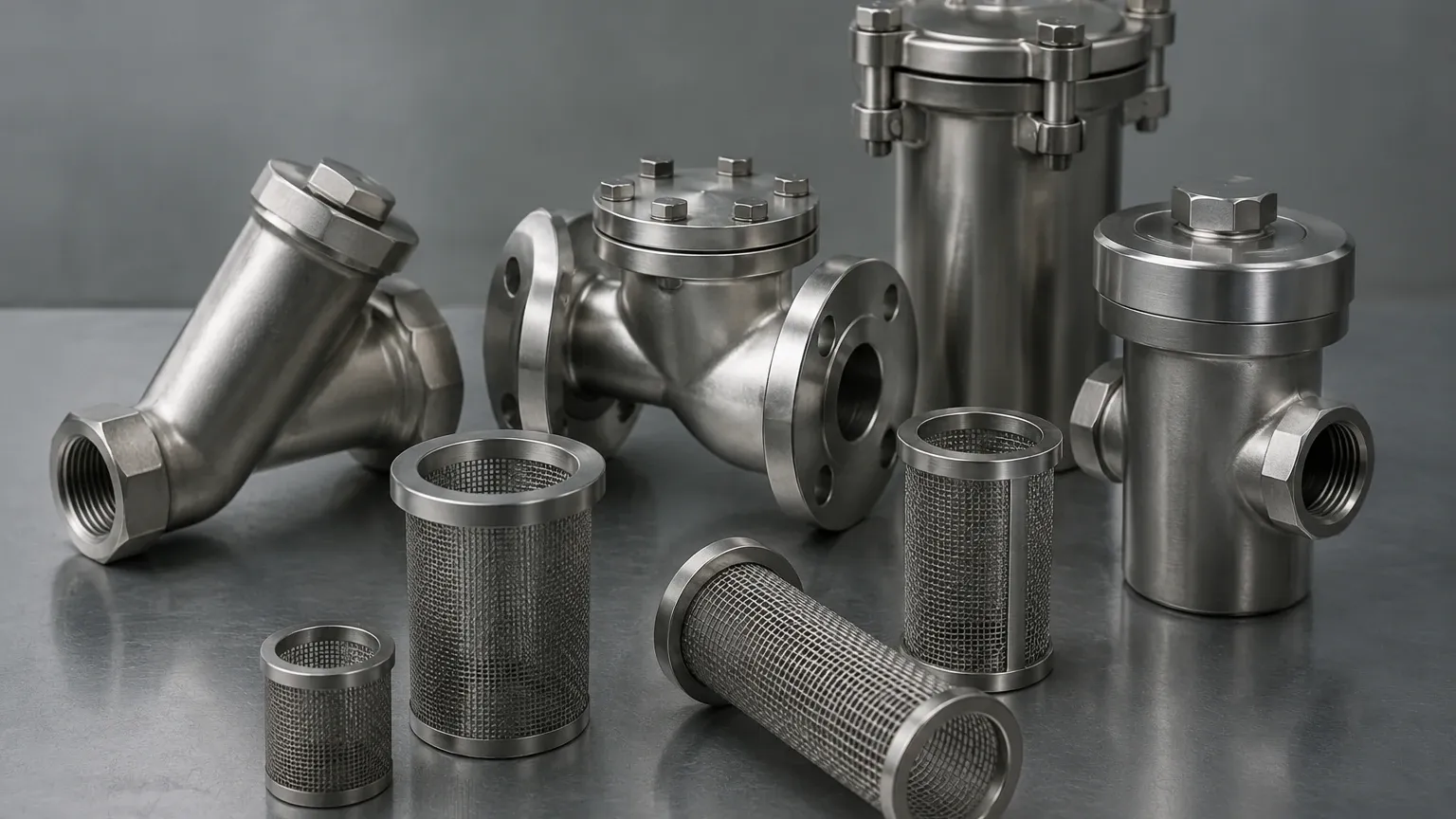
Named for their "Y" shape, these strainers are the most common choice for high-pressure applications and systems where the amount of material to be removed is relatively small. Their compact design allows for installation in both horizontal and vertical piping runs. In vertical installations, the "leg" of the Y must point downward to effectively trap debris using gravity. Y-strainers are often preferred in steam or gas lines because they can handle high velocities and pressures with minimal risk of housing failure.
Basket Strainers (Simplex and Duplex)
Basket strainers, or bucket strainers, feature a vertical cylinder that houses a removable basket-shaped element. These are typically used in horizontal lines and offer a much larger dirt-holding capacity than Y-strainers.
* Simplex Strainers: These are used in batch processes where the system can be shut down temporarily to clean the basket. They offer a lower pressure drop due to the larger surface area of the internal screen.
* Duplex Strainers: For continuous-flow applications that cannot be interrupted, duplex line strainers are essential. They consist of two separate strainer chambers connected by a diversion valve. When one side becomes clogged, the flow is diverted to the clean chamber, allowing the operator to clean the first basket without stopping the process.
Technical Evaluation Criteria for Selection
When specifying line strainers for an industrial application, engineers must evaluate several critical parameters to ensure the component performs reliably under varying operational conditions.
1. Pressure Drop (ΔP)
Every strainer introduces a restriction in the flow, resulting in a loss of pressure. The initial clean pressure drop must be calculated to ensure the system pump has sufficient head to maintain the required flow rate. Factors influencing ΔP include fluid viscosity, flow velocity, and the "open area ratio" of the strainer element. A common engineering rule of thumb is to select a strainer that provides an open area at least four times the cross-sectional area of the inlet pipe.
2. Filtration Accuracy (Mesh and Micron Rating)
Determining the correct hole size is a balance between protection and maintenance frequency. If the mesh is too coarse, harmful particles will pass through. If it is too fine, the strainer will clog rapidly, leading to frequent downtime for cleaning. Engineers must identify the largest particle size that the downstream equipment can safely tolerate and select a screen size slightly smaller than that value.
3. Material Compatibility
The housing and the internal element must be compatible with the process fluid and the external environment. Stainless steel (Grade 304 or 316L) is the industry standard for most demanding applications due to its excellent corrosion resistance and ability to withstand high temperatures. In pharmaceutical and food-grade applications, 316L stainless steel is often required to meet sanitary standards and resist pitting from cleaning agents.
4. Viscosity Considerations
High-viscosity fluids, such as heavy oils or resins, require larger strainers with coarser screens to prevent excessive pressure drops. As viscosity increases, the flow resistance through the mesh increases exponentially. In these cases, heating jackets may be integrated into the strainer housing to maintain fluid temperature and reduce viscosity during the filtration process.
Engineering Considerations: Mesh vs. Perforated Metal
The internal element of line strainers is typically constructed from either perforated metal or wire mesh, and often a combination of both.
* Perforated Metal: These are rigid sheets with punched holes. They are extremely durable and used for coarse straining (typically 1/32" to 1/4" holes). They serve as the "backup" or support structure for finer mesh screens.
* Wire Mesh: For finer filtration, woven wire mesh is used. It can achieve much smaller opening sizes (down to 5 microns). However, mesh is delicate. In high-pressure applications, the mesh is usually lined or pleated inside a perforated metal basket to provide structural integrity against the force of the flow.
Kaifil specializes in the precision manufacturing of these components, ensuring that the weld points and fitment within the housing prevent "bypass," where fluid escapes around the edges of the filter element without being strained.
Common Risks and Failure Modes
Failure to properly specify or maintain line strainers can lead to several operational risks:
* Element Collapse: If the differential pressure across the strainer exceeds the structural limits of the basket, the element may collapse. This not only allows all trapped debris to rush downstream but may also introduce metal fragments from the collapsed basket into the system.
* Erosion: High-velocity fluids carrying abrasive particles can erode the strainer housing over time, particularly at the points of impact. Regular ultrasonic thickness testing is recommended for strainers in abrasive service.
* Gasket Failure: Using incompatible gasket materials (e.g., using standard EPDM in a high-temperature hydrocarbon line) will lead to external leaks, which pose safety and environmental hazards.
Customization and OEM Solutions
Standard off-the-shelf line strainers may not meet the specific spatial or performance requirements of complex industrial skids. Customization is often necessary to optimize performance. Engineering teams should confirm the following with their manufacturer before production:
1. Connection Types: Whether the application requires flanged (ANSI, DIN, JIS), threaded (NPT, BSPT), or socket-weld connections.
2. Special Coatings: For highly corrosive environments, internal linings such as PTFE or specialized passivated finishes may be required.
3. Instrumentation Ports: The inclusion of NPT taps for pressure gauges or differential pressure sensors is critical for monitoring the state of the strainer element.
4. Custom Dimensions: In retrofit projects, the "face-to-face" dimensions of the strainer must match existing piping to avoid costly modifications.
As a manufacturer focused on custom stainless steel filtration, Kaifil works closely with global customers to develop high-performance components that meet these exact specifications. From material selection to filtration accuracy, our OEM capabilities ensure that the final product is tailored to the demanding environments of chemical processing, hydraulics, and water treatment.
Maintenance and Total Cost of Ownership (TCO)
The true cost of line strainers is not the purchase price, but the total cost of ownership over the life of the system. This includes the labor for cleaning, the cost of replacement gaskets, and the energy costs associated with the pressure drop.
Implementing a proactive maintenance schedule based on differential pressure (DP) readings is the most effective way to manage these costs. Installing DP gauges allows operators to see exactly when a basket needs cleaning, preventing unnecessary labor and avoiding the risk of element collapse. Furthermore, choosing high-quality stainless steel components reduces the frequency of replacement due to corrosion or mechanical wear, providing a better long-term return on investment.
Conclusion
Line strainers are indispensable for the protection of industrial infrastructure. By understanding the nuances of Y-type and basket configurations, the physics of pressure drop, and the importance of material science, engineers can select filtration solutions that enhance system reliability. Whether for standard water treatment or complex pharmaceutical processing, the right strainer ensures that the process remains clean, efficient, and safe.
For technical professionals seeking reliable, high-performance Strainers & Baskets, partnering with a manufacturer that understands both the engineering and the production of precision metal components is essential. Kaifil continues to support global industries by providing durable, customized filtration solutions designed for the most demanding applications.
