


Metal Mesh Air Filter: An Engineering Guide to Industrial Performance and Selection
In industrial environments, air filtration is not merely a matter of maintaining air quality for personnel; it is a critical requirement for protecting high-value machinery, ensuring the purity of chemical processes, and maintaining the efficiency of pneumatic systems. The metal mesh air filter represents a specialized class of filtration media designed to withstand conditions that would cause standard synthetic or paper filters to fail. From high-temperature exhaust streams to corrosive chemical vapors, these robust components provide a level of durability and cleanability essential for modern industrial operations.
For engineers and procurement professionals, selecting the correct filtration medium involves a complex trade-off between filtration efficiency, airflow resistance, and structural integrity. This guide explores the technical foundations of metal mesh filtration, with a specific focus on the application of Wire Mesh Filter Cylinders & Tubes in air and gas processing environments.
1. Fundamentals of Metal Mesh Air Filtration
Unlike disposable media that rely on a dense mat of disordered fibers, a metal mesh air filter utilizes a precision-woven structure of metallic wires. This construction allows for exact control over pore size and distribution, which is critical for achieving consistent performance across large-scale industrial installations.
Mechanisms of Particle Capture
The filtration process in metal mesh occurs through several primary physical mechanisms:
* Inertial Impingement: Larger particles traveling in the air stream have too much momentum to follow the fluid streamlines around the wire. They strike the wire directly and are captured, often aided by a light coating of oil in "viscous" filter applications.
* Interception: Smaller particles that follow the streamlines come within one particle radius of a wire and are trapped by the mesh surface.
* Diffusion: For sub-micron particles, Brownian motion causes them to deviate from streamlines and contact the mesh fibers. While less dominant in coarse metal mesh than in HEPA filters, multi-layered sintered mesh can effectively utilize this mechanism.
Surface vs. Depth Filtration
Single-layer wire mesh acts primarily as a surface filter, where particles larger than the mesh opening are blocked at the upstream face. However, in many industrial air applications, multiple layers of mesh are pleated or wrapped to create a depth filtration effect. This increases the "dust holding capacity" (DHC), allowing the filter to operate longer before the pressure drop reaches a critical threshold.
2. Structural Integrity: Wire Mesh Filter Cylinders & Tubes
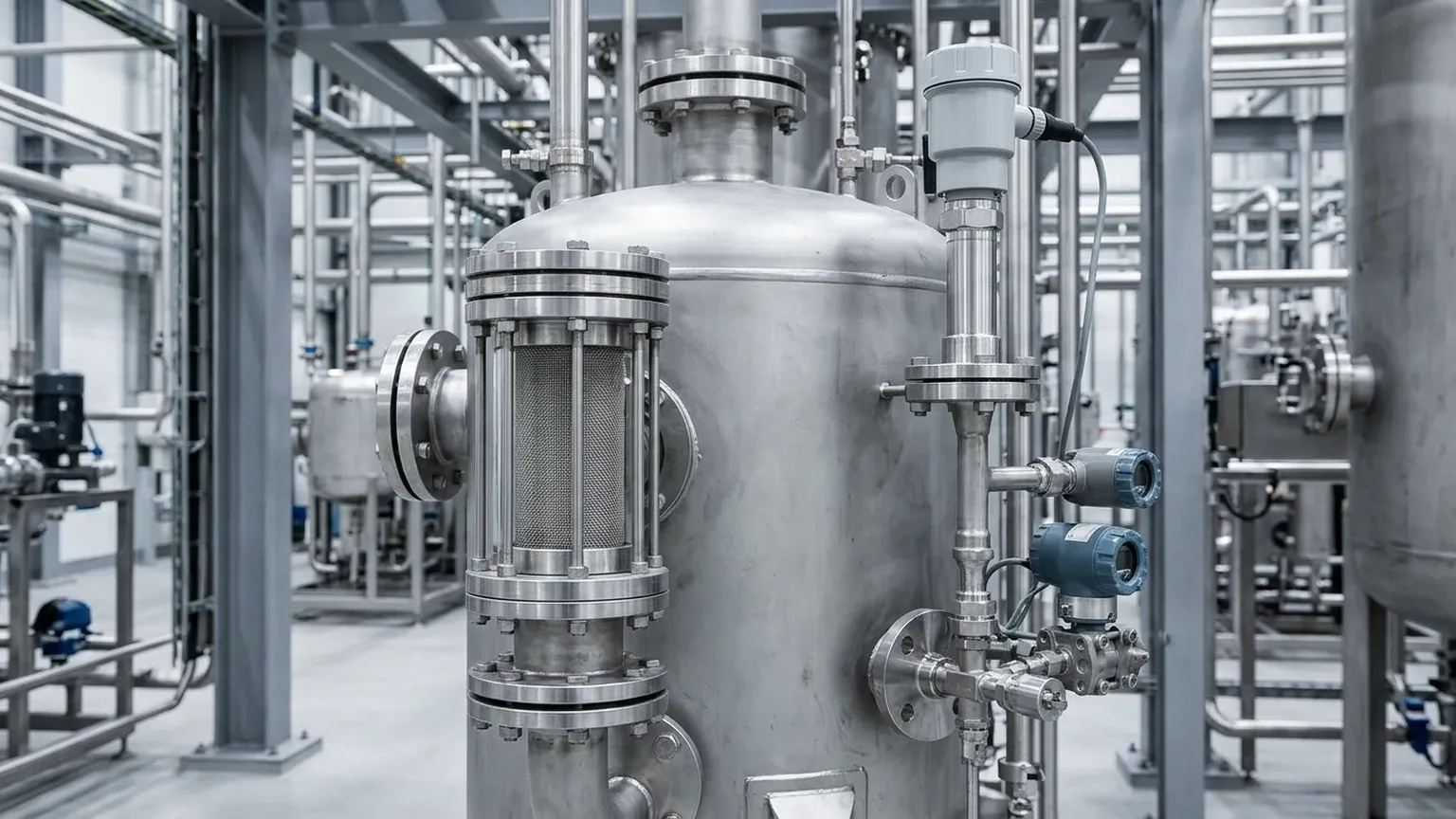
In many industrial air intake and exhaust systems, the geometry of the filter is as important as the material. Wire Mesh Filter Cylinders & Tubes are the preferred form factor for high-pressure and high-velocity air streams. The cylindrical shape inherently resists deformation under pressure better than flat panels, making them ideal for compressor intakes, turbine air inlets, and vacuum pump exhausts.
Engineering the Cylindrical Form
When designing a cylindrical metal mesh filter, several structural elements must be considered:
1. The Inner Support Core: For filters where airflow moves from the outside in (O-to-I), a perforated metal core or a heavy-duty wire cage is necessary to prevent the mesh from collapsing under the differential pressure.
2. The Filtration Layers: This may consist of a single layer of fine Dutch weave mesh or multiple layers of graduated density mesh to optimize particle capture.
3. End Caps and Sealing: Precision-engineered end caps—often TIG welded or bonded with high-temperature resins—ensure that no air bypasses the filtration media. Common configurations include open ends with gaskets or closed ends with threaded fittings for secure mounting.
3. Material Selection and Environmental Compatibility
The primary advantage of a metal mesh air filter over synthetic alternatives is its resilience in harsh environments. The choice of alloy determines the filter's lifespan and its resistance to specific industrial stressors.
Stainless Steel (304 and 316L)
Stainless steel is the industry standard for most B2B industrial applications. Grade 304 provides excellent strength and basic corrosion resistance suitable for general industrial air intake. However, in chemical processing plants or coastal environments where salt-laden air is present, Grade 316L is preferred. The addition of molybdenum in 316L provides superior resistance to pitting and chloride-induced corrosion.
Temperature Limits
While synthetic filters often degrade at temperatures exceeding 100°C (212°F), stainless steel mesh filters can operate continuously at temperatures up to 450°C (842°F), and even higher with specialized alloys like Inconel or Hastelloy. This makes them indispensable for hot gas filtration in smelting, glass manufacturing, and engine exhaust treatment.
4. Performance Metrics: Pressure Drop and Micron Rating
From an engineering perspective, the efficiency of a metal mesh air filter is defined by its ability to remove particles of a specific size while maintaining a low pressure drop ($ΔP$).
Understanding Micron Ratings
In air filtration, the micron rating can be "nominal" or "absolute."
* Nominal Rating: Indicates the ability of the mesh to retain the majority of particles at a given size (e.g., 90% of 20-micron particles).
* Absolute Rating: Refers to the diameter of the largest hard spherical particle that will pass through the filter under specified test conditions. For critical applications like protecting precision pneumatic valves, an absolute rating is required.
Managing Airflow Resistance
Pressure drop is the difference in total pressure between the upstream and downstream sides of the filter. A high initial pressure drop increases the energy consumption of fans and blowers. Engineers must balance the mesh density (the number of wires per inch) with the wire diameter. A finer mesh provides better filtration but increases resistance. Using pleated Wire Mesh Filter Cylinders & Tubes increases the available surface area within the same footprint, effectively lowering the face velocity and the resulting pressure drop.
5. Customization for OEM and Industrial Systems
Industrial filtration requirements are rarely "one size fits all." Customization is often necessary to integrate filtration components into existing equipment or to meet specific process parameters. As a manufacturer, Kaifil specializes in tailoring these components to meet rigorous engineering specifications.
Key Specification Parameters
When requesting a custom metal mesh air filter, engineers should be prepared to provide the following data:
* Flow Rate (CFM or m³/h): The volume of air the filter must handle.
* Operating Temperature: Both the steady-state and peak temperatures.
* Contaminant Characteristics: Are the particles abrasive, sticky, or chemically reactive?
* Allowable Pressure Drop: The maximum $ΔP$ the system can tolerate before maintenance is required.
* Mechanical Interface: Threaded connections, flange mounts, or friction fits.
By focusing on these parameters, Kaifil helps purchasing teams and engineers develop filtration solutions that optimize the total cost of ownership (TCO) rather than just the initial purchase price.
6. Maintenance, Cleaning, and Total Cost of Ownership
One of the strongest arguments for the adoption of metal mesh air filters in a B2B context is their cleanability. While the initial capital expenditure (CAPEX) for a stainless steel filter is higher than that of a disposable unit, the operational expenditure (OPEX) is significantly lower over the long term.
Cleaning Methodologies
Metal mesh filters can be restored to near-original pressure drop levels through several cleaning methods:
1. Backwashing/Backpulsing: Using compressed air or fluid sent in the reverse direction to dislodge accumulated dust.
2. Ultrasonic Cleaning: Using high-frequency sound waves in a solvent bath to remove fine particles trapped deep within the mesh layers.
3. Chemical Cleaning: Using mild acids or surfactants to dissolve scale or organic deposits, provided the chemical is compatible with the filter alloy.
4. Pressure Washing: Effective for removing coarse debris from the surface of robust mesh cylinders.
Sustainability and Waste Reduction
In the context of modern ESG (Environmental, Social, and Governance) goals, the use of permanent metal filters reduces the volume of industrial waste sent to landfills. A single stainless steel filter can replace hundreds of disposable cartridges over its service life, contributing to a more sustainable manufacturing process.
7. Application Focus: Where Metal Mesh Excels
While metal mesh air filters are versatile, they are particularly dominant in several key sectors:
* Power Generation: Protecting gas turbines from airborne particulates that can cause blade erosion.
* Food & Beverage Processing: Ensuring sterile air for tank venting and pneumatic conveying where plastic shedding from synthetic filters is a contamination risk.
* Hydraulic Systems: Acting as air breathers on hydraulic reservoirs to prevent atmospheric dust from entering the oil.
* Chemical Processing: Filtering aggressive vapors and hot gases where polymer-based media would melt or dissolve.
Conclusion
The selection of a metal mesh air filter is a strategic decision that impacts the reliability and efficiency of industrial systems. By understanding the nuances of mesh geometry, material properties, and the structural advantages of Wire Mesh Filter Cylinders & Tubes, engineers can specify solutions that withstand the most demanding environments.
Kaifil remains committed to providing the technical expertise and manufacturing precision required to meet these challenges. Whether you are designing a new system or looking to optimize an existing filtration process, focusing on durable, cleanable, and precisely engineered metal mesh components is the key to long-term operational success.
