


Raw Water Strainers
In industrial fluid management, the initial stage of treatment is often the most critical for the longevity of the entire system. Raw water strainers serve as the primary line of defense, removing large-scale contaminants from untreated water sources such as rivers, lakes, wells, or municipal supplies before the water reaches sensitive downstream equipment. For engineers and procurement professionals, selecting the correct strainer configuration is not merely a matter of sizing a pipe connection; it requires a deep understanding of fluid dynamics, material compatibility, and the specific debris profile of the source water.
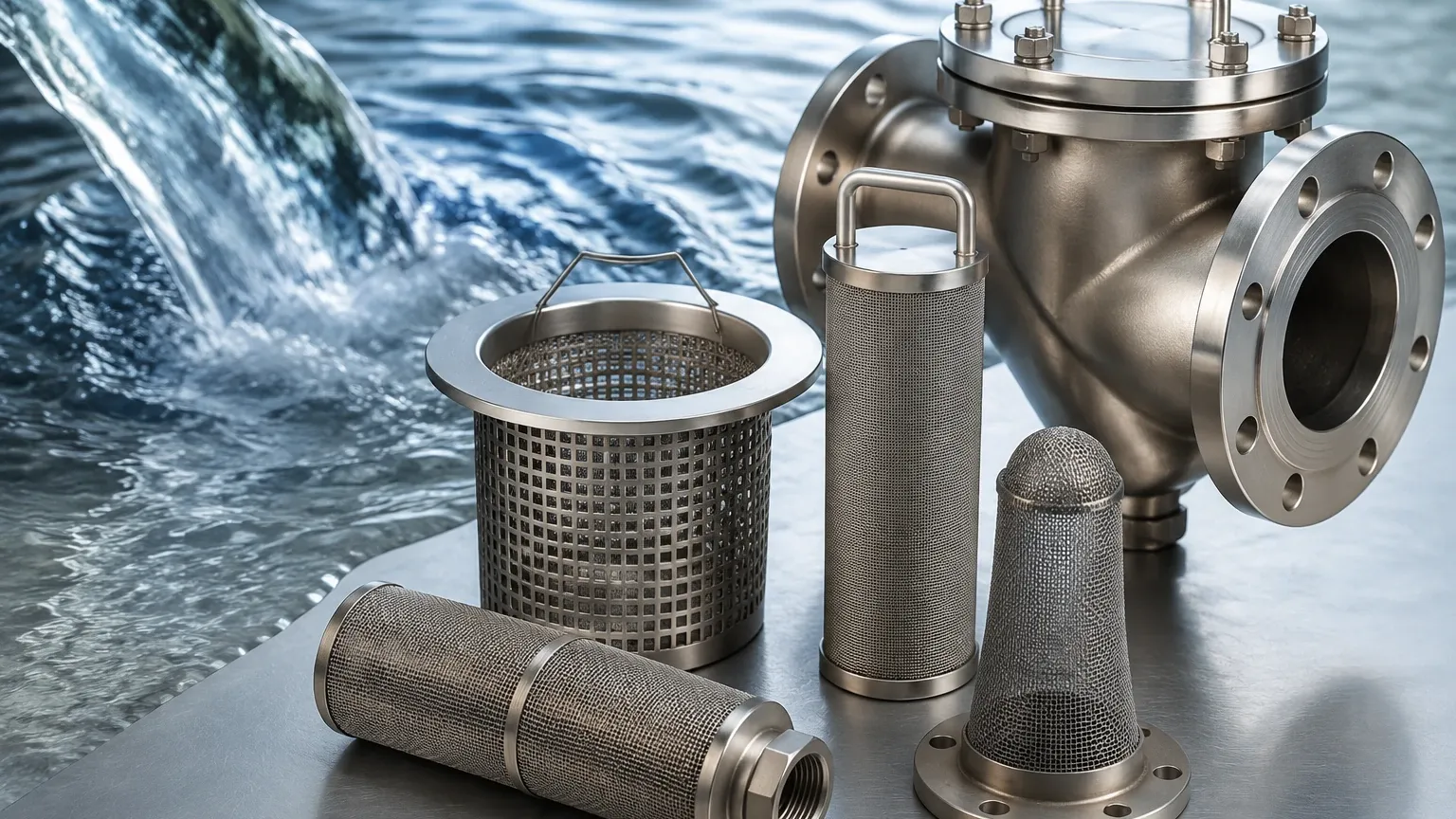
Industrial raw water often contains a diverse array of suspended solids, including sand, silt, organic matter, and aquatic debris. Without effective primary filtration, these contaminants can lead to catastrophic pump failure, clogged heat exchanger tubes, and premature fouling of fine filtration membranes. By implementing robust Strainers & Baskets, facilities can significantly reduce maintenance overhead and ensure process stability.
The Functional Role of Raw Water Strainers
Raw water strainers are mechanical devices designed to remove coarse solids from a flowing liquid. Unlike fine filters that may target sub-micron particles, strainers are typically used for "macro-filtration," focusing on particles ranging from 50 microns up to several millimeters.
In a typical industrial circuit, the raw water strainer is positioned at the intake or immediately following the raw water pump. Its primary functions include:
1. Equipment Protection: Preventing large debris from entering pumps, where it can cause cavitation or impeller damage.
2. Process Integrity: Ensuring that cooling water or process water does not carry solids that could settle in low-velocity areas of the piping network.
3. Pre-filtration: Reducing the load on secondary and tertiary filtration systems, such as sand filters or ultrafiltration (UF) units, thereby extending their backwash intervals and service life.
Engineering Considerations: Mesh, Micron, and Open Area
When specifying raw water strainers, engineers must balance filtration efficiency with hydraulic performance. The two most critical technical parameters are the filtration rating and the open area ratio.
Filtration Rating (Mesh vs. Micron)
In the context of stainless steel wire mesh filters, the filtration rating is often expressed in mesh count (the number of openings per linear inch) or microns (the actual size of the opening). For raw water applications, a 20 to 60 mesh screen is common for general protection, while finer applications may require 100 mesh or higher. It is essential to confirm the maximum particle size that downstream components can tolerate to determine the appropriate rating.
Open Area Ratio
The "Open Area Ratio" (OAR) is the ratio of the total area of the holes in the strainer element to the internal cross-sectional area of the inlet pipe. A high OAR (typically 4:1 or 6:1) is preferred for raw water intake. A higher ratio means the strainer can accumulate a significant amount of debris before the pressure drop becomes excessive, reducing the frequency of required cleaning cycles.
Pressure Drop ($ΔP$)
Every strainer introduces a degree of flow resistance. Engineers must calculate the clean pressure drop to ensure the system pump has sufficient head. As the strainer collects debris, the differential pressure increases. Industrial systems typically include differential pressure gauges to alert operators when the $ΔP$ reaches a threshold (often 5-10 psi), indicating that the basket requires cleaning.
Material Selection for Corrosive Environments
Raw water is rarely chemically neutral. Depending on the source, it may contain high levels of chlorides, dissolved oxygen, or biological agents that promote corrosion. Consequently, the material of the strainer body and the internal basket is a primary factor in the total cost of ownership.
Stainless Steel 304
Grade 304 stainless steel is the standard for many general-purpose industrial water applications. It offers excellent strength and good corrosion resistance at a competitive price point. However, it may be susceptible to pitting in high-chloride environments.
Stainless Steel 316 and 316L
For raw water sourced from brackish areas or water containing higher chemical concentrations, Type 316 stainless steel is the preferred choice. The addition of molybdenum enhances resistance to chloride-induced pitting. 316L (low carbon) is often specified for components that require extensive welding to prevent carbide precipitation and maintain corrosion resistance at the weld seams.
Specialized Alloys
In extreme cases, such as seawater intake for desalination or offshore platforms, even 316 stainless steel may prove insufficient. In these scenarios, manufacturers like Kaifil can provide custom solutions using duplex stainless steel or other high-nickel alloys to ensure long-term structural integrity.
Design Configurations: Simplex vs. Duplex
The choice between a simplex and a duplex strainer configuration depends entirely on the required uptime of the process.
Simplex Basket Strainers
A simplex strainer is used in systems where the flow can be intermittently stopped. When the basket is full, the system is shut down, the strainer housing is opened, and the basket is manually cleaned. This is a cost-effective solution for batch processes or systems with redundant parallel lines.
Duplex (Twin) Strainers
In continuous processes where downtime is not an option, duplex strainers are mandatory. A duplex system consists of two separate strainer chambers connected by a diversion valve. When one chamber becomes clogged, the flow is diverted to the clean chamber without interrupting the process. The dirty basket can then be serviced safely while the system remains pressurized and operational.
Customization and OEM Capabilities
Standard off-the-shelf strainers often fail to meet the specific spatial or performance requirements of complex industrial layouts. Customization is a core aspect of modern filtration engineering. As a professional manufacturer, Kaifil specializes in tailoring raw water strainers to meet precise technical specifications.
Customization options often include:
* Housing Dimensions: Adjusting the inlet/outlet orientation (e.g., offset or right-angle) to fit existing piping footprints.
* Reinforced Baskets: For high-pressure applications where the differential pressure might cause a standard mesh basket to collapse, internal support structures or perforated metal backings are added.
* Connection Types: Providing flanged (ANSI, DIN, JIS), NPT threaded, or socket weld connections based on regional standards and pressure ratings.
* Surface Finishes: Passivation or electropolishing for pharmaceutical or food-grade raw water applications to prevent bacterial growth.
Maintenance and Operational Longevity
The reliability of a raw water strainer is heavily dependent on its maintenance regime. Because raw water quality can fluctuate seasonally (e.g., increased silt during rainy seasons or algae blooms in summer), the strainer must be designed for ease of access.
Cleaning Procedures
Manual cleaning involves removing the basket and pressure-washing the mesh from the outside in to dislodge trapped particles. For heavy-duty applications, ultrasonic cleaning may be used to remove scale or biological films that have adhered to the stainless steel wires.
Replacement Cycles
While stainless steel baskets are designed for long-term use, they are considered wear parts. Erosion from high-velocity sand particles or mechanical stress from repeated pressure spikes can eventually fatigue the wire mesh. Facilities should maintain a stock of replacement baskets to prevent extended downtime. When selecting a manufacturer, confirming the availability of exact-fit replacement components is a critical step for procurement teams.
Identifying Requirements for Procurement
To ensure the delivery of an effective filtration solution, engineering teams should confirm the following data points before requesting a quote:
1. Flow Rate: Minimum, normal, and maximum flow (GPM or m³/h).
2. Operating Pressure and Temperature: To determine the required wall thickness and seal materials.
3. Nature of Contaminants: Is the debris organic, abrasive (sand), or fibrous?
4. Target Particle Size: What is the largest allowable particle that can pass through to the next stage?
5. Allowable Pressure Drop: What is the maximum $ΔP$ the system can tolerate when the strainer is clean?
Conclusion
Raw water strainers are a fundamental component of industrial water management, serving as the primary barrier against equipment damage and process inefficiency. By focusing on high-quality materials like 304 and 316 stainless steel and selecting the appropriate basket configuration, engineers can optimize system performance and minimize the total cost of ownership.
Whether the application involves chemical processing, power generation, or municipal water treatment, the integration of precision-engineered filtration components is essential. For organizations requiring specialized designs or OEM manufacturing, partnering with a manufacturer that understands the nuances of wire mesh and metal fabrication ensures that the resulting filtration system will meet the rigorous demands of industrial raw water intake.
