


Strainer Synonym
In the complex landscape of industrial fluid handling and filtration, terminology often overlaps, leading to potential confusion during the procurement and engineering design phases. While the term "strainer" is ubiquitous, technical professionals frequently seek a strainer synonym to better describe specific components or to align with international standards and regional engineering vernacular. Understanding these synonyms and the technical nuances they represent is critical for ensuring that the selected hardware meets the rigorous demands of industrial applications.
At its core, a strainer is a device used to remove unwanted solids from a liquid or gas stream via a perforated or wire mesh straining element. However, depending on the industry—whether it be chemical processing, food and beverage, or pharmaceutical—the terminology can shift significantly. This article explores the various terms used interchangeably with strainers, the technical distinctions between them, and how to select the appropriate Strainers & Baskets for high-performance systems.
Understanding the Strainer Synonym in Industrial Engineering
When engineers look for a strainer synonym, they are often searching for terms that define the scale, method, or placement of the filtration process. In many contexts, the word "filter" is used as a broad synonym, yet in strict engineering terms, there is a functional distinction based on the size of the particles being removed. Generally, if the particles are visible to the naked eye (typically larger than 40 microns), the device is classified as a strainer. If the particles are microscopic, it is classified as a filter.
Other common synonyms include:
* Sieve: Often used in laboratory settings or dry material processing, but occasionally applied to liquid strainers that utilize a specific mesh count to separate solids.
* Screen: This term usually refers to the internal component of the strainer, but in some industries, "pipe screen" or "line screen" is used to describe the entire assembly.
* Separator: While separators often use centrifugal force or gravity, mechanical separators that use mesh are functionally synonymous with high-capacity strainers.
* Purifier: Used more frequently in the food and beverage and pharmaceutical sectors to denote a strainer that ensures the purity of the end product.
By understanding these variations, purchasing teams can more effectively communicate with global manufacturers like Kaifil to ensure the technical specifications match the intended application.
Technical Distinctions: Strainers vs. Filters vs. Sieves
While a strainer synonym might help in a general conversation, engineering specifications require precise definitions. The distinction between a strainer and a filter is perhaps the most significant in B2B procurement.
The Role of the Strainer
A strainer is primarily designed to protect downstream equipment—such as pumps, valves, and flow meters—from damage caused by debris, scale, or weld slag. Because they are intended to handle a higher load of solids, they are designed for easy cleaning and low pressure drop. The straining medium is usually a robust stainless steel mesh or perforated plate.
The Role of the Filter
Filters are typically used to refine the fluid itself, removing much smaller contaminants to achieve a specific level of clarity or purity. Filters often utilize disposable media (like paper or fabric) or fine sintered metal, whereas strainers almost exclusively use reusable metal elements. In many industrial systems, a strainer is placed upstream of a filter to extend the life of the more expensive, finer filter media.
The Role of the Sieve or Screen
In the context of a strainer synonym, a sieve is defined by its ability to provide a precise "cut point" in particle size distribution. In industrial filtration, "screening" refers to the surface filtration process where particles larger than the mesh openings are trapped on the surface, while the fluid passes through. This is the fundamental mechanism used in most basket-style strainers.
Structural Variations in Strainers & Baskets
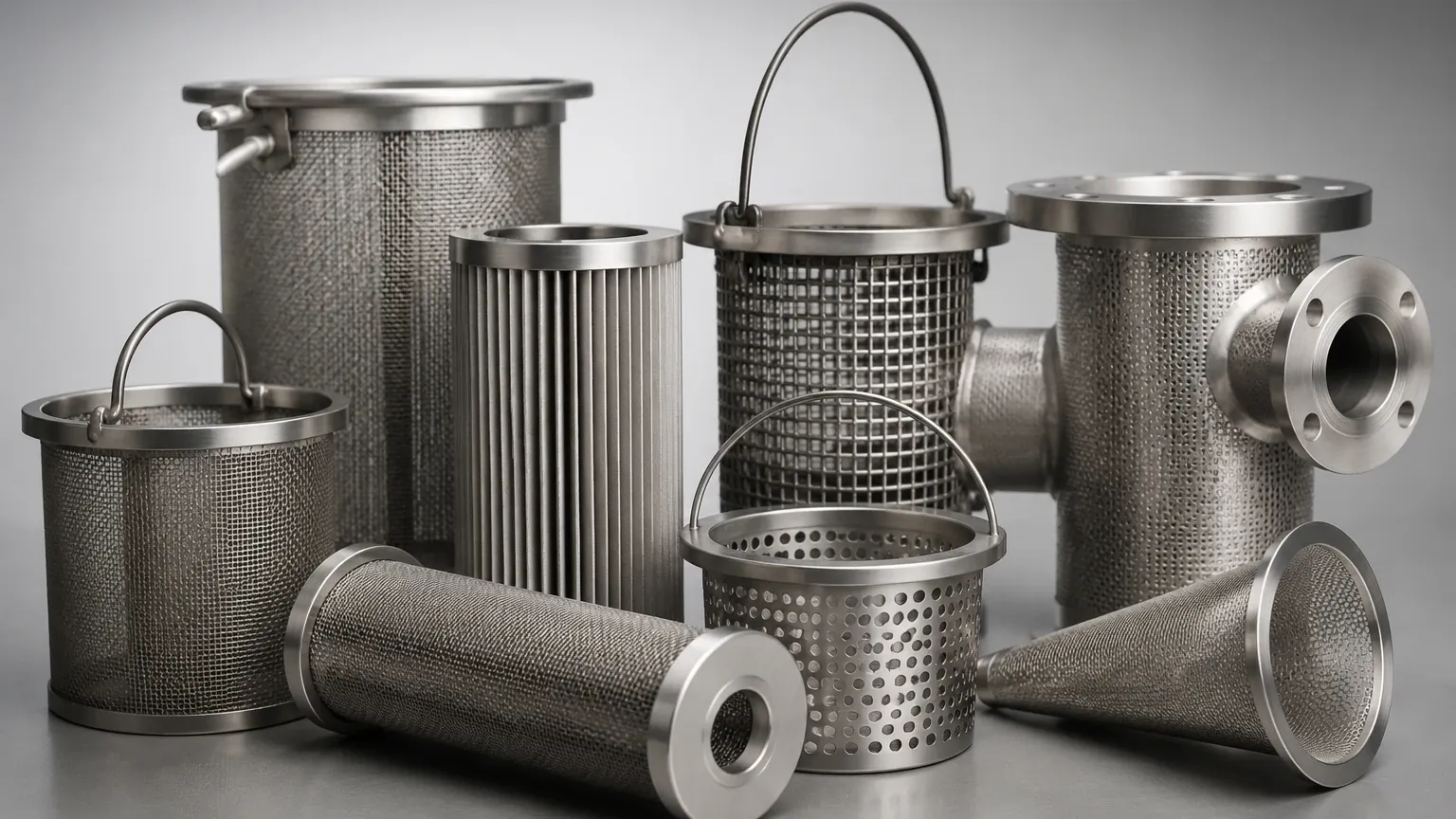
The physical design of the filtration component is often what dictates the terminology used. The most common configuration in heavy-duty industrial applications involves Strainers & Baskets. The "basket" refers to the removable, cup-shaped straining element that sits inside the housing.
Simplex and Duplex Designs
* Simplex Strainers: These are used in systems where the flow can be temporarily shut down to clean or replace the basket. They are common in batch processing applications.
* Duplex Strainers: Also known as twin strainers, these consist of two separate strainer housings connected by a diverting valve. This allow for continuous operation; while one basket is being cleaned, the fluid is diverted to the other. In this context, "dual filter" is a common strainer synonym.
Y-Strainers vs. Basket Strainers
Y-strainers are named for their shape and are typically used for gases or liquids where the amount of debris is relatively low. They are more compact but have a smaller holding capacity than basket strainers. Basket strainers, by contrast, offer a much larger surface area and are preferred for liquid applications with higher solids loading, as they can hold more debris before requiring a cleaning cycle.
Engineering Criteria: Micron Rating and Mesh Selection
Choosing the right strainer synonym or component requires a deep dive into technical specifications. The most critical factor is the filtration accuracy, usually measured in mesh size or microns.
Mesh Count
Mesh count refers to the number of openings per linear inch. A higher mesh count indicates smaller openings. For example, a 20-mesh screen has larger openings than a 100-mesh screen. Engineers must balance the need for fine filtration with the reality of pressure drop.
Micron Rating
Microns (micrometers) provide a more precise measurement of the opening size. One micron is one-millionth of a meter. When specifying a basket for an industrial strainer, engineers must determine if they need a "nominal" rating (where a percentage of particles of a certain size are trapped) or an "absolute" rating (where 100% of particles above a certain size are trapped).
Open Area Ratio (OAR)
One often overlooked engineering metric is the Open Area Ratio. This is the ratio of the total area of the holes in the mesh to the total area of the pipe's cross-section. A high OAR (typically 4:1 or higher) ensures that the strainer does not significantly impede the flow of the fluid, even as the basket begins to fill with debris.
Material Science in High-Performance Filtration
In industrial environments, the material of the strainer is just as important as the design. Stainless steel is the industry standard due to its durability and resistance to corrosion. As a specialist manufacturer, Kaifil focuses on high-grade alloys to meet different environmental challenges.
* 304 Stainless Steel: The most common grade, offering good corrosion resistance and excellent value for water treatment and general industrial use.
* 316/316L Stainless Steel: Contains molybdenum, which provides superior resistance to chlorides and acids. This is the preferred material for chemical processing and marine environments.
* Specialty Alloys: For highly aggressive environments, materials like Monel or Hastelloy may be used, though stainless steel remains the most versatile for the majority of Strainers & Baskets.
Durability is also enhanced through the construction method. For instance, reinforced baskets with a perforated metal backup can withstand higher differential pressures without collapsing, a critical consideration in hydraulic and high-pressure chemical lines.
Customization and OEM Integration for Industrial Systems
Because every industrial system has unique flow rates, pressure requirements, and space constraints, a "one-size-fits-all" approach rarely works. This is where the value of a professional manufacturer becomes apparent. Customization allows engineers to adapt the strainer synonym—the hardware—to fit existing infrastructure perfectly.
OEM (Original Equipment Manufacturer) services allow for the development of bespoke filtration components. This includes:
* Custom Dimensions: Tailoring the height, diameter, and flange connections of the basket to fit proprietary housings.
* Layered Media: Combining different mesh sizes or adding a layer of sintered metal to achieve specific filtration profiles.
* Structural Reinforcement: Adding handles, support rings, or heavy-duty frames to ensure the basket can be easily handled during maintenance and can withstand the mechanical stresses of the system.
By working closely with a manufacturer that understands these engineering nuances, purchasing teams can reduce the total cost of ownership by acquiring components that are optimized for their specific process, rather than settling for generic off-the-shelf parts.
Operational Maintenance and Total Cost of Ownership
When evaluating a strainer synonym or selecting a new filtration system, the initial purchase price is only one part of the equation. The total cost of ownership (TCO) includes maintenance labor, downtime, and the cost of replacement parts.
Cleaning Cycles
Industrial strainers are designed to be cleaned and reused. The frequency of cleaning is determined by the differential pressure (ΔP) across the strainer. As the basket fills with debris, the ΔP increases. Most systems are designed with gauges to alert operators when the pressure drop reaches a critical point, indicating that the basket needs to be cleaned.
Durability and Replacement
A high-quality stainless steel basket should last for years if maintained properly. However, improper cleaning techniques (such as using high-pressure water that deforms the mesh) or operating beyond the design pressure can lead to failure. Selecting robustly constructed Strainers & Baskets reduces the frequency of replacements and prevents the risk of debris bypassing a damaged screen and harming downstream equipment.
Ease of Access
For systems with high solids loading, the ease of access to the basket is paramount. Features like quick-opening covers and ergonomic basket handles can significantly reduce the time required for maintenance, thereby increasing the overall efficiency of the industrial process.
Conclusion: Selecting the Right Filtration Partner
Whether you refer to it as a filter, a sieve, a screen, or use another strainer synonym, the fundamental goal remains the same: protecting your industrial equipment and ensuring the integrity of your fluid stream. For engineers and procurement professionals, the key is to look beyond the terminology and focus on the technical specifications—material grade, micron rating, flow capacity, and structural integrity.
Kaifil provides the technical expertise and manufacturing precision required to deliver high-performance filtration solutions. By specializing in custom stainless steel components, Kaifil ensures that every strainer and basket is engineered to meet the specific demands of the application, from chemical processing to food production. When performance and reliability are non-negotiable, selecting the right manufacturer is the most important step in the filtration process.
