


Stainless Steel Strainers
In industrial fluid handling systems, the protection of downstream equipment—such as pumps, valves, flow meters, and heat exchangers—is a critical engineering priority. Stainless steel strainers serve as the primary line of defense, utilizing a mechanical removal process to capture solid contaminants from liquid or gas streams. Unlike fine filtration systems designed for sub-micron particle removal, strainers are typically used for coarser separation, ensuring that debris does not cause mechanical wear, clogging, or catastrophic failure in high-value components.
Selecting the appropriate configuration for Strainers & Baskets requires a deep understanding of fluid dynamics, material science, and the specific operational parameters of the application. As a professional manufacturer, Kaifil emphasizes that the efficacy of a strainer is not merely determined by its mesh size, but by its structural integrity, chemical compatibility, and ease of maintenance within a specific industrial workflow.
Engineering Fundamentals of Industrial Strainers
At its core, a strainer is a pressure-vessel component containing a removable screen or basket. The fluid enters the inlet, passes through the straining element, and exits the outlet, leaving solids trapped within the element. While the concept is simple, the engineering behind the flow path is complex.
Y-Strainers vs. Basket Strainers
The two most common configurations for stainless steel strainers are Y-type and Basket-type.
* Y-Strainers: These are characterized by their "Y" shape and are typically used in high-pressure applications where the amount of debris to be removed is relatively small. They are compact and can be installed in either horizontal or vertical piping. However, their dirt-holding capacity is limited compared to basket designs.
* Basket Strainers: These feature a larger, vertical chamber that houses a basket-shaped element. They offer a significantly higher dirt-holding capacity and a lower pressure drop. Because the basket is serviced from the top, they are generally easier to clean, making them ideal for high-flow systems or applications with high solids loading.
Material Selection and Chemical Compatibility
The choice of stainless steel grade is perhaps the most significant factor in determining the service life and safety of a strainer. While various alloys exist, the industrial standard typically focuses on the 300-series austenitic stainless steels.
Grade 304 Stainless Steel
SS304 is the most common grade used for general-purpose industrial strainers. It provides excellent resistance to atmospheric corrosion and is suitable for most water treatment and food-grade applications. However, it is susceptible to chloride-induced pitting and stress corrosion cracking in highly saline or acidic environments.
Grade 316 and 316L Stainless Steel
For more demanding environments, such as chemical processing or marine applications, SS316 is the preferred choice. The addition of molybdenum (2-3%) significantly enhances its resistance to chlorides and acetic acids. SS316L (low carbon) is often specified for components requiring welding, as it minimizes carbide precipitation that can lead to intergranular corrosion at the weld sites.
Surface Finishes and Coatings
In the pharmaceutical and food and beverage industries, the internal surface finish of the strainer is critical. Electropolishing or high-grit mechanical polishing is used to reduce surface roughness, preventing bacterial growth and ensuring that the strainer meets stringent sanitary standards.
Performance Evaluation: Sizing and Pressure Drop
An undersized strainer is a common point of failure in industrial design. Engineers must balance the need for fine particle removal with the requirement for maintaining system pressure.
The Open Area Ratio (OAR)
The Open Area Ratio is the relationship between the total area of the holes in the strainer element and the cross-sectional area of the inlet pipe. A common industry benchmark is an OAR of 4:1 or 6:1. A higher OAR ensures that even as the strainer begins to clog, the pressure drop remains within acceptable limits, extending the interval between cleaning cycles.
Calculating Pressure Drop ($ΔP$)
Every strainer introduces a degree of resistance to flow. This resistance, or pressure drop, increases as the mesh becomes finer or as the element accumulates debris. If the $ΔP$ exceeds the system's design limits, it can lead to cavitation in pumps or reduced flow rates downstream. Engineers should always consult flow coefficient ($Cv$) charts provided by the manufacturer to predict the initial pressure drop across a clean strainer at a given flow rate.
Customization and Design Considerations
Standard off-the-shelf strainers often fail to meet the specific nuances of specialized industrial processes. Customization allows engineers to optimize the strainer for specific mechanical and chemical stressors.
Element Construction: Mesh vs. Perforated Plate
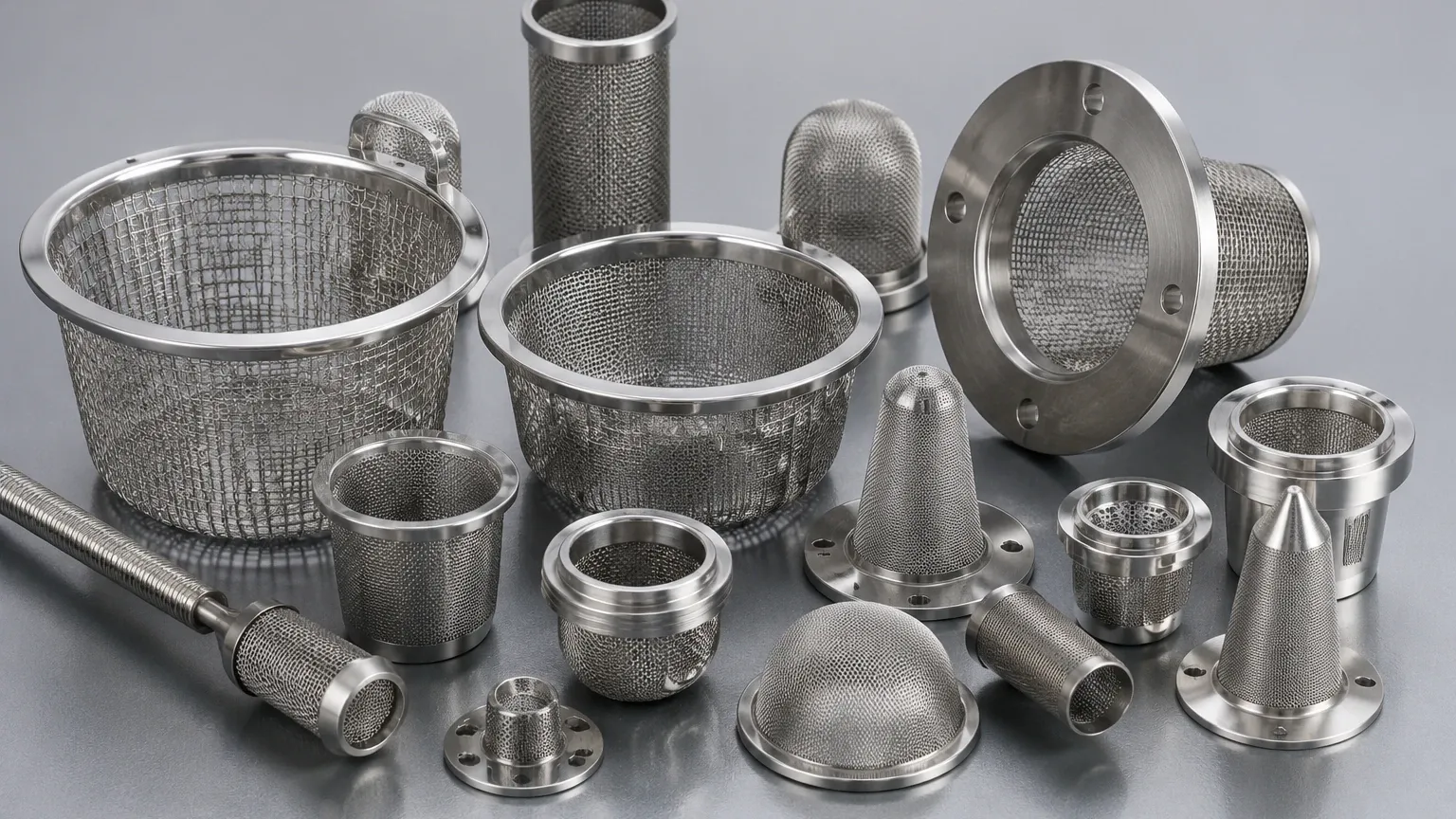
Straining elements are usually constructed from perforated metal or wire mesh. For heavy-duty applications, a perforated metal plate provides the necessary structural strength. If finer filtration is required, a wire mesh lining is added to the interior of the perforated basket. The choice of weave—such as plain weave, twilled weave, or Dutch weave—impacts the flow characteristics and the ease with which the element can be backwashed or manually cleaned.
Connection Types and Standards
Depending on the piping system, stainless steel strainers can be configured with various connection types:
* Flanged: Ideal for high-pressure and large-diameter pipes, allowing for easy removal of the entire unit.
* Threaded (NPT/BSPT): Common in smaller piping systems (under 2 inches) where simplicity is preferred.
* Socket Weld: Used in high-pressure steam or chemical lines where a permanent, leak-proof joint is required.
* Sanitary Tri-Clamp: The standard for food, beverage, and pharmaceutical industries, designed for rapid disassembly and cleaning.
Maintenance, Cleaning, and Replacement Cycles
The total cost of ownership (TCO) for a strainer is heavily influenced by its maintenance requirements. A strainer that is difficult to clean or prone to damage during servicing will result in higher labor costs and increased downtime.
Monitoring Differential Pressure
The most effective way to manage strainer maintenance is through the installation of differential pressure gauges. By monitoring the pressure difference between the inlet and outlet, operators can identify the exact moment the strainer requires cleaning. Cleaning a strainer prematurely wastes labor, while waiting too long can result in element collapse or system bypass.
Cleaning Procedures
Stainless steel elements are valued for their ability to be cleaned and reused. Depending on the contaminant, cleaning may involve:
1. Manual Washing: Using high-pressure water or air to dislodge particles.
2. Ultrasonic Cleaning: Effective for removing fine particles trapped within complex wire mesh weaves.
3. Chemical Soaking: Used when the debris consists of scale, oils, or organic matter that cannot be mechanically removed.
Replacement Indicators
While stainless steel is durable, elements eventually fatigue. Signs that a basket or screen requires replacement include distorted mesh, broken welds, or visible thinning of the metal due to erosion or corrosion. Using damaged elements risks "bypass," where contaminants flow through gaps in the strainer, defeating its purpose.
Industry-Specific Applications
Chemical and Petrochemical Processing
In these sectors, strainers must withstand aggressive solvents and high temperatures. Heavy-wall Strainers & Baskets are often required to handle the high viscosity of certain chemical intermediate products.
Food and Beverage Production
Strainers in this industry must be designed with "no-dead-leg" geometries to prevent product stagnation. Stainless steel 316L is standard to resist the corrosive effects of cleaning-in-place (CIP) chemicals like caustic soda and nitric acid.
Hydraulic and Lube Oil Systems
Precision hydraulic components are extremely sensitive to particulate matter. Stainless steel strainers are used in the suction lines of pumps to prevent large particles from entering the hydraulic circuit, where they could cause internal scoring of cylinders and valves.
Conclusion: Selecting the Right Partner
Selecting the right stainless steel strainers involves more than matching a pipe size. It requires a comprehensive evaluation of flow rates, particle size distribution, chemical environment, and maintenance capabilities. For engineers and purchasing teams, the goal is to find a balance between initial capital expenditure and long-term operational reliability.
Kaifil provides the technical expertise and manufacturing flexibility required to produce high-performance filtration components. By focusing on precision engineering and high-quality materials, Kaifil ensures that every strainer and basket meets the rigorous demands of modern industrial applications. When specifying your next filtration solution, confirming the exact material grade, pressure ratings, and open area ratios will ensure a system that operates efficiently with minimal intervention.
