


Strainer Upvc
In industrial fluid handling systems, the protection of sensitive downstream equipment—such as pumps, flow meters, and spray nozzles—is a critical engineering priority. While stainless steel and exotic alloys are often the default choice for high-pressure or high-temperature environments, the strainer upvc (Unplasticized Polyvinyl Chloride) serves as a specialized solution for applications where chemical inertness and corrosion resistance are more critical than thermal or mechanical extremes.
Understanding the technical nuances of UPVC as a material for Strainers & Baskets allows engineers to optimize system longevity while managing total cost of ownership. This guide examines the engineering properties, selection criteria, and operational considerations for integrating UPVC filtration components into industrial piping systems.
Engineering Properties of UPVC in Filtration
UPVC is a rigid, unplasticized version of polyvinyl chloride. Unlike plasticized PVC used in flexible tubing, UPVC is engineered for structural integrity and chemical resistance. In the context of industrial filtration, several specific properties define its utility:
Chemical Inertness
One of the primary reasons for selecting a strainer upvc over a metallic counterpart is its immunity to electrochemical corrosion. Unlike stainless steel, which can suffer from pitting or crevice corrosion in high-chloride environments (such as seawater or brine), UPVC remains unaffected. It is highly resistant to a broad spectrum of acids, alkalis, and salt solutions. This makes it the standard choice for chemical processing lines where metallic contamination must be avoided.
Temperature and Pressure Limitations
Engineers must account for the thermoplastic nature of UPVC. Its mechanical strength is temperature-dependent. Most industrial UPVC strainers are rated for a maximum operating temperature of approximately 60°C (140°F). As the temperature of the fluid increases, the pressure-bearing capacity of the strainer body decreases. It is essential to consult pressure-temperature de-rating charts during the design phase to ensure the component remains within its safe operating envelope.
Surface Smoothness and Flow Efficiency
UPVC possesses a low friction coefficient. The smooth internal bore of a UPVC strainer body reduces turbulence and minimizes pressure drop (head loss) compared to cast metal strainers with rougher internal surfaces. This efficiency can contribute to lower energy requirements for pumping systems over the long term.
Design Variations: Y-Strainers vs. Basket Strainers
When specifying a strainer upvc, the choice usually falls between two primary configurations: the Y-strainer and the basket (or Simplex) strainer. Each serves a distinct operational profile.
UPVC Y-Strainers
The Y-strainer is characterized by its compact, cylindrical design where the filter element is housed in a leg that branches off the main flow path at an angle.
- Application: Best suited for systems with low concentrations of solids or where space is at a premium.
- Installation: Can be installed horizontally or vertically (with downward flow), providing flexibility in tight piping layouts.
- Maintenance: Requires the system to be depressurized and the cap removed to clean the screen. Because the holding capacity is smaller than a basket strainer, it is typically used for "polishing" or protecting equipment from occasional debris.
UPVC Basket Strainers
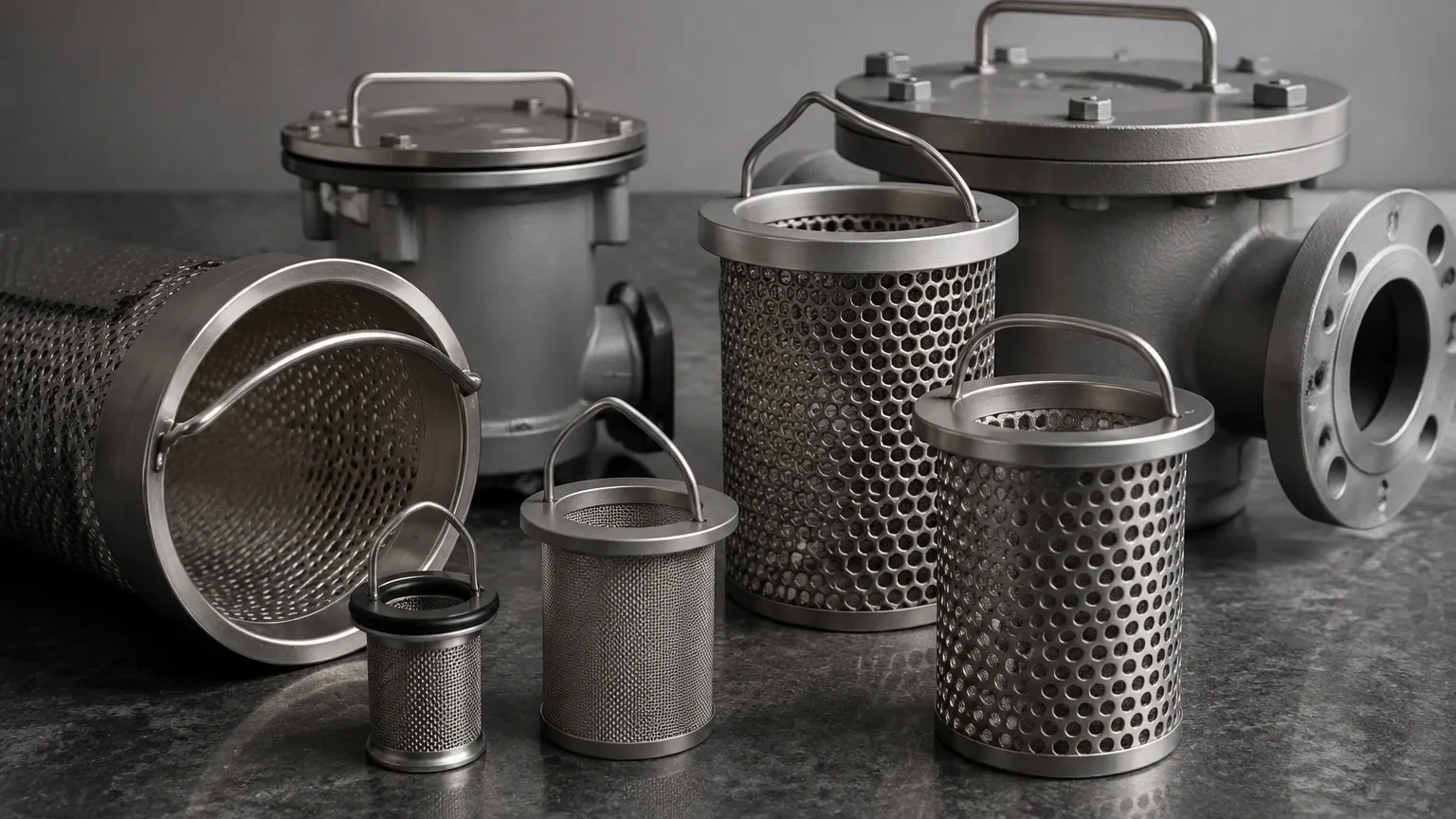
Basket strainers feature a larger, vertical chamber that houses a removable basket-shaped filter element.
- Application: Designed for high-flow systems or applications with a higher solids load. The larger surface area of the basket allows for longer intervals between cleanings.
- Maintenance: The top-entry design allows for easier access to the internal basket. In many industrial UPVC designs, the cover is secured by a hand-removable union nut or a bolted flange, facilitating tool-free maintenance.
- Performance: Due to the larger internal volume, basket strainers typically exhibit a lower pressure drop than Y-strainers of the same pipe size.
Technical Selection Criteria for Engineers
Selecting the correct strainer upvc requires more than matching the pipe diameter. Technical professionals must evaluate several variables to ensure the component meets the application's performance expectations.
Micron Rating and Mesh Selection
The internal screen or basket is the heart of the strainer. While the body is UPVC, the filter element can be made of UPVC, PP (polypropylene), or stainless steel mesh.
- Mesh Size: Refers to the number of openings per linear inch.
- Micron Rating: Refers to the physical size of the particles that will be trapped.
Engineers must balance the need for fine filtration with the risk of rapid clogging. A screen that is too fine will cause an immediate and significant pressure drop, potentially leading to pump cavitation or system failure.
Seal Compatibility
Every strainer upvc relies on elastomeric seals (O-rings) to prevent leaks at the cap or union. The most common materials are EPDM and FPM (Viton).
- EPDM: Excellent for water, steam, and many dilute acids, but unsuitable for oils or petroleum-based fluids.
- FPM (Viton): Offers superior resistance to oils, chemicals, and higher temperatures, though at a higher cost.
Verifying the compatibility of the seal material with the process fluid is as important as the body material itself.
Connection Types
Industrial UPVC strainers are typically available with three types of connections:
1. Socket Fusion: The pipe is solvent-welded into the strainer ports, creating a permanent, leak-proof bond.
2. Threaded (NPT/BSPT): Allows for easy installation and removal but requires careful sealing with PTFE tape or specialized compounds.
3. Flanged: The preferred choice for larger pipe sizes (typically 2" and above) and systems that require frequent disassembly for maintenance.
Installation and Maintenance Guidelines
To ensure the reliability of a strainer upvc, specific installation and maintenance protocols must be followed. Plastic components do not behave like metal, and improper handling can lead to premature failure.
Avoiding Mechanical Stress
UPVC is a brittle material compared to ductile iron or stainless steel. Piping systems must be properly supported to ensure that the weight of the pipe and the fluid is not supported by the strainer body. Misalignment of the piping can introduce bending moments that cause the UPVC housing to crack over time.
Water Hammer and Pressure Surges
Thermoplastic systems are particularly sensitive to water hammer—a pressure surge caused by the rapid stopping or starting of fluid flow. Engineers should incorporate slow-closing valves or surge suppressors to protect the strainer upvc from these high-pressure spikes, which can exceed the material's burst pressure.
Cleaning Cycles
Monitoring the pressure differential ($ΔP$) across the strainer is the most effective way to determine when the internal basket needs cleaning. A common rule of thumb is to clean the element when the pressure drop reaches 0.3 to 0.5 bar (5 to 8 psi) above the clean-screen pressure drop. Allowing the strainer to become completely clogged can lead to the structural collapse of the internal mesh or basket due to the extreme pressure differential.
Industrial Applications of UPVC Filtration
The unique properties of UPVC make these strainers indispensable in several specific sectors:
* Water Treatment and Desalination: In reverse osmosis (RO) pre-filtration and brine handling, the corrosion resistance of UPVC is mandatory to prevent metal ions from leaching into the treated water.
* Chemical Processing: Handling corrosive acids like hydrochloric or sulfuric acid at ambient temperatures requires the chemical stability of UPVC.
* Aquaculture and Aquariums: Because UPVC is non-toxic and does not corrode in saltwater, it is the standard for life support systems in large-scale aquatic environments.
* Electroplating and Surface Finishing: The harsh chemicals used in plating baths are often incompatible with metallic strainers, making UPVC the preferred material for maintaining bath purity.
Customization and Performance Optimization
While standard off-the-shelf components meet many needs, demanding industrial environments often require customized solutions. At Kaifil, we understand that filtration is rarely a one-size-fits-all challenge. Whether an application requires a specific mesh density, a reinforced basket design for higher solids loading, or a custom connection configuration, our expertise in Strainers & Baskets ensures that the final product aligns with the specific hydraulic and chemical requirements of the project.
When evaluating a strainer upvc, engineers should look beyond the initial purchase price and consider the total cost of ownership, including maintenance intervals, the cost of replacement seals, and the protection provided to more expensive downstream components. By selecting the correct material, design, and micron rating, technical teams can ensure a stable, efficient, and corrosion-free filtration process for years to come.
