


Strainer vs Colander
In the context of fluid handling and industrial processing, the terms "strainer" and "colander" are often used interchangeably in casual conversation. However, for engineers, procurement specialists, and plant managers, the distinction between these two concepts—and more accurately, the distinction between fine mesh strainers and coarse perforated baskets—is critical for operational efficiency and equipment protection. Understanding the technical nuances of a strainer vs colander involves evaluating aperture size, material construction, pressure ratings, and the specific requirements of the medium being processed.
At the industrial level, the comparison usually shifts from kitchenware to a discussion of Strainers & Baskets designed for heavy-duty applications. While both serve the primary function of separating solids from liquids, their engineering specifications, flow dynamics, and structural integrity differ significantly. This article examines these differences from a technical perspective to assist in the selection of the correct filtration component for industrial environments.
Defining the Functional Differences
The primary difference between a strainer and a colander (or its industrial equivalent, the coarse basket) lies in the intended particle size separation and the method of construction.
The Industrial Strainer
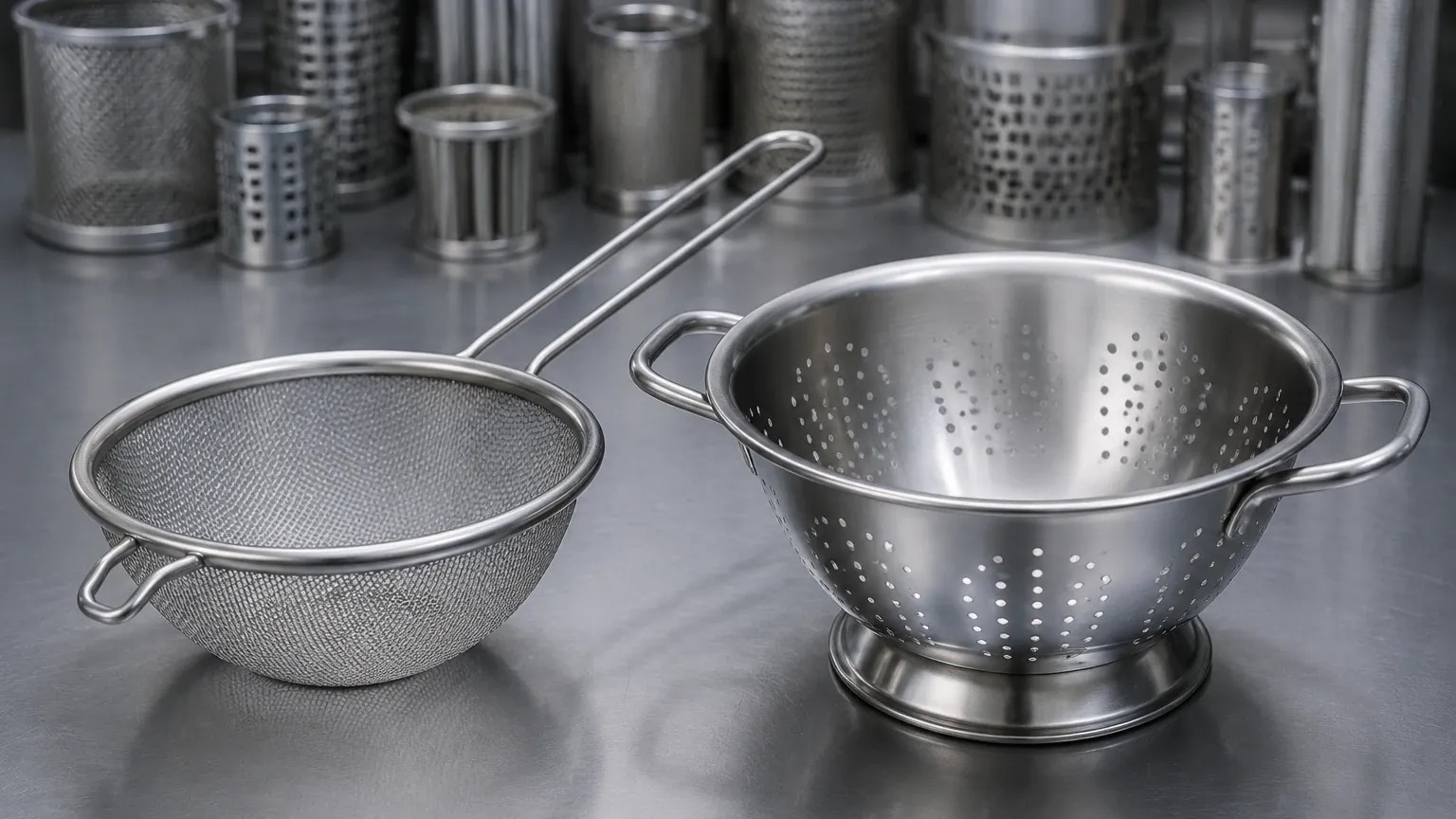
An industrial strainer is typically designed to remove smaller particulates from a fluid stream. These are often integrated into piping systems to protect downstream components like pumps, valves, and flow meters. Strainers frequently utilize wire mesh—a woven fabric of metal wires—which allows for much finer filtration ratings, often measured in microns (µm). Because they handle finer debris, strainers are subject to higher pressure differentials and require precise engineering to ensure the mesh does not bypass or fail under load.
The Industrial Colander (Perforated Basket)
In an industrial setting, what a consumer might call a colander is more accurately described as a perforated basket strainer. These components feature larger, punched holes in a metal sheet rather than a woven mesh. They are used for primary filtration or "scalping," where the goal is to remove large debris, such as stones, scale, or large organic matter, from a high-volume flow. These are characterized by high structural strength and a high open-area ratio, allowing for high flow rates with minimal pressure drop.
Engineering Considerations: Mesh vs. Perforation
When choosing between a fine mesh strainer and a perforated basket, the method of manufacturing the filtration surface dictates the performance characteristics.
Wire Mesh Characteristics
Wire mesh strainers are manufactured by weaving stainless steel wires in various patterns, such as plain weave, twilled weave, or Dutch weave. The advantage of wire mesh is its versatility in filtration accuracy. Engineers can specify mesh counts that target particles as small as 5 to 10 microns. However, wire mesh is inherently more delicate than perforated plate. In industrial applications, fine mesh is often supported by a heavier perforated metal cylinder to provide the necessary mechanical strength to withstand system pressure.
Perforated Plate Characteristics
Perforated plates, the industrial version of the colander design, are created by punching holes into sheet metal. The hole size, shape (round, square, or slotted), and pitch (the distance between holes) are engineered to balance filtration efficiency with structural integrity. Perforated baskets are typically the first line of defense in a system. They are easier to clean and more resistant to mechanical damage from heavy debris compared to fine wire mesh.
Material Selection for Industrial Environments
In B2B applications, material selection is non-negotiable. Whether a project requires a fine strainer or a coarse basket, the material must be compatible with the chemical properties of the fluid and the temperature of the process.
1. Stainless Steel 304: This is the standard grade for most industrial filtration applications. It offers excellent corrosion resistance and durability for water treatment, food and beverage, and general industrial use.
2. Stainless Steel 316/316L: For more demanding environments, such as chemical processing or marine applications, 316 stainless steel is preferred due to its molybdenum content, which provides superior resistance to chlorides and pitting corrosion.
3. Specialty Alloys: In highly corrosive or high-temperature environments, materials like Monel, Hastelloy, or Duplex stainless steel may be required to ensure the longevity of the strainer or basket.
For engineers, the choice of material directly impacts the total cost of ownership. While a 316L basket may have a higher upfront cost, its resistance to corrosion can significantly extend the replacement cycle, reducing downtime and maintenance labor.
Flow Dynamics and Pressure Drop
A critical factor in the strainer vs colander debate is the "Clean Pressure Drop." Every filtration component introduces resistance into the system.
* Open Area Ratio: This is the ratio of the total area of the holes to the total area of the basket or screen. A higher open area ratio generally results in a lower pressure drop. Industrial baskets (colander-style) typically offer a high open area, making them suitable for high-velocity systems.
* Flow Velocity: As fluid passes through the apertures, the velocity increases. If the apertures are too small (as in a fine mesh strainer), the pressure drop can increase exponentially as the screen begins to clog.
* Viscosity: The viscosity of the fluid plays a major role. Highly viscous fluids, like oils or resins, require larger apertures and more surface area to prevent excessive backpressure, often leading engineers to select a basket-style design over a fine mesh screen.
Application-Specific Selection
Choosing the right component depends heavily on the specific industry and the goals of the filtration process.
Food and Beverage Processing
In this sector, the distinction between a strainer and a colander-style basket is often related to the stage of production. For example, during the initial washing of raw produce, large perforated baskets are used to separate the product from wash water. Later in the process, fine mesh strainers are used to ensure that liquid products, like juices or syrups, are free of microscopic particulates. Compliance with sanitary standards is paramount here, requiring smooth welds and easy-to-clean surfaces.
Chemical and Petrochemical
In chemical processing, strainers are used to protect sensitive instrumentation. A Y-strainer with a fine mesh lining might be used before a control valve. Conversely, a large basket strainer (the industrial colander) might be placed at the suction side of a pump to prevent large debris from damaging the impeller. The focus here is on pressure ratings and chemical compatibility.
Water Treatment
Water treatment plants often use a multi-stage approach. Coarse baskets remove large objects like branches or plastic waste, while finer strainers or sand filters handle smaller suspended solids. The "strainer vs colander" logic here follows a gradient of particle sizes.
Maintenance and Operational Lifespan
Maintenance requirements are a significant part of the decision-making process for purchasing teams.
* Ease of Cleaning: Perforated baskets are generally easier to clean than fine mesh strainers. Debris tends to sit on the surface of a perforated plate, whereas it can become wedged in the weaves of a wire mesh.
* Durability: Fine mesh is susceptible to "blinding" (where particles plug the openings) and mechanical fatigue. If a system experiences frequent pressure surges, a fine mesh strainer may require a reinforced backing or more frequent replacement.
* Replacement Cycles: Engineers must calculate the expected lifespan of the filtration media. In many cases, a dual-basket system (duplex strainer) is used so that one basket can be cleaned while the other remains in operation, ensuring continuous flow.
Customization and Engineering Requirements
Off-the-shelf solutions rarely meet the specific needs of complex industrial systems. When evaluating Strainers & Baskets, customization is often necessary. Factors that can be customized include:
* Flange Connections: Matching the strainer housing to existing piping standards (ANSI, DIN, JIS).
* Micron Ratings: Tailoring the mesh or perforation size to the specific particle distribution of the process fluid.
* Structural Reinforcement: Adding internal supports or external cages to the basket to handle high differential pressures.
* Handle and Lifting Lug Designs: For large industrial baskets, ease of removal for cleaning is a safety and efficiency concern.
Conclusion: Making the Informed Choice
While the domestic "strainer vs colander" comparison is simple, the industrial application requires a deep dive into fluid mechanics and material science. A "colander" in the industrial sense is a robust, perforated basket designed for high-volume, coarse filtration. A "strainer" is a precision-engineered component utilizing fine wire mesh for high-accuracy particle removal.
For engineers and purchasing professionals, the selection process should begin with a clear understanding of the target particle size, the fluid's chemical properties, and the system's pressure and flow requirements. By selecting the appropriate filtration component—whether it be a coarse perforated basket or a fine mesh strainer—facilities can ensure the longevity of their equipment, maintain product quality, and optimize their total cost of operation. Working with a manufacturer that understands these technical boundaries allows for the development of customized solutions that meet the rigorous demands of modern industrial environments.
