


Victaulic Strainers
In modern industrial piping systems, the efficiency of fluid transport and the protection of downstream equipment depend heavily on effective filtration. Victaulic strainers, designed for use with grooved piping systems, represent a standard in mechanical pipe joining technology. These components are essential for removing entrained solids from fluid streams, thereby preventing damage to pumps, valves, heat exchangers, and sensitive instrumentation.
For engineers and procurement professionals, understanding the technical nuances of these strainers—ranging from housing geometry to the precision of the internal Strainers & Baskets—is critical for ensuring system reliability and minimizing total cost of ownership. This guide examines the engineering principles, material considerations, and selection criteria for victaulic strainers in industrial applications.
Engineering Fundamentals of Grooved-End Strainers
The term "Victaulic strainers" typically refers to strainers designed with grooved ends, a method of joining pipe that utilizes a housing, a gasket, and a set of bolts and nuts to create a secure, leak-proof joint. This design offers significant advantages over traditional flanged or threaded connections, particularly in terms of installation speed, vibration attenuation, and ease of maintenance.
From a filtration perspective, the grooved-end design allows for rapid access to the internal filter element. In industrial environments where downtime is costly, the ability to quickly disassemble a joint to clean or replace a basket is a primary engineering consideration. The mechanical coupling provides a union at every joint, which simplifies the removal of the strainer body without the need for extensive pipe disassembly.
Types of Victaulic Strainers: Y-Type and T-Type
Grooved-end strainers are generally categorized into two primary configurations: Y-strainers and T-strainers (or Basket strainers). Each serves a specific role based on the flow characteristics and the volume of debris expected in the system.
Y-Type Strainers
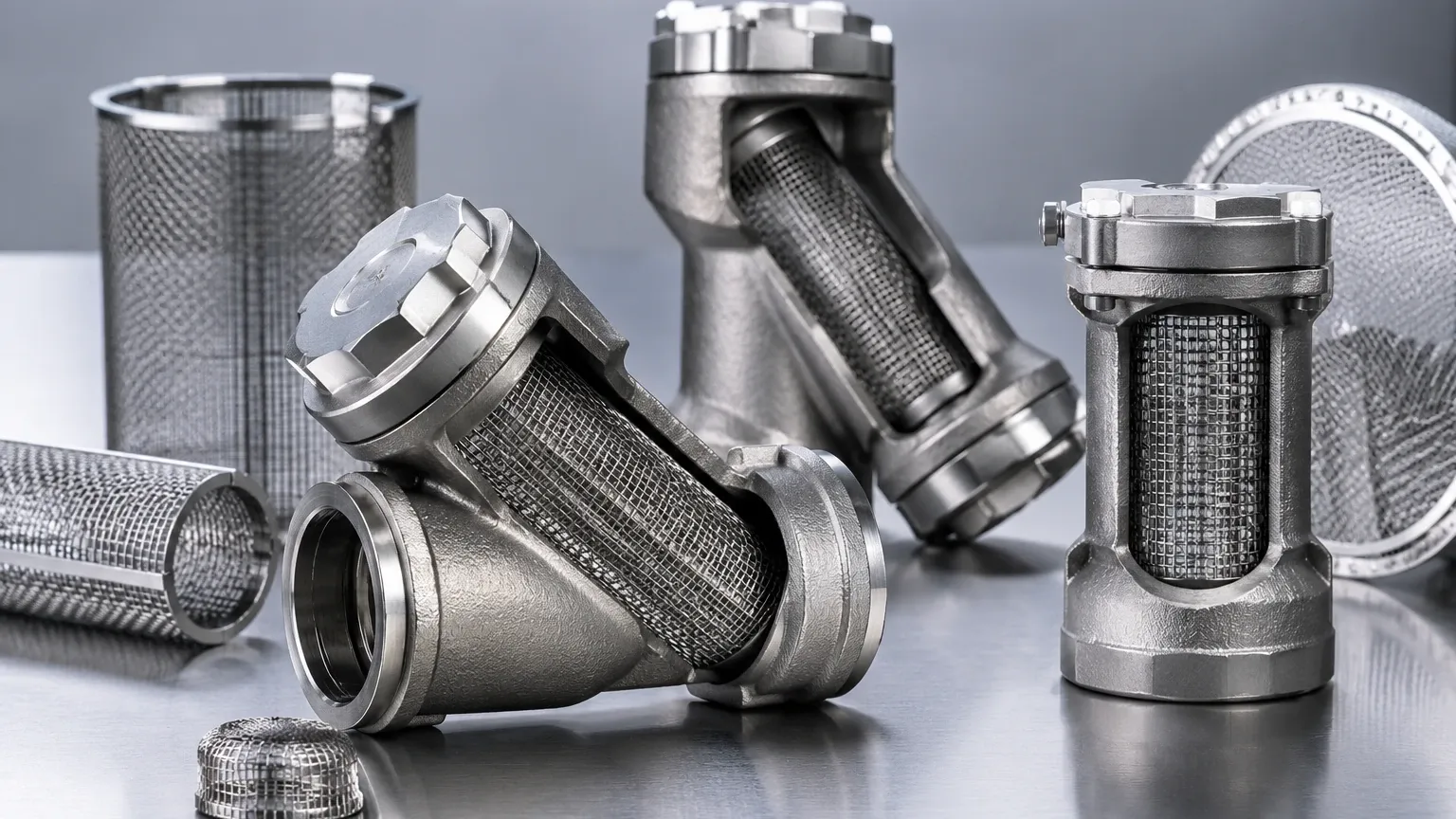
Y-strainers are characterized by their compact, cylindrical shape with a leg that extends at an angle from the main flow line. They are typically used in applications where the amount of solids to be removed is relatively small and where space is at a premium. Because of their design, Y-strainers can be installed in either horizontal or vertical orientations (provided the "leg" points downward to collect debris). They are frequently used in high-pressure steam, liquid, or gas lines.
T-Type (Basket) Strainers
T-type strainers, often referred to as victaulic strainers in larger diameter piping, feature a larger internal volume compared to Y-types. The basket design allows for a greater holding capacity for debris and typically results in a lower pressure drop across the unit. These are preferred for suction-side pump protection and applications involving higher concentrations of particulates. The vertical orientation of the basket makes manual cleaning more straightforward, as the debris is contained within the basket and does not spill back into the pipeline upon removal.
The Role of Internal Filtration Components
While the external housing of a victaulic strainer provides structural integrity and the means of connection, the actual filtration performance is determined by the internal mesh or perforated element. High-performance Strainers & Baskets are the core of the filtration process.
Material Selection for Internals
Most industrial grooved strainers utilize stainless steel for their internal elements, even if the outer housing is made of ductile iron or carbon steel. Stainless steel (typically Grades 304 or 316) provides the necessary corrosion resistance to withstand constant exposure to process fluids. In chemical processing or pharmaceutical applications, 316L stainless steel is often specified to prevent localized pitting and to ensure compatibility with aggressive cleaning agents.
Mesh vs. Perforation
Engineers must choose between perforated metal and wire mesh based on the required filtration accuracy.
- Perforated Metal: Usually serves as the primary support or for "coarse" straining (removing large stones, scale, or welding slag). Typical hole sizes range from 1/16" to 1/4".
- Wire Mesh: Used for "fine" straining. Stainless steel wire mesh can be lined inside a perforated basket to achieve filtration ratings down to 5 microns or lower. The weave type—plain, twill, or dutch weave—is selected based on the desired strength and flow capacity.
Technical Specification and Performance Evaluation
When evaluating victaulic strainers for a specific project, several technical parameters must be verified to ensure the component meets the application's demands.
Pressure Drop (Differential Pressure)
The pressure drop ($ΔP$) is the difference in pressure between the inlet and outlet of the strainer. A high initial pressure drop indicates that the strainer is undersized or that the mesh is too fine for the flow rate. Engineers use the $C_v$ (flow coefficient) to calculate the expected pressure drop. It is essential to ensure that the strainer is sized so that the clean pressure drop does not exceed 2-3 psi in most liquid applications.
Open Area Ratio
The ratio of the total open area of the strainer element to the internal cross-sectional area of the inlet pipe is known as the Open Area Ratio (OAR). For industrial strainers, an OAR of at least 4:1 is often recommended. A higher OAR allows for longer run times between cleanings and reduces the velocity of the fluid through the mesh, which prevents debris from being forced through the openings.
Pressure and Temperature Ratings
Victaulic strainers must be rated for the maximum operating pressure and temperature of the system. While the grooved coupling itself is highly resilient, the internal gaskets (often EPDM or Nitrile) and the structural integrity of the basket must be verified against the process conditions. For instance, high-temperature steam applications require specialized gasket materials and reinforced stainless steel baskets to prevent collapsing under pressure spikes.
Maintenance Protocols and Operational Longevity
One of the most significant risks in industrial filtration is the neglect of strainer maintenance. As debris accumulates, the differential pressure increases. If the pressure exceeds the structural limit of the internal basket, the element can collapse, sending both the debris and pieces of the stainless steel mesh downstream into expensive equipment.
Blow-Down vs. Manual Cleaning
Many Y-type victaulic strainers are equipped with a blow-down port. This allows the operator to open a valve and flush out accumulated debris using the system's own pressure without stopping the flow. However, blow-down is only effective for loose, non-fibrous debris. In many cases, manual cleaning is required to remove stubborn particulates or to inspect the integrity of the mesh.
Replacement Cycles
While the housing of a victaulic strainer may last for decades, the internal Strainers & Baskets are considered wear items. Regular inspection should look for:
- Wire Fraying: Breaking of the mesh strands due to high-velocity impact or fatigue.
- Bypass: Gaps between the basket and the housing seat that allow unfiltered fluid to pass through.
- Corrosion: Signs of chemical attack on the stainless steel, which can weaken the structure.
Customization for Specialized Industrial Applications
Standard off-the-shelf strainers may not meet the requirements of every industrial process. OEM manufacturers like Kaifil specialize in providing customized filtration solutions where standard victaulic strainers fall short.
Customization options often include:
- Reinforced Baskets: Adding internal or external support frames to the mesh to handle high-differential pressure events.
- Magnetic Inserts: Incorporating magnets within the basket to capture fine ferrous particles that might otherwise pass through a standard mesh.
- Dual-Stage Filtration: Combining a coarse perforated outer layer with a fine wire mesh inner layer for multi-stage particle removal within a single housing.
- Custom Dimensions: Designing baskets to fit legacy housings or non-standard grooved-end dimensions.
Critical Pre-Purchase Considerations for Engineers
Before finalizing a specification for victaulic strainers, engineers and purchasing teams should confirm the following data points with their supplier:
1. Fluid Characteristics: What is the viscosity and density of the fluid? High-viscosity fluids require larger surface areas to maintain flow.
2. Particle Load: Is the debris loading continuous or intermittent? This determines the choice between a Y-strainer and a high-capacity T-basket.
3. Filtration Goal: Is the goal to protect a pump (coarse) or to ensure product purity (fine)? This dictates the micron rating of the stainless steel mesh.
4. Housing Material: Is ductile iron sufficient, or does the environment require a full stainless steel assembly to prevent external corrosion?
5. Compliance: Does the strainer need to meet specific industry standards, such as ASME B31.1 for power piping or FDA/3A standards for food and beverage processing?
By addressing these factors, technical professionals can ensure that the selected victaulic strainers provide reliable service, protect critical infrastructure, and maintain the integrity of the industrial process. High-quality internal components, such as those found in professional Strainers & Baskets, are the fundamental line of defense in any grooved piping filtration strategy.
