


Strainer Zwilling
In the landscape of industrial fluid management, the term "Strainer Zwilling"—derived from the German word for "twin"—refers to duplex or dual-chamber strainer systems designed for uninterrupted operation. For engineers and facility managers operating in high-stakes environments like chemical processing, power generation, or large-scale manufacturing, the ability to maintain continuous flow while performing routine maintenance is not merely a convenience; it is a critical requirement for operational stability.
Unlike simplex strainers, which necessitate a complete system shutdown for basket cleaning, a strainer zwilling configuration allows for the diversion of fluid from one chamber to another. This redundancy ensures that downstream equipment, such as high-pressure pumps and precision valves, remains protected from particulate contamination at all times. As a professional manufacturer, Kaifil specializes in providing the customized Strainers & Baskets necessary to support these complex duplex systems, ensuring that material integrity and filtration accuracy meet the most demanding industrial standards.
The Mechanics of Continuous Flow: How Duplex Systems Operate
The core engineering principle behind a strainer zwilling is the integration of two separate filtration chambers connected by a common diversion valve assembly. This valve—typically a ball valve, a plug valve, or a sliding gate mechanism—is the heart of the duplex system. Its primary function is to redirect the fluid path without interrupting the flow or causing significant pressure surges.
When the active chamber’s filter basket becomes saturated with debris, the differential pressure across the unit rises. To address this, the operator manipulates the diversion valve to transition the flow to the standby chamber. In high-quality industrial designs, this transition is engineered to be "overlap-positive," meaning both chambers are briefly open during the switch to prevent any momentary blockage or water hammer effect that could damage sensitive pipeline components.
Once the flow is fully diverted to the second chamber, the first chamber is isolated. It can then be vented and drained, allowing the operator to open the cover, remove the fouled basket, and replace it with a clean one. This cycle ensures that the system never has to stop, making the strainer zwilling an essential component in 24/7 production cycles where downtime costs can reach thousands of dollars per hour.
Material Engineering and Corrosion Resistance in Stainless Steel Filtration
Material selection is perhaps the most critical factor in the longevity of a strainer zwilling system. Because these units are often exposed to aggressive chemicals, high temperatures, and abrasive particulates, the structural components and the internal mesh must be manufactured from high-grade alloys. Kaifil emphasizes the use of stainless steel for its superior mechanical properties and resistance to various forms of degradation.
Grade 304 vs. 316L Stainless Steel
For standard industrial water applications or non-corrosive oils, Grade 304 stainless steel is often sufficient. It provides excellent tensile strength and basic resistance to oxidation. However, in environments involving chlorides (such as marine applications) or acidic chemical processing, Grade 316L is the industry standard. The addition of molybdenum in 316L significantly improves the Pitting Resistance Equivalent Number (PREN), ensuring that the strainer housing and the delicate wire mesh do not succumb to localized corrosion or crevice attack.
Specialized Surface Treatments
Beyond the base alloy, the performance of a strainer zwilling can be enhanced through surface treatments. For the pharmaceutical and food industries, electropolishing is frequently employed to create a microscopically smooth surface. This reduces the risk of bacterial growth and makes the cleaning process more efficient. In heavy industrial settings, pickling and passivation are used to restore the protective chromium oxide layer after welding, ensuring that the welded joints of the basket remain as corrosion-resistant as the base metal.
Design Parameters: Sizing, Pressure Drop, and Open Area Ratios
Specifying a strainer zwilling requires a deep understanding of fluid dynamics. Engineers must balance the need for fine filtration with the requirement for low resistance to flow. The primary metric used to evaluate this balance is the pressure drop (ΔP).
Calculating the Clean Pressure Drop
A well-designed strainer should ideally have a clean pressure drop of less than 2 psi (0.14 bar). If the initial pressure drop is too high, it indicates that the strainer is undersized for the flow rate, which will lead to frequent clogging and increased energy consumption by the pumps. Factors influencing ΔP include fluid viscosity, specific gravity, flow velocity, and the percentage of open area in the mesh.
The Importance of the Open Area Ratio
The open area ratio is the relationship between the total area of the holes in the strainer basket and the cross-sectional area of the inlet pipe. For industrial applications, a ratio of at least 4:1 is recommended, while high-viscosity or high-debris loads may require a ratio of 6:1 or higher. A larger open area ratio means the strainer can accumulate more debris before the pressure drop reaches a critical level, thereby extending the interval between chamber switchovers. Kaifil’s engineering team works closely with clients to customize the basket geometry—using pleated or multi-layered mesh—to maximize this ratio within the physical constraints of the duplex housing.
Customization of Filter Baskets and Precision Mesh Liners
No two industrial processes are identical, and the internal components of a strainer zwilling must be tailored to the specific contaminants being targeted. Kaifil’s expertise lies in the manufacture of custom Strainers & Baskets that can be adapted for various filtration accuracies.
Perforated Supports and Fine Mesh Liners
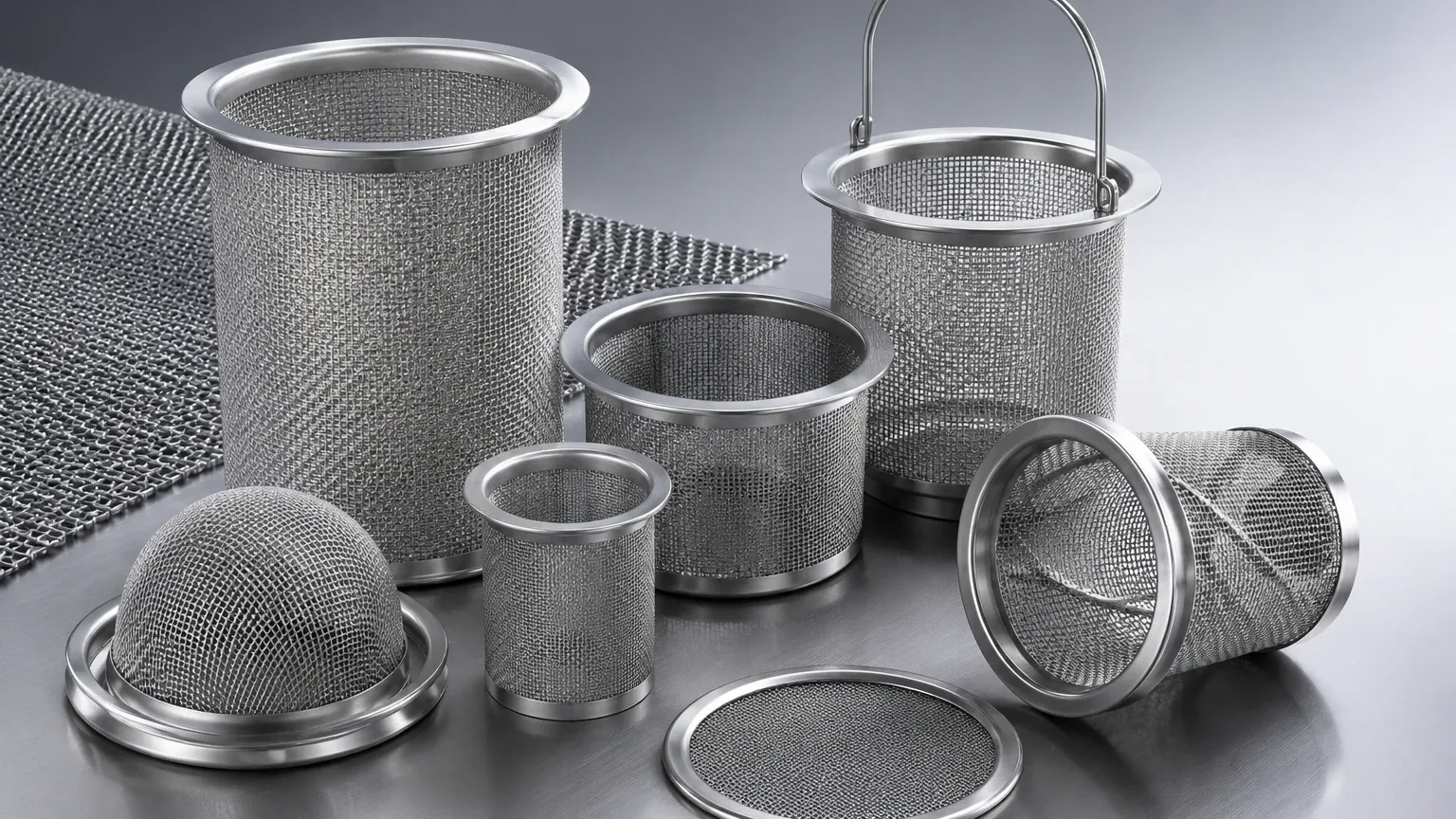
In many duplex systems, the filter basket consists of a heavy-duty perforated metal cylinder that provides structural rigidity. Inside this cylinder, a fine wire mesh liner is fitted to achieve the desired micron rating. For example, a system might use a 1/8" perforated hole for large debris but require a 100-mesh (150-micron) liner to capture smaller particles. The liner must be securely attached—often via spot welding or precision crimping—to ensure that fluid cannot bypass the mesh.
Pleated Designs for High Surface Area
When space is limited but high dirt-holding capacity is required, pleated filter baskets are utilized. By folding the mesh into a series of pleats, the surface area can be increased by 200% to 300% compared to a standard cylindrical basket. This design is particularly effective for removing gelatinous or fibrous contaminants that would quickly blind a flat mesh surface. Kaifil utilizes advanced pleating and welding technologies to ensure these complex structures can withstand the mechanical stresses of high-flow environments.
Maintenance Protocols and Monitoring for Industrial Uptime
The effectiveness of a strainer zwilling is only as good as the maintenance protocols supporting it. Because the system is designed for continuous use, it is easy for operators to overlook the standby chamber. A rigorous maintenance schedule is essential for long-term reliability.
Differential Pressure Monitoring
The most reliable method for determining when to switch chambers is through differential pressure (DP) monitoring. Industrial strainers should be equipped with DP gauges or electronic transmitters that provide real-time data to the facility's control room. Typically, a switchover is triggered when the DP reaches 5–10 psi over the clean reading. Waiting too long can result in "mesh blinding," where particles are forced into the mesh openings so deeply that they cannot be easily cleaned, or worse, the structural failure of the basket due to excessive pressure.
Gasket and Seal Integrity
Since the strainer zwilling involves a diversion valve and two removable covers, the integrity of the seals is paramount. Depending on the process fluid, seals may be made from Nitrile (Buna-N), EPDM, Viton, or PTFE. During every cleaning cycle, the seals on the offline chamber should be inspected for signs of compression set, swelling, or cracking. A failed seal in a duplex system can lead to internal bypassing—where unfiltered fluid leaks into the clean stream—negating the purpose of the filtration system.
Industry-Specific Applications and Regulatory Compliance
The application of strainer zwilling technology spans across diverse sectors, each with its own set of technical challenges and regulatory requirements.
* Chemical Processing: In this sector, the primary concern is compatibility with aggressive solvents and reagents. The strainer must be designed to withstand potentially volatile reactions and maintain a hermetic seal to prevent the escape of hazardous fumes.
* Food and Beverage: Here, hygiene is the priority. Strainers must feature sanitary fittings (such as Tri-Clamp connections) and be designed without "dead legs" where bacteria could proliferate. The use of 316L stainless steel is standard to resist the caustic chemicals used in Clean-in-Place (CIP) cycles.
* Oil and Gas: Duplex strainers are used in lubrication systems for large turbines and compressors. In these applications, the strainer zwilling ensures that the lubricating oil remains free of metal shavings, which could cause catastrophic mechanical failure if allowed to reach the bearings.
* Water Treatment: For municipal or industrial water intake, these systems protect downstream reverse osmosis (RO) membranes or UV sterilizers from sand, grit, and organic matter. The continuous flow capability is essential for maintaining constant water pressure in the distribution network.
Technical Evaluation: What Engineers Must Confirm Before Purchase
When sourcing a strainer zwilling, procurement teams and engineering departments must look beyond the initial purchase price and consider the total cost of ownership. A low-cost unit that requires frequent basket replacements or has a high pressure drop will eventually become more expensive than a high-quality, precision-engineered solution.
Key technical questions to address with a manufacturer like Kaifil include:
1. Burst Pressure Rating: What is the maximum differential pressure the basket can withstand before deforming?
2. Valve Type: Is the diversion valve a single-shaft design or a linked-valve design? Single-shaft designs are often more compact and easier to automate.
3. Ease of Access: Does the housing feature quick-opening covers (such as swing bolts) to reduce the time required for basket cleaning?
4. Documentation: Can the manufacturer provide material test reports (MTRs), hydrostatic test certificates, and drawings for approval?
By focusing on these engineering details, organizations can ensure that their investment in a strainer zwilling system provides the necessary protection for their critical infrastructure while maintaining the 100% uptime required in modern industrial operations. Kaifil remains a dedicated partner in this process, offering the technical expertise and manufacturing precision required to deliver high-performance Strainers & Baskets tailored to any application.
