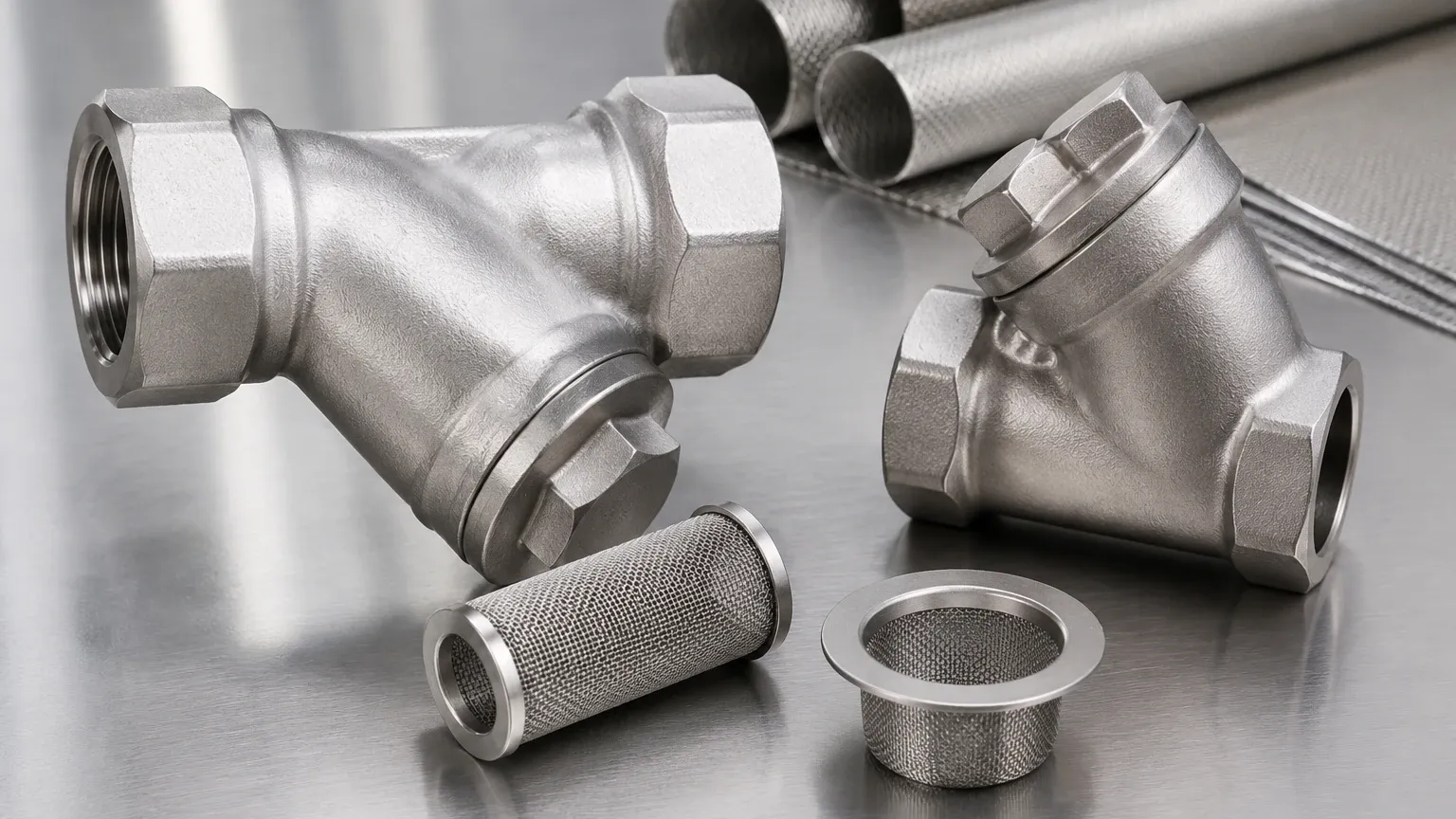
2 Y Strainers
In industrial fluid handling systems, the 2-inch Y strainer serves as a critical line of defense for downstream equipment. Designed to mechanically remove solids from flowing liquids or gases, these components protect sensitive machinery such as pumps, control valves, meters, and steam traps from damage caused by scale, rust, or foreign debris. For engineers and procurement teams, selecting the correct 2 y strainers involves a deep understanding of material compatibility, pressure ratings, and filtration precision to ensure long-term system integrity.
The Engineering Design of Y Strainers
The "Y" designation refers to the physical configuration of the strainer body. The device consists of a main flow path and a secondary cylinder branching off at an angle, typically 45 or 60 degrees. This branch contains the filtration element—either a perforated metal screen or a wire mesh liner.
The 2-inch nominal pipe size (NPS) is one of the most common specifications in industrial piping, frequently found in chemical processing lines, water treatment facilities, and hydraulic systems. Because the 2-inch size sits at the intersection of high-flow utility and compact design, the internal engineering must balance the effective filtration area with the allowable pressure drop.
Unlike basket strainers, which are typically designed for larger debris and higher dirt-holding capacities in horizontal lines, Y strainers are versatile. They can be installed in both horizontal and vertical (downward flow) orientations, provided the "leg" of the Y points downward to collect and retain particles effectively.
Material Selection for Demanding Environments
Material integrity is the most significant factor in the service life of 2 y strainers. While cast iron or bronze may suffice for low-pressure water applications, industrial-grade filtration often demands the superior properties of stainless steel. Kaifil specializes in manufacturing stainless steel filtration components that withstand corrosive environments and high temperatures.
1. 304 Stainless Steel: This is the standard for general industrial use, offering excellent resistance to atmospheric corrosion and many organic and inorganic chemicals. It is frequently used in food and beverage processing where hygiene and durability are required.
2. 316/316L Stainless Steel: For more aggressive environments, such as chemical processing or marine applications, 316 stainless steel includes molybdenum to enhance resistance to pitting and chloride-induced stress corrosion cracking. The "L" (low carbon) variant is preferred for welded components to prevent carbide precipitation.
3. Specialty Alloys: In extreme cases involving high-concentration acids or ultra-high temperatures, alloys like Monel or Hastelloy may be integrated into the strainer design, though stainless steel remains the benchmark for the majority of B2B industrial applications.
Filtration Accuracy: Screens and Mesh Liners
The performance of Strainers & Baskets is defined by the filtration media housed within the Y-leg. Engineers must specify the opening size based on the smallest particle that needs to be removed.
* Perforated Screens: These are typically used for "coarse" filtration. Standard hole sizes range from 1/32" to 1/4". Perforated screens provide structural rigidity and are often used as a support structure for finer mesh.
* Wire Mesh Liners: For "fine" filtration, a woven wire mesh is layered inside the perforated screen. Mesh sizes are defined by the number of openings per linear inch. A 20-mesh screen might be used for large particulates, while a 200-mesh screen (approximately 74 microns) is used for fine sediment removal.
When selecting the mesh for 2 y strainers, it is vital to consider the "Open Area Ratio." This is the ratio of the total area of the holes in the screen to the cross-sectional area of the inlet pipe. A ratio of 4:1 is generally recommended to ensure that the strainer does not become a bottleneck in the system, allowing for significant debris accumulation before a cleaning cycle is required.
Hydraulic Considerations and Pressure Drop
Every component added to a piping system introduces a degree of resistance to flow, known as pressure drop ($ΔP$). For a 2-inch Y strainer, the pressure drop is influenced by the fluid's viscosity, velocity, and the cleanliness of the internal screen.
Engineers use the Flow Coefficient ($Cv$) to calculate the expected pressure drop. The $Cv$ value represents the volume of water in gallons per minute that will flow through the strainer with a 1 psi pressure drop. A clean 2-inch Y strainer typically has a $Cv$ value ranging from 60 to 80, depending on the specific internal design and screen type.
If the pressure drop across the strainer increases significantly, it indicates that the screen is becoming clogged. In high-stakes industrial environments, installing differential pressure gauges upstream and downstream of the strainer is a standard practice. This allows maintenance teams to monitor the "loading" of the strainer in real-time and schedule cleaning before the flow is restricted or the screen collapses under the pressure differential.
Installation and Maintenance Protocols
Correct installation is paramount to the functionality of 2 y strainers. There are three primary considerations for the installation phase:
1. Orientation: In horizontal piping, the Y-leg should point downward. This ensures that gravity helps trap debris in the collection pocket. In vertical piping, the flow must be downward so that the debris is carried into the leg rather than falling back into the main line.
2. Accessibility: The strainer must be installed with sufficient clearance to remove the screen for cleaning. For a 2-inch unit, this typically requires several inches of clearance below the Y-leg.
3. Blow-down Connections: Many industrial Y strainers are equipped with a threaded or flanged "blow-off" port in the cover. By installing a blow-down valve, operators can flush out accumulated debris without shutting down the system or dismantling the strainer. This is particularly effective for removing loose sediment and scale.
Maintenance cycles depend entirely on the fluid quality. In a closed-loop system, the strainer may only need inspection annually. In a raw water intake or a process line with frequent particulate generation, cleaning may be required weekly. During maintenance, the screen should be inspected for signs of "blinding" (permanent clogging of the mesh) or physical deformation. If the wire mesh is frayed or the perforated support is dented, the element must be replaced to prevent bypass or downstream contamination.
Customization for OEM and Industrial Applications
Standard off-the-shelf strainers do not always meet the rigorous demands of specialized industrial equipment. This is where custom manufacturing becomes essential. Kaifil provides tailored solutions for 2 y strainers, allowing engineers to specify unique parameters that go beyond standard catalog items.
Customization options often include:
* Non-standard End Connections: While NPT (threaded) and ANSI flanges are standard, some systems require socket weld, butt weld, or specialized hygienic couplings (e.g., Tri-Clamp for pharmaceutical use).
* Reinforced Elements: For high-pressure applications where the differential pressure might exceed the structural limits of standard mesh, internal support cages or double-layered screens can be engineered.
* Magnetic Inserts: In systems where fine iron or steel particles (black amagnetite) are a concern, magnetic rods can be inserted into the Y-leg to capture sub-micron metallic debris that would otherwise pass through the mesh.
* Specific Gasket Materials: Depending on the chemical nature of the fluid, gaskets may need to be fabricated from PTFE, EPDM, Viton, or spiral-wound graphite to ensure a leak-proof seal under varying temperatures.
Total Cost of Ownership in Filtration
When evaluating 2 y strainers, the initial purchase price is only one component of the total cost. Technical professionals must also consider:
* Operational Efficiency: A poorly designed strainer with a high initial pressure drop will increase the energy consumption of system pumps over the life of the installation.
* Maintenance Labor: Strainers that are difficult to clean or lack blow-down capabilities increase labor costs and system downtime.
* Equipment Protection: The cost of a high-quality stainless steel strainer is negligible compared to the cost of repairing a damaged high-pressure pump or replacing a fouled heat exchanger.
By focusing on precision engineering and material quality, facilities can reduce the frequency of unplanned outages. Choosing a manufacturer like Kaifil ensures that the filtration components are built to the exact specifications required for the application, providing a reliable barrier against contamination.
Conclusion for Engineering Selection
The 2-inch Y strainer is a versatile and essential component in modern industrial fluid systems. Whether it is used for protecting a boiler feed pump or ensuring the purity of a chemical batch, the effectiveness of the strainer relies on the synergy between the body design and the internal filtration element.
When selecting 2 y strainers, engineers should verify the chemical compatibility of the housing and screen, calculate the expected pressure drop based on the required mesh size, and ensure the installation environment allows for regular maintenance. For those requiring specialized performance, custom-engineered Strainers & Baskets provide the necessary durability and precision to meet the most demanding industrial standards.