


40 Mesh Strainers
In industrial fluid handling, the selection of the correct filtration media is a critical engineering decision that impacts pump longevity, downstream equipment protection, and overall process efficiency. Among the various specifications available for Strainers & Baskets, the 40 mesh configuration represents a versatile middle ground, offering a balance between flow capacity and the capture of mid-sized particulates.
Understanding the technical nuances of 40 mesh strainers—ranging from aperture dimensions to material integrity—is essential for engineers and procurement teams tasked with maintaining rigorous industrial standards. This guide examines the engineering considerations, application environments, and selection criteria for 40 mesh filtration components.
Technical Specifications of 40 Mesh Media
The term "mesh" refers to the number of openings per linear inch of the wire cloth. A 40 mesh strainer contains 40 openings in one inch, measured from the center of one wire to the center of the next. However, the mesh count alone does not fully define the filtration capability; the wire diameter and the resulting aperture size are the primary metrics for performance evaluation.
Aperture and Micron Rating
For a standard 40 mesh stainless steel screen, the wire diameter typically ranges from 0.010 inches (0.25 mm) to 0.012 inches (0.30 mm). Using a standard wire diameter of 0.010 inches, the calculation for the aperture (opening size) is as follows:
* Mesh Count: 40
* Pitch (1/40): 0.025 inches (635 microns)
* Wire Diameter: 0.010 inches (254 microns)
* Aperture Size: 0.015 inches (approx. 381 to 400 microns)
In practical industrial terms, 40 mesh strainers are generally rated to capture particles larger than 400 microns. This makes them ideal for removing sand, scale, large sediment, and debris that could damage mechanical seals or clog spray nozzles.
Open Area Percentage
The open area is a critical factor in determining the flow rate and the initial pressure drop across the strainer. It is calculated as the ratio of the area of the openings to the total area of the mesh. For a 40 mesh screen with 0.010-inch wire, the open area is approximately 36%. A higher open area reduces resistance to flow but may require a more robust support structure (such as a perforated metal backing) to prevent the mesh from deforming under high differential pressure.
Material Selection and Engineering Durability
Industrial 40 mesh strainers must withstand chemical exposure, thermal fluctuations, and mechanical stress. At Kaifil, material selection is guided by the specific corrosive profile of the process fluid.
Stainless Steel Grades
* Type 304 Stainless Steel: The most common material for general-purpose filtration. It offers excellent strength and good corrosion resistance for water treatment, food processing, and basic chemical applications.
* Type 316/316L Stainless Steel: Contains molybdenum, which provides superior resistance to chlorides and pitting. This is the standard choice for marine environments, pharmaceutical manufacturing, and aggressive chemical processing.
* Specialty Alloys: For extreme environments involving high temperatures or highly acidic fluids, alloys such as Monel or Hastelloy may be utilized in the construction of the mesh and the basket frame.
Structural Integrity
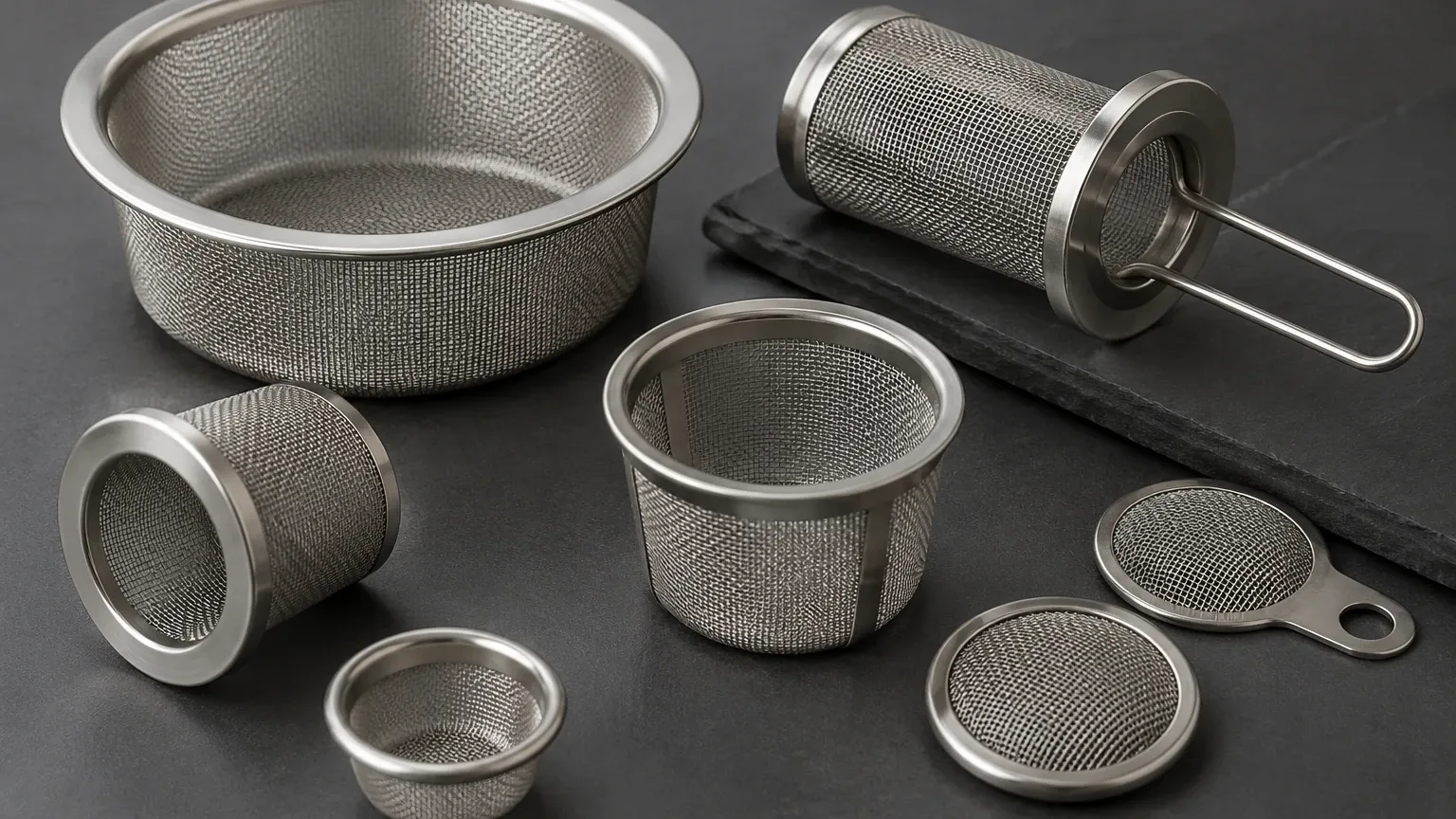
Because 40 mesh is relatively fine, the wire cloth is often pleated or layered to increase the effective filtration surface area. In high-pressure applications, the 40 mesh screen is typically sintered or welded to a perforated metal support cylinder. This reinforcement ensures that the mesh does not experience "media migration" or structural failure when the strainer becomes loaded with contaminants.
Design Variations in Strainers & Baskets
The physical housing and basket design are as important as the mesh size itself. Depending on the installation requirements, 40 mesh strainers are integrated into several different configurations:
Simplex Basket Strainers
Simplex designs are used in batch processes where the flow can be intermittently stopped to clean or replace the basket. These are common in fuel loading stations and chemical transfer lines where 40 mesh provides the necessary protection for flow meters.
Duplex Strainers
For continuous processes that cannot be shut down, duplex strainers utilize two separate baskets with a diverter valve. While one basket is in operation, the other can be cleaned. 40 mesh strainers in a duplex configuration are frequently found in cooling water systems and lubrication oil circuits.
Y-Strainers
Y-strainers are typically used for steam or gas applications, but they are also effective for liquid lines with low concentrations of solids. A 40 mesh lining in a Y-strainer is an excellent choice for protecting sensitive valves from pipe scale.
Application Environments for 40 Mesh Filtration
40 mesh strainers serve as the primary line of defense in various industrial sectors. Their ability to handle high flow rates while removing visible particulates makes them indispensable in the following areas:
1. Chemical Processing: Protecting centrifugal pumps from undissolved solids or catalyst fines. The 400-micron retention level is often sufficient to prevent impeller erosion.
2. Food and Beverage: Used in the initial stages of processing to remove pulp, seeds, or larger debris from raw ingredients. 316L stainless steel 40 mesh strainers ensure compliance with hygienic standards.
3. Water Treatment: Acting as a pre-filter for finer membrane systems or UV sterilizers. Removing 400-micron particles significantly extends the life of downstream pleated cartridges.
4. Hydraulic and Lubrication Systems: Ensuring that large wear particles do not circulate through the system, which could lead to catastrophic component failure.
5. Pulp and Paper: Filtering process water to remove wood fibers and knots before the water is recycled or treated.
Evaluating Performance: Pressure Drop and Flow Velocity
When specifying 40 mesh strainers, engineers must account for the Clean Pressure Drop (ΔP). As fluid passes through the mesh, a loss of pressure occurs due to friction and the restriction of the flow path.
The Impact of Viscosity
The ΔP is directly proportional to the viscosity of the fluid. While a 40 mesh strainer may have a negligible pressure drop with water, the resistance increases significantly with heavy oils or syrups. Engineering teams must ensure that the total pressure drop at the maximum flow rate does not exceed the system's design limits, even when the basket is 50% clogged.
Dirt-Holding Capacity
The dirt-holding capacity of a 40 mesh basket is determined by its surface area. By utilizing pleated designs or oversized baskets, manufacturers can increase the interval between cleaning cycles. This reduces labor costs and minimizes process downtime.
Maintenance and Cleaning Protocols
To maintain the efficiency of Strainers & Baskets, a proactive maintenance schedule is required. 40 mesh strainers are generally cleanable and reusable, making them a cost-effective alternative to disposable filter elements.
* Differential Pressure Monitoring: The most reliable way to determine when a 40 mesh strainer needs cleaning is by monitoring the pressure gauge before and after the strainer. A common rule of thumb is to clean the basket when the differential pressure reaches 5-10 psi over the clean drop.
* Cleaning Methods: Stainless steel 40 mesh can be cleaned using high-pressure water jets, steam, or ultrasonic baths. In chemical applications, backwashing (reversing the flow) can be automated to clear the mesh surface without manual intervention.
* Inspection for Fatigue: During cleaning, the mesh should be inspected for signs of "blinding" (permanent clogging of the pores) or wire breakage. Even small breaches in the 40 mesh screen can allow bypass, defeating the purpose of the filtration system.
Customization and OEM Solutions
Standard off-the-shelf strainers may not meet the specific geometric or material requirements of complex industrial machinery. Kaifil specializes in the custom manufacture of 40 mesh components tailored to unique engineering specifications.
Customization options include:
* Bespoke Dimensions: Baskets designed to fit existing housings from various manufacturers.
* Reinforced Frames: Heavy-duty flanges and support skeletons for high-vibration environments.
* Multi-Layered Sintered Mesh: Combining a 40 mesh outer layer with finer inner layers for graduated filtration and increased structural rigidity.
* Specialized Coatings: Applying PTFE or other coatings to the stainless steel to reduce adhesion of sticky process fluids.
Total Cost of Ownership (TCO) Considerations
When purchasing 40 mesh strainers, the initial acquisition cost is only one part of the TCO. Engineers should also evaluate:
* Durability: High-quality stainless steel construction reduces the frequency of replacements.
* Ease of Cleaning: Designs that allow for quick removal and thorough cleaning reduce labor overhead.
* Energy Efficiency: A well-sized 40 mesh strainer with a low clean pressure drop reduces the energy required by the system's pumps.
By selecting a precision-engineered 40 mesh solution, facilities can achieve a more stable process flow and better protection for their high-value capital equipment.
Conclusion
40 mesh strainers are a fundamental component in the industrial filtration toolkit. By providing reliable 400-micron filtration, they bridge the gap between coarse trash racks and fine cartridge filters. Whether utilized in chemical plants, food production lines, or water treatment facilities, the performance of these strainers depends on precise manufacturing, appropriate material selection, and correct sizing for flow conditions.
For engineers seeking reliable and customized filtration components, focusing on the technical integrity of the mesh and the structural robustness of the basket is the key to long-term operational success. Through advanced manufacturing and material expertise, Kaifil provides the precision-engineered solutions necessary to meet the most demanding industrial filtration challenges.
