


Strainer 5 Letters
In the world of industrial engineering and fluid handling, terminology often overlaps with common language. When searching for a "strainer 5 letters," the most frequent answer in a linguistic context is "sieve." However, for engineers, procurement specialists, and plant managers, a sieve is only the most basic form of a much more complex category of equipment: Strainers & Baskets.
While a sieve might be the five-letter solution to a crossword, the industrial reality involves sophisticated filtration components designed to protect downstream equipment, ensure product purity, and maintain system integrity under high pressure and temperature. Understanding the nuances of these components—from their material composition to their structural design—is essential for optimizing industrial processes.
Decoding the Terminology: 5-Letter Terms in Filtration
Beyond the word "sieve," several other five-letter terms are critical to the technical vocabulary of filtration. Understanding these terms helps bridge the gap between simple definitions and complex engineering requirements.
Sieve
A sieve is a device with meshes or perforations for separating finer particles from coarser ones. In industrial liquid filtration, the term is often replaced by "strainer," but the principle remains the same. A sieve-like element within a housing serves as the primary barrier against contaminants.
Mesh
Mesh refers to the number of openings per linear inch in a wire cloth. It is the most common way to define the filtration fineness of a strainer. Choosing the right mesh size is a balance between capturing small enough particles and preventing excessive pressure drop.
Grade
The "grade" of the material, such as 304 or 316 stainless steel, determines the strainer’s resistance to corrosion and temperature. In chemical processing, selecting the wrong grade can lead to premature failure and system contamination.
Valve
Strainers are frequently installed in tandem with a valve. Whether it is a blow-off valve for cleaning or an isolation valve for maintenance, the interaction between the strainer and the valve is a key consideration in piping design.
Engineering Fundamentals of Industrial Strainers & Baskets
Industrial strainers are closed vessels that mechanically remove solids from flowing liquids or gases by means of a perforated or wire mesh straining element. Unlike filters, which remove much smaller particles (often measured in sub-micron levels), strainers are typically used to remove larger particles that could damage pumps, valves, or spray nozzles.
The Role of the Basket
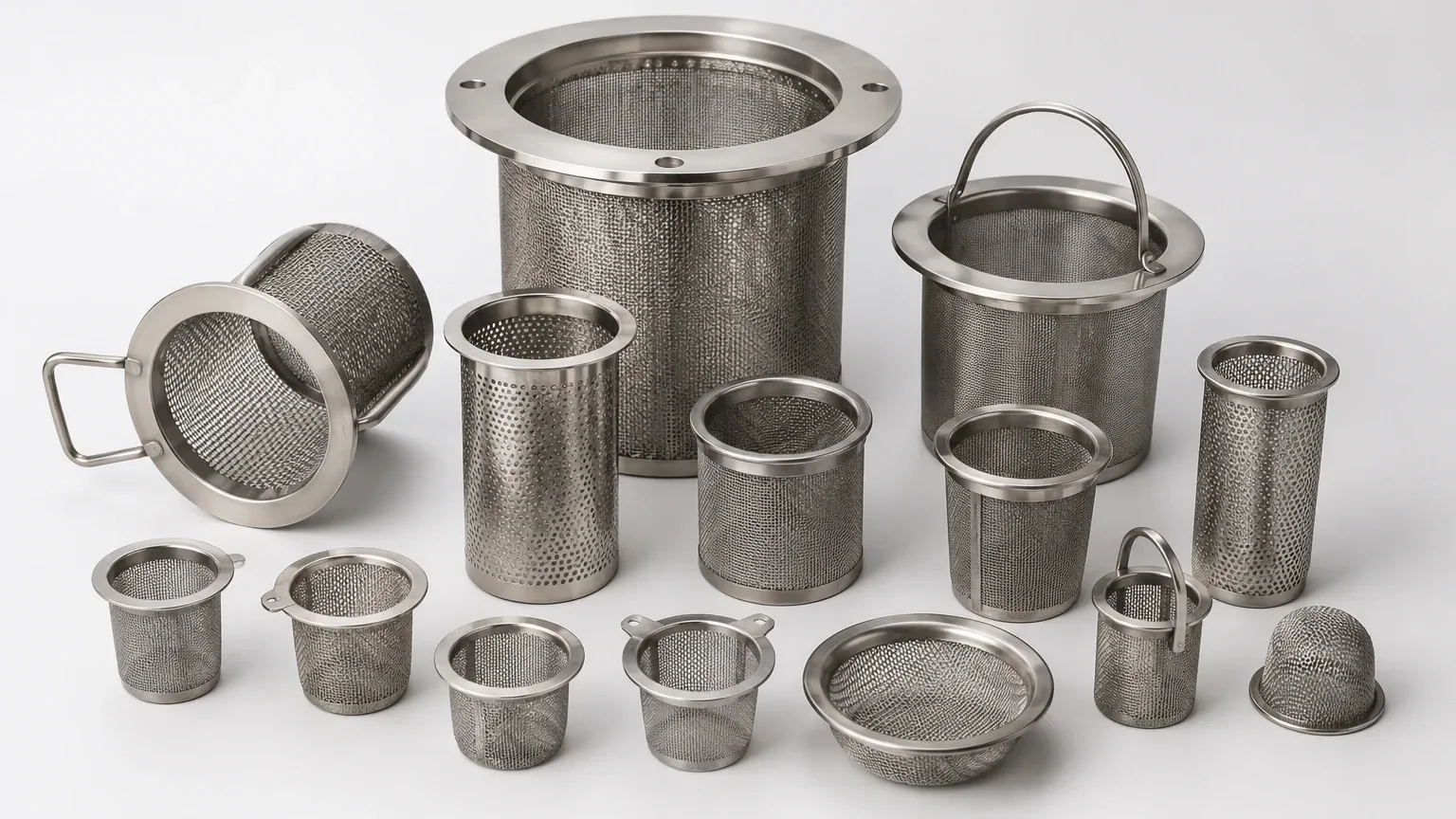
The "basket" in a basket strainer is the replaceable component that captures debris. Because the basket has a larger surface area than a standard Y-strainer element, it allows for a greater holding capacity and a lower pressure drop. This makes basket strainers ideal for applications with high flow rates or high solids loading.
Flow Dynamics and Pressure Drop
Every strainer introduces a restriction in the flow path, resulting in a pressure drop (Delta P). Engineers must calculate the clean pressure drop and the maximum allowable pressure drop before cleaning is required. A common rule of thumb is to size the strainer so that the clean pressure drop does not exceed 2 PSI. If the pressure drop increases significantly, it indicates that the basket is reaching its holding capacity and requires maintenance.
Material Selection: Stainless Steel and Alloy Performance
The longevity of Strainers & Baskets depends heavily on the materials used in their construction. Stainless steel is the industry standard due to its durability and versatility.
Type 304 Stainless Steel
304 stainless steel is the most common material for industrial strainers. It offers excellent corrosion resistance in most water and atmospheric conditions. It is cost-effective and suitable for food and beverage applications where high-strength and basic sanitary standards are required.
Type 316/316L Stainless Steel
For more demanding environments, Type 316 stainless steel includes molybdenum, which provides superior resistance to chlorides and pitting. This is the preferred choice for pharmaceutical manufacturing, chemical processing, and marine applications. The "L" variant (low carbon) is used to prevent sensitization during welding, ensuring the integrity of the mesh-to-frame bonds.
Specialized Alloys
In highly corrosive environments involving concentrated acids or high-temperature steam, specialized alloys like Monel, Hastelloy, or Duplex stainless steel may be required. These materials ensure that the strainer does not become the weak point in a high-value industrial system.
Design Considerations for High-Performance Basket Strainers
When specifying a basket strainer, several design factors must be evaluated to ensure the component meets the application's specific needs. A one-size-fits-all approach often leads to operational inefficiencies.
Perforated Metal vs. Woven Wire Mesh
The straining element usually consists of a perforated metal support sheet lined with a finer woven wire mesh.
- Perforated Metal: Provides structural strength and handles the bulk of the pressure load. It is characterized by hole diameter and pitch.
- Woven Wire Mesh: Provides the actual filtration accuracy. It can be woven in various patterns (plain, twilled, or dutch) to achieve specific micron ratings.
Open Area Ratio (OAR)
The Open Area Ratio is the relationship between the total open area of the strainer element and the internal cross-sectional area of the inlet pipe. A high OAR (typically 6:1 or 8:1) ensures that the strainer can operate for longer periods between cleanings without significantly impacting flow velocity.
Sealing and Gaskets
The seal between the basket and the housing is a critical failure point. If the seal is compromised, "bypass" occurs, allowing unfiltered fluid to pass downstream. Common gasket materials include EPDM, Viton (FKM), and PTFE, selected based on the chemical compatibility of the fluid.
Filtration Accuracy and Micron Ratings
Choosing the correct level of filtration is a technical trade-off. If the mesh is too coarse, it won't protect the equipment; if it is too fine, it will clog rapidly, leading to frequent downtime.
Understanding Mesh to Micron Conversion
Industrial professionals often use "mesh" and "micron" interchangeably, but they represent different measurement systems. A 100-mesh screen has approximately 140-150 micron openings. For precision applications, it is better to specify the required micron rating to ensure the strainer captures the specific particle size of concern.
Absolute vs. Nominal Ratings
- Nominal Rating: Indicates the ability of the strainer to retain a majority of particles of a specified size (e.g., 90%).
- Absolute Rating: Refers to the diameter of the largest hard spherical particle that will pass through the strainer under specified test conditions. In critical protection scenarios, absolute ratings provide higher security.
Maintenance and Operational Longevity
No matter how well-engineered a strainer is, its performance is dependent on a proper maintenance schedule. In many B2B industrial settings, the total cost of ownership is driven more by maintenance labor and downtime than by the initial purchase price.
Differential Pressure Monitoring
Installing differential pressure gauges across the inlet and outlet of the strainer is the most effective way to monitor performance. When the pressure differential reaches a pre-set limit (usually 10-15 PSI), it signals the need for cleaning.
Cleaning Protocols
Basket strainers are designed for easy removal. In batch processes, the system is shut down, the housing cover is removed, and the basket is cleaned manually. In continuous processes, a "duplex" strainer configuration is used, allowing flow to be diverted to a second strainer while the first is being serviced.
Inspecting for Wear
During cleaning, the mesh should be inspected for signs of "blinding" (permanent clogging), corrosion, or mechanical damage such as wire breakage. A damaged basket should be replaced immediately to prevent downstream damage that could cost thousands of dollars in pump repairs.
Customization and OEM Solutions for Industrial Systems
Standard off-the-shelf strainers often fail to meet the unique constraints of specialized industrial equipment. This is where custom manufacturing becomes vital. Manufacturers like Kaifil specialize in tailoring Strainers & Baskets to exact engineering specifications.
Custom Dimensions and Connections
In many retrofit projects, the available space for a strainer is limited. Custom-designed housings and baskets can be manufactured to fit existing piping footprints, utilizing specific flange types (ANSI, DIN, JIS) or threaded connections to ensure a seamless installation.
Reinforced Construction
For high-pressure applications or systems subject to water hammer, standard baskets may collapse. Custom reinforcements, such as internal support cages or heavier gauge perforated plate, can be added to increase the mechanical strength of the element.
Multi-Stage Filtration
In some cases, a single basket may contain multiple layers of different mesh sizes. This graduated filtration approach allows for the capture of varying particle sizes within a single unit, extending the life of the finest mesh layer and improving overall efficiency.
Conclusion: Selecting the Right Filtration Component
While the search for a "strainer 5 letters" might begin as a simple query, the path to efficient industrial filtration is paved with technical decisions regarding materials, flow rates, and structural design. A sieve is a concept, but a high-performance basket strainer is an engineered solution.
By focusing on high-quality stainless steel construction, calculating the correct open area ratio, and implementing a robust maintenance strategy, industrial facilities can protect their critical assets and ensure the purity of their products. Whether you are dealing with hydraulic fluids, food-grade liquids, or aggressive chemicals, the right strainer is the first line of defense in a well-maintained system.
