


Strainer 8 Letters
When searching for the term "strainer 8 letters," many users are navigating the intersection of general terminology and specific industrial components. In common parlance and word puzzles, an eight-letter synonym for a strainer might be "colander" or even the word "strainer" itself. However, in the context of high-performance industrial processes, the term refers to a critical category of mechanical components designed to remove unwanted solids from liquid or gas streams. For engineers and procurement specialists, the focus is not on the word length, but on the technical specifications and durability of Strainers & Baskets used in demanding environments.
Industrial filtration requires a deep understanding of fluid dynamics, material compatibility, and structural integrity. Whether you are managing a chemical processing plant or a food production line, selecting the right strainer is a matter of protecting expensive downstream equipment—such as pumps, valves, and meters—from damage caused by debris. This article explores the technical nuances of these components, moving beyond simple definitions to provide actionable engineering insights.
The Technical Vocabulary of Industrial Filtration
While "colander" is a common 8-letter answer for a domestic strainer, industrial professionals use more precise terminology to describe their equipment. Understanding these terms is essential for accurate specification and communication with manufacturers like Kaifil.
1. Filtrate (8 letters): This refers to the liquid that has passed through the filter or strainer. In industrial design, the quality of the filtrate is the primary metric of success.
2. Screener (8 letters): Often used interchangeably with strainers in bulk solids handling, a screener typically refers to a device that separates materials by size using a mesh or perforated plate.
3. Strainer (8 letters): The core component itself. Unlike a filter, which often removes microscopic particles, a strainer is generally used to remove larger, visible solids from a process stream.
In a B2B environment, the distinction between a "filter" and a "strainer" is often defined by the size of the particles removed and the pressure drop across the element. Strainers & Baskets are typically designed for higher flow rates and lower pressure drops compared to fine-micron depth filters. They are the first line of defense in a multi-stage filtration system.
Material Selection for Industrial Strainers & Baskets
The performance of a strainer is largely dictated by the materials used in its construction. In industrial applications, stainless steel is the gold standard due to its corrosion resistance and mechanical strength. Kaifil specializes in utilizing high-grade alloys to ensure longevity in harsh environments.
Stainless Steel 304 and 316L
Stainless steel 304 is suitable for many general-purpose industrial applications where moisture and mild chemicals are present. However, for more aggressive environments—such as pharmaceutical manufacturing or chemical processing—316L stainless steel is preferred. The addition of molybdenum in 316L provides superior resistance to chlorides and pitting, which is essential for maintaining the integrity of the mesh over long-term exposure.
Specialty Alloys
For extreme conditions involving high temperatures or highly corrosive acids, manufacturers may turn to specialty alloys like Monel, Hastelloy, or Inconel. These materials ensure that the Strainers & Baskets do not degrade, which could lead to bypass or contamination of the process fluid.
Material Compatibility
Engineers must confirm the chemical compatibility of the strainer material with the process fluid. This includes not only the metal mesh but also the gaskets and seals. Common sealing materials include EPDM, Viton (FKM), and PTFE. A mismatch in material compatibility can lead to seal failure, resulting in leaks or system downtime.
Engineering the Open Area Ratio for Optimal Flow
One of the most critical factors in strainer design is the "Open Area Ratio" (OAR). This is the ratio of the total area of the holes in the strainer to the cross-sectional area of the inlet pipe. A well-engineered strainer should have an OAR that minimizes pressure drop while maximizing the time between cleanings.
Calculating the Ratio
A common industry standard is to aim for an OAR of at least 4:1 or 6:1. This means the total open area of the basket is four to six times the area of the pipe. A higher ratio allows the strainer to collect a significant amount of debris before the pressure drop (differential pressure) becomes high enough to require maintenance. If the OAR is too low, the strainer will clog quickly, leading to frequent system shutdowns.
Mesh vs. Perforation
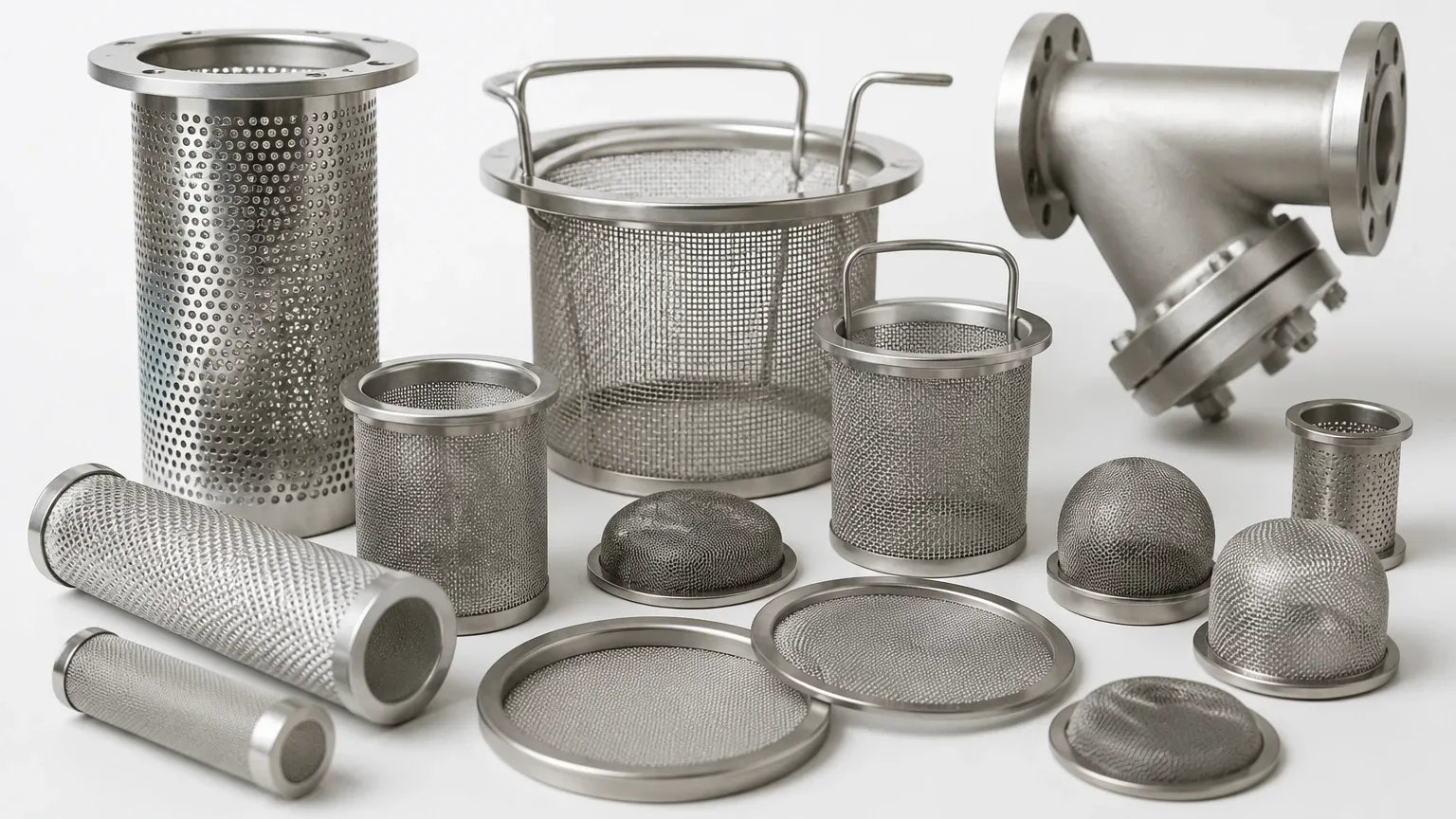
Industrial Strainers & Baskets often feature a two-layer design: a heavy-duty perforated metal basket for structural support and a fine wire mesh liner for precise filtration. The perforated metal provides the strength to withstand high differential pressures, while the wire mesh determines the filtration accuracy. Engineers must balance the need for fine filtration with the requirement for high flow rates.
Customization and OEM Capabilities in Filter Basket Manufacturing
Off-the-shelf solutions rarely meet the specific needs of complex industrial systems. Customization is often necessary to accommodate unique flow rates, piping configurations, or particle sizes. Kaifil’s OEM capabilities allow for the development of bespoke filtration components that integrate seamlessly into existing infrastructure.
Custom Dimensions and Flanges
Whether a system requires a standard Y-strainer or a large-capacity duplex basket strainer, the physical dimensions must be precise. Customization options include specialized flange ratings (ANSI, DIN, JIS), unique handle designs for easy removal, and reinforced bottoms for high-velocity applications.
Specialized Weave Types
The choice of wire mesh weave—such as plain weave, twill weave, or Dutch weave—affects both the filtration rating and the flow characteristics. For example, a Dutch weave provides a dense, strong mesh capable of very fine filtration, whereas a plain weave offers a higher open area for less demanding applications. Working with a manufacturer that understands these nuances ensures that the Strainers & Baskets are optimized for the specific task at hand.
Performance Evaluation: Pressure Drop and Filtration Efficiency
Before purchasing industrial strainers, engineers must evaluate performance expectations. The two primary metrics are filtration efficiency (the ability to capture particles of a specific size) and the clean pressure drop.
Understanding Pressure Drop (ΔP)
Every component placed in a fluid stream creates resistance. The pressure drop across a clean strainer should be calculated using the fluid's viscosity, density, and flow rate. If the initial pressure drop is too high, it leaves very little room for the buildup of debris, necessitating frequent cleaning. Manufacturers provide flow coefficient (Cv) values to help engineers calculate these losses accurately.
Micron Ratings and Mesh Counts
Filtration accuracy is typically measured in microns or mesh count. A 100-mesh screen has 100 openings per linear inch. It is vital to specify the largest particle size that the downstream equipment can tolerate. Over-filtering (selecting a mesh that is much finer than necessary) is a common mistake that leads to excessive pressure drops and increased maintenance costs.
Maintenance and Cleaning of Stainless Steel Filtration Components
The total cost of ownership (TCO) for Strainers & Baskets is heavily influenced by how easily they can be maintained. Unlike disposable cartridges, stainless steel baskets are designed to be cleaned and reused, providing a more sustainable and cost-effective solution over time.
Cleaning Cycles
Maintenance schedules should be determined by monitoring the differential pressure across the strainer. Installing pressure gauges upstream and downstream of the strainer allows operators to see exactly when the basket is becoming clogged. Automated systems can even trigger a backwash cycle or an alarm when the ΔP reaches a predetermined limit.
Cleaning Methods
Depending on the nature of the contaminants, cleaning methods may include:
* Manual Rinsing: Using high-pressure water or air to dislodge particles.
* Ultrasonic Cleaning: Using high-frequency sound waves in a solvent bath to remove fine particles trapped deep within the mesh.
* Chemical Cleaning: Using acids or alkalis to dissolve organic or mineral deposits, provided the strainer material is compatible with the cleaning agent.
Proper cleaning extends the lifespan of the component and ensures that the system operates at peak efficiency. Neglecting maintenance can lead to "basket burst," where the differential pressure exceeds the structural strength of the basket, causing it to collapse and release all captured debris into the downstream system.
Selecting the Right Strainer for Your Application
When it comes to procurement, the "strainer 8 letters" search is just the beginning. To make an informed decision, purchasing teams should confirm several key pieces of information with their supplier:
1. Operating Conditions: What are the maximum operating pressure and temperature? These factors dictate the required wall thickness and material grade.
2. Fluid Characteristics: Is the fluid corrosive, abrasive, or shear-sensitive? What is its viscosity at operating temperature?
3. Contaminant Profile: What is the nature of the solids being removed? Are they hard, soft, fibrous, or gelatinous?
4. Flow Rate: What is the normal and maximum flow rate? This determines the size of the strainer and the required open area.
By addressing these questions, engineers can ensure they select Strainers & Baskets that provide reliable protection and optimal process performance.
Conclusion: Beyond the 8-Letter Word
Whether you arrived here looking for a crossword answer or a technical solution, it is clear that in the industrial world, a "strainer" is much more than an 8-letter word. It is a precision-engineered component that plays a vital role in process safety and efficiency. From selecting the correct grade of stainless steel to optimizing the open area ratio, every design choice has a direct impact on the success of your operation.
Kaifil remains committed to providing high-quality, customized filtration solutions that meet the rigorous demands of modern industry. By focusing on durability, precision, and engineering expertise, we help our global partners achieve reliable filtration performance in even the most challenging environments. When your process depends on clean fluids and protected equipment, the quality of your Strainers & Baskets is the most important specification of all.
