


8ft Strainers
In large-scale industrial fluid handling, the scale of filtration equipment often dictates the efficiency and safety of the entire process. Large-format strainers, specifically those reaching dimensions such as 8ft strainers, are critical components in high-flow environments where protecting downstream equipment—like pumps, heat exchangers, and sensitive instrumentation—is paramount. These substantial filtration units are designed to handle massive volumes of liquid or gas while removing debris, scale, and particulate matter that could cause mechanical failure or process contamination.
Selecting or designing an 8ft strainer requires a deep understanding of fluid dynamics, material science, and mechanical engineering. Because of their size, these units are rarely "off-the-shelf" products; they are typically engineered to meet specific pressure ratings, flow velocities, and chemical compatibility requirements. For engineers and procurement teams, the challenge lies in balancing the initial capital expenditure with the long-term operational costs associated with pressure drop, cleaning cycles, and structural durability.
Engineering Considerations for Large-Scale 8ft Strainers
When dealing with a strainer of this magnitude, the structural integrity of the housing and the internal basket becomes the primary engineering focus. An 8ft strainer—whether it is a T-type, Y-type, or a large basket strainer—must withstand significant internal pressures and the mechanical stresses of high-velocity flow.
Structural Integrity and Pressure Ratings
The housing of an 8ft strainer must be designed according to rigorous standards, such as ASME Section VIII, to ensure it can handle the operating pressure of the system. At this scale, the weight of the fluid contained within the unit, combined with the weight of the stainless steel structure itself, necessitates robust support legs or mounting brackets. Engineering teams must also account for "water hammer" or pressure surges, which can exert immense force on the internal filtration element. If the internal basket is not sufficiently reinforced, the pressure differential ($\\Delta P$) across a clogged mesh could cause it to collapse, leading to catastrophic downstream damage.
Flow Dynamics and Pressure Drop
One of the primary advantages of an 8ft strainer is the massive surface area it provides. In filtration, the relationship between surface area and pressure drop is inverse: the larger the available filtration area, the lower the initial pressure drop. For high-flow applications, maintaining a low $\\Delta P$ is essential to minimize energy consumption by the pumps. Engineers typically aim for an Open Area Ratio (OAR) of at least 6:1. This means the total open area of the strainer mesh is six times the cross-sectional area of the inlet pipe. With an 8ft vertical or horizontal footprint, achieving these ratios is possible even with fine mesh linings, ensuring long intervals between cleaning cycles.
Material Selection and Corrosion Resistance
For industrial applications, particularly in chemical processing, water treatment, and the food and beverage industry, the material of construction is non-negotiable. Stainless steel is the industry standard for 8ft strainers due to its exceptional strength-to-weight ratio and resistance to various forms of corrosion.
SS304 vs. SS316L
* SS304: This is the most common material for general industrial use. It provides excellent resistance to atmospheric corrosion and many organic and inorganic chemicals. It is frequently used in water treatment and general manufacturing where the environment is not highly acidic or saline.
* SS316L: For more demanding environments, such as pharmaceutical manufacturing or marine applications, SS316L is preferred. The addition of molybdenum enhances its resistance to pitting and crevice corrosion in chloride-rich environments. The "L" denotes low carbon content, which is vital for large-scale welded structures like 8ft strainers, as it prevents carbide precipitation during the welding process, maintaining the integrity of the heat-affected zones.
Surface Treatments and Passivation
In addition to the base alloy, the longevity of large strainers is often extended through specialized surface treatments. Passivation is a standard process that removes free iron from the surface of the stainless steel, enhancing the protective oxide layer. For the food and beverage or pharmaceutical sectors, electropolishing may be required to achieve a specific Ra (Roughness Average) value, ensuring that the internal surfaces are smooth enough to prevent bacterial growth and facilitate thorough cleaning.
Filtration Efficiency and Mesh Selection
The heart of the 8ft strainer is the internal basket or screen. Selecting the correct mesh size is a delicate balance between protecting downstream equipment and maintaining flow efficiency. If the mesh is too coarse, harmful particles pass through; if it is too fine, the strainer will clog prematurely, leading to frequent downtime.
Perforated Plate vs. Wire Mesh
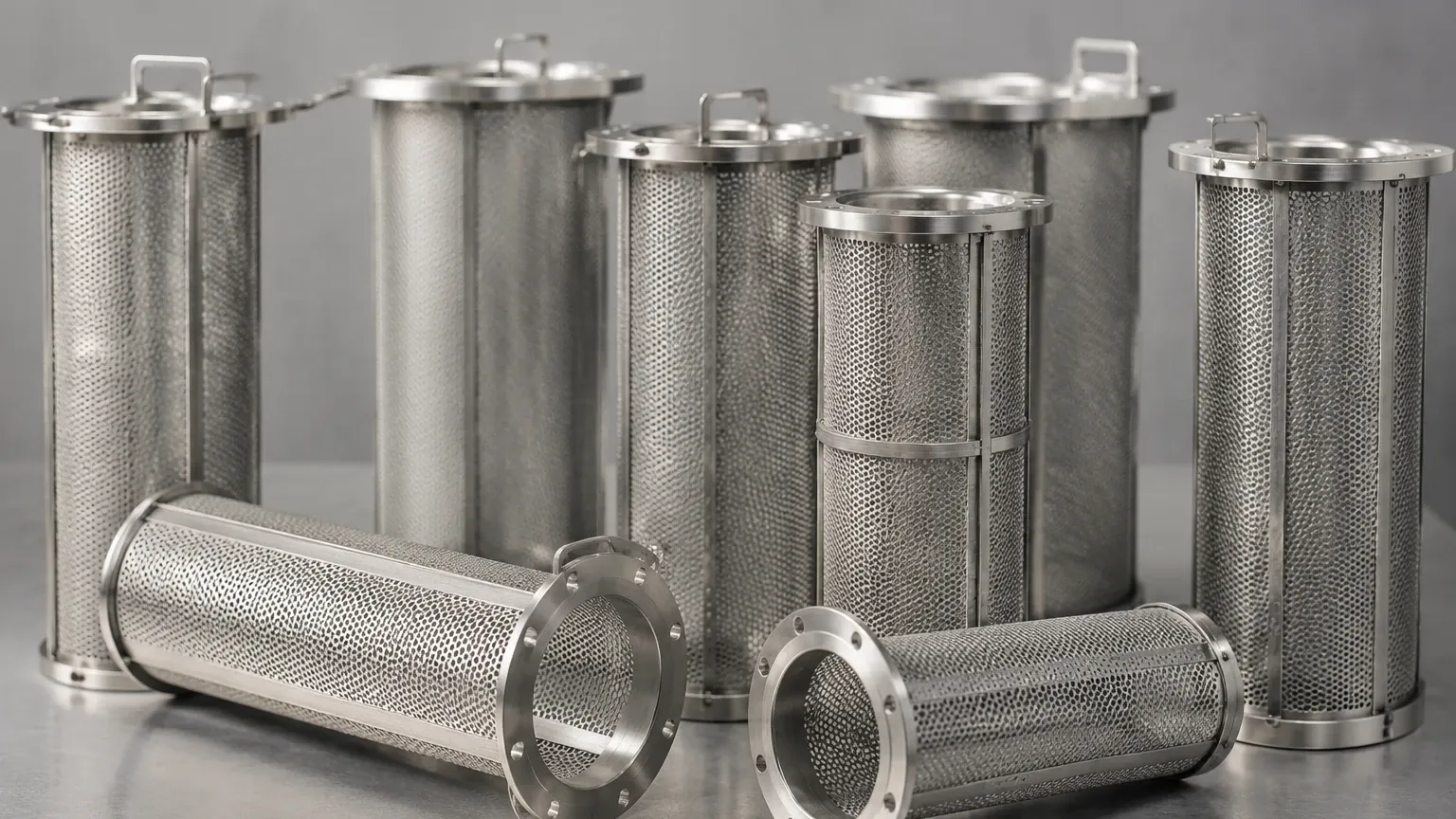
Large strainers often utilize a two-stage filtration approach. The primary structural component is usually a heavy-duty perforated plate made of stainless steel. This plate provides the mechanical strength to resist flow pressure. To achieve finer filtration, a layer of precision stainless steel wire mesh is sintered or mechanically fastened to the inside of the perforated plate. This combination allows the 8ft strainer to capture particles down to the micron level while maintaining the structural rigidity needed for high-volume throughput.
Custom Mesh Configurations
Because 8ft strainers are often used in unique industrial contexts, the mesh configuration must be tailored to the specific debris being targeted. For example, in power plant cooling water intakes, the strainer may need to handle organic debris like seaweed or fish, requiring a different basket geometry than a strainer used in a closed-loop chemical process designed to catch pipe scale and welding slag. Customization options include pleated mesh designs, which further increase the surface area within the same 8ft footprint, effectively extending the service life of the filter element.
Maintenance and Operational Longevity
Maintenance is a critical factor in the total cost of ownership for large-scale filtration systems. An 8ft strainer represents a significant physical asset, and its design must facilitate ease of service to minimize downtime.
Cleaning Mechanisms
Given the size and weight of the internal baskets in 8ft strainers, manual cleaning can be labor-intensive. Many large-scale units are equipped with lifting lugs or davit arms. A davit arm allows a single operator to safely lift the heavy cover and swing it out of the way, providing access to the basket. In some high-load applications, automated backwashing systems are integrated, using a portion of the filtered fluid to flush debris out of the mesh without interrupting the main flow. This is particularly common in continuous processes where shutting down the line for manual cleaning is not an option.
Monitoring and Replacement Cycles
To optimize maintenance, differential pressure gauges are typically installed across the inlet and outlet of the strainer. These gauges provide real-time data on the state of the mesh. A sudden rise in $\\Delta P$ indicates a clog, while a sudden drop could indicate a bypass or a ruptured basket. Establishing a predictable replacement cycle for the internal mesh elements is essential. While the 8ft housing may last for decades, the internal Strainers & Baskets are considered wear parts that require periodic inspection for signs of fatigue, erosion, or mechanical damage.
Customization and OEM Solutions for Specialized Applications
In the B2B industrial sector, one size rarely fits all. This is especially true for 8ft strainers, which are often integrated into complex, pre-existing piping systems. Customization is not just a feature; it is a requirement for successful integration.
Tailored Connection Types
Depending on the industry, the 8ft strainer may require specific connection types. While standard ANSI or DIN flanges are common, some applications may require specialized hub connections or victaulic couplings. The orientation of the inlet and outlet can also be customized—such as offset, right-angle, or inline configurations—to fit within the spatial constraints of a facility's floor plan.
Industry-Specific Requirements
* Chemical Processing: Requires high-grade alloys and specialized gasket materials (like PTFE or Viton) to ensure chemical compatibility and leak-free operation.
* Water Treatment: Often focuses on high-volume throughput and the ability to handle varying solids loads, requiring robust backwashing capabilities.
* Oil and Gas: Demands high-pressure ratings and compliance with stringent safety standards, often necessitating heavy-wall thicknesses and X-ray testing of all welds.
By working with a manufacturer that specializes in custom stainless steel filtration, engineers can ensure that their 8ft strainers are optimized for their specific process conditions. This includes everything from the initial material selection to the final filtration accuracy and the inclusion of custom features like magnetic inserts to capture fine ferrous particles.
Conclusion: Selecting the Right Partner for Large-Scale Filtration
The implementation of 8ft strainers in an industrial system is a significant engineering undertaking. These units are more than just simple screens; they are engineered pressure vessels that play a vital role in process stability and equipment protection. When evaluating a supplier for these large-scale components, it is essential to look for a partner with proven expertise in stainless steel fabrication and a deep understanding of filtration principles.
Factors such as welding quality, adherence to international pressure vessel standards, and the ability to provide customized internal basket designs are what separate a standard supplier from a technical partner. By focusing on the engineering details—such as the Open Area Ratio, material grade, and maintenance access—purchasing teams can secure a filtration solution that delivers reliable performance, low operational costs, and a long service life in the most demanding industrial environments.
