


Kitchen Sink Strainers & Strainer Baskets
In industrial and commercial plumbing systems, the integrity of the drainage network depends heavily on the initial point of filtration. Kitchen sink strainers & strainer baskets serve as the primary defense mechanism against solid waste entering the wastewater stream. For engineers, facility managers, and OEM equipment designers, selecting the correct filtration component is not merely a matter of fit, but a critical decision involving material science, fluid dynamics, and long-term maintenance efficiency.
While residential applications may prioritize aesthetics, commercial and industrial environments demand high-performance Strainers & Baskets that can withstand corrosive cleaning agents, high-temperature discharge, and constant mechanical stress. This guide explores the technical considerations, material requirements, and engineering specifications necessary for optimizing filtration at the source.
The Role of High-Performance Strainers in Industrial and Commercial Plumbing
In a commercial kitchen or a food processing facility, the sink is a hub for various waste products, ranging from organic matter and fats to abrasive cleaning residues. Without effective kitchen sink strainers & strainer baskets, these solids migrate into the plumbing system, leading to several operational failures:
1. Downstream Blockages: Accumulated solids can cause immediate clogs in P-traps and lateral lines, leading to costly downtime and emergency plumbing repairs.
2. Grease Trap Inefficiency: Excessive solid waste entering a grease interceptor reduces its capacity and efficiency, requiring more frequent pumping and increasing the risk of environmental non-compliance.
3. Pump Damage: In facilities where wastewater is pumped to a higher elevation or a treatment plant, solids can cause premature wear or catastrophic failure of pump impellers and seals.
From an engineering perspective, the strainer is a passive filtration device designed to achieve a specific balance between flow rate and particle retention. The objective is to maximize the capture of solids while minimizing the pressure drop (or in gravity systems, the drainage time) to prevent sink overflow.
Material Engineering: Why Stainless Steel is the Standard
In the production of industrial-grade kitchen sink strainers & strainer baskets, the choice of material is the most significant factor in determining the component's lifespan. Kaifil specializes in stainless steel solutions because of the material's inherent resistance to the harsh conditions found in professional environments.
Grade 304 Stainless Steel
Grade 304 is the most common material for commercial strainers. It offers excellent corrosion resistance to most organic acids found in food products and can withstand the high temperatures of commercial dishwashing systems. Its mechanical strength ensures that the basket maintains its shape even when subjected to heavy loads of waste or accidental impact.
Grade 316 Stainless Steel
For environments involving high salinity (such as seafood processing) or exposure to aggressive chemical cleaners (such as phosphoric or nitric acids used in CIP systems), Grade 316 stainless steel is preferred. The addition of molybdenum provides enhanced resistance to pitting and crevice corrosion, making it the superior choice for high-demand industrial applications.
Surface Finishes and Hygiene
Beyond the alloy composition, the surface finish of the strainer plays a role in hygiene. Electropolished or high-grit brushed finishes reduce surface roughness, which prevents bacterial adhesion and makes the cleaning process more effective. This is a critical consideration for facilities adhering to strict food safety standards like HACCP.
Technical Specifications: Mesh Size, Flow Dynamics, and Filtration Accuracy
When specifying kitchen sink strainers & strainer baskets, engineers must look beyond the physical dimensions of the sink opening. The performance of the strainer is dictated by its perforation or mesh configuration.
Perforation Patterns
Most commercial strainers utilize perforated metal. The diameter of the holes determines the "filtration rating." Typical commercial baskets feature 2mm to 5mm perforations. Smaller holes provide finer filtration but require more frequent cleaning to prevent drainage slowdowns. Large holes allow for faster drainage but may permit debris to pass through that could clog downstream components.
Open Area Ratio
The "Open Area Ratio" is the percentage of the total surface area that is open for fluid flow. A higher open area ratio reduces the risk of the sink backing up during high-volume discharge. However, the engineering challenge lies in maintaining structural integrity; if the open area is too high, the metal between the holes (the "bridge") may become too thin, leading to basket deformation over time.
Wire Mesh Integration
In specialized applications where fine particulate must be captured—such as in laboratory sinks or specific food manufacturing processes—a secondary layer of stainless steel wire mesh can be integrated into the basket design. This allows for filtration down to the micron level while maintaining the structural support of a perforated outer shell.
Design Variations in Kitchen Sink Strainers & Strainer Baskets
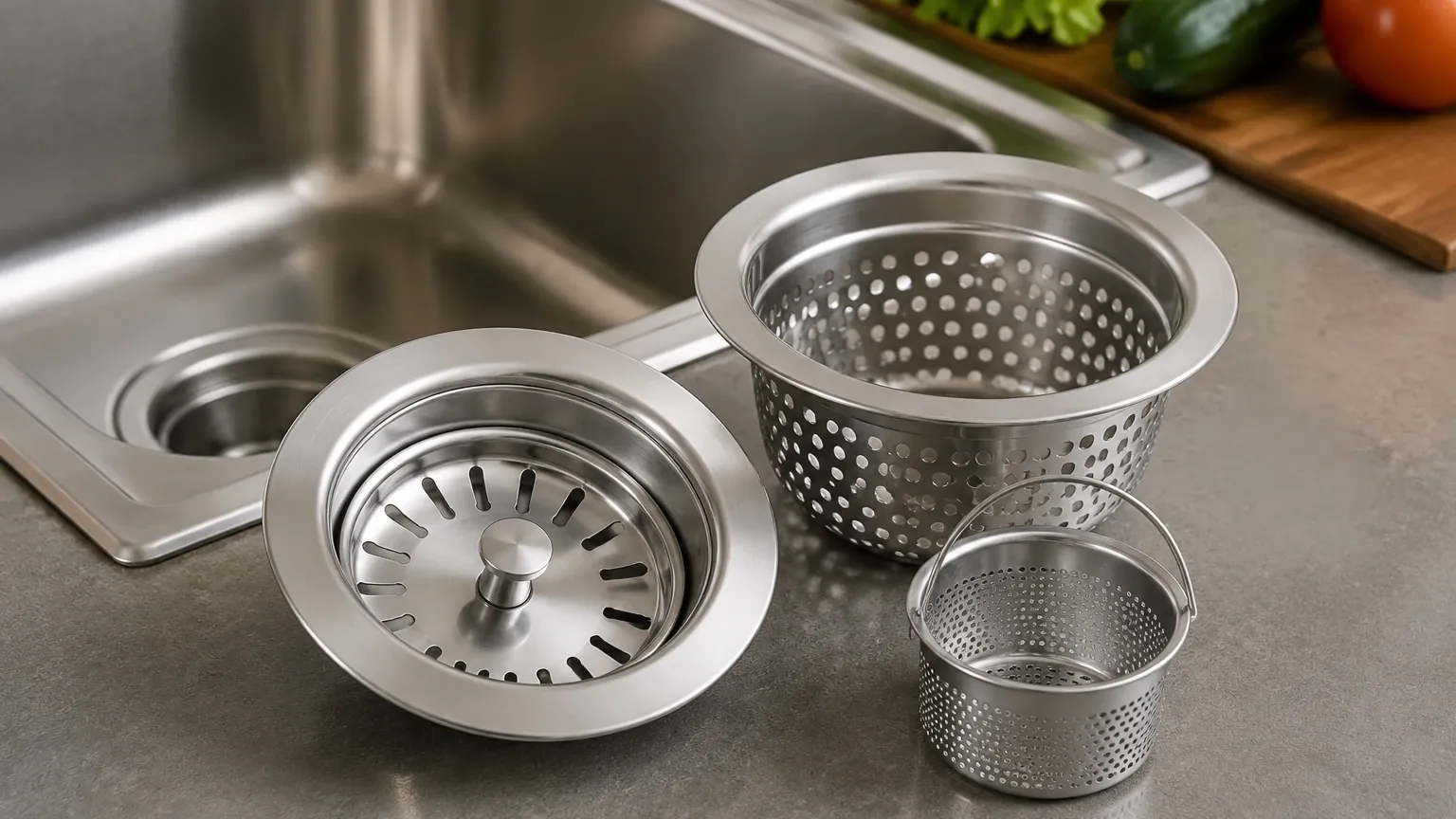
The geometry of the strainer basket is often dictated by the specific requirements of the application. There are several common designs used in professional settings:
* Deep-Cup Strainers: These are designed for sinks that handle large volumes of solid waste. The increased depth allows for a larger collection volume, extending the time between manual cleaning cycles.
* Flat Strainers: Often used in floor sinks or shallow prep sinks, these provide a low-profile solution where vertical space is limited. While they have a lower holding capacity, they are easier to clean quickly.
* Locking Strainers: In some industrial environments, it is necessary to prevent unauthorized removal of the strainer to ensure that solids are never bypassed into the drain. Locking mechanisms ensure the strainer remains in place at all times.
* Dual-Function Baskets: Some designs include a center post that allows the basket to act as a stopper when pressed down and a strainer when lifted. While common in residential settings, professional versions utilize heavy-duty brass or stainless steel stems to ensure durability under repeated use.
Evaluating Total Cost of Ownership and Maintenance Cycles
For purchasing teams, the initial price of kitchen sink strainers & strainer baskets is often a secondary consideration compared to the Total Cost of Ownership (TCO). A lower-quality component made from thin-gauge metal or inferior alloys may fail within months, leading to several hidden costs:
1. Replacement Labor: The cost of a maintenance technician's time to replace a failed strainer often exceeds the cost of the part itself.
2. Collateral Damage: If a strainer fails and allows debris to enter the line, the cost of hydro-jetting or mechanical snaking of the pipes can be substantial.
3. Operational Disruption: In a fast-paced commercial kitchen, a non-functional sink can disrupt the entire workflow, leading to lost revenue.
High-quality Strainers & Baskets from a professional manufacturer like Kaifil are designed for longevity. By utilizing thicker gauges of stainless steel and precision welding techniques, these components can withstand the daily rigors of industrial use for years. Maintenance cycles are also improved; a well-designed basket is easier to empty and clean, reducing the time staff must spend on sanitation tasks.
Custom OEM Solutions for Specialized Filtration Requirements
Standard off-the-shelf strainers do not always meet the needs of specialized industrial equipment. Manufacturers of commercial dishwashers, industrial food processing vats, and specialized laboratory sinks often require custom-engineered kitchen sink strainers & strainer baskets.
Customization options include:
* Bespoke Dimensions: Tailoring the flange diameter, basket depth, and thread pitch to match proprietary equipment designs.
* Specialized Filtration Media: Utilizing specific wire mesh weaves (such as plain, twilled, or dutch weave) to achieve precise filtration targets.
* Enhanced Durability Features: Adding reinforced rims, heavy-duty handles, or specialized coatings for extreme environments.
* Integrated Components: Designing strainers that incorporate sensors or specific mounting hardware for automated systems.
Working with a manufacturer that understands both the manufacturing process and the engineering requirements of filtration ensures that the final product performs reliably under the specific pressures and flow rates of the intended application.
Conclusion: Selecting the Right Solution
Selecting the appropriate kitchen sink strainers & strainer baskets is a vital step in maintaining the efficiency and longevity of an industrial plumbing system. By focusing on material quality, perforation specifications, and the specific demands of the environment, engineers can prevent the most common causes of drainage failure.
Whether you are designing a new facility or upgrading an existing system, prioritizing high-performance stainless steel components will lead to reduced maintenance costs and improved operational reliability. For those requiring precision-engineered or custom filtration components, consulting with a specialist manufacturer like Kaifil provides the technical support necessary to ensure that every strainer meets the highest standards of industrial performance.
