


Types of Basket Strainers
In industrial fluid handling, the protection of downstream equipment—such as pumps, valves, flow meters, and heat exchangers—is critical to operational longevity and process efficiency. Basket strainers serve as the primary line of defense, mechanically removing solids from flowing liquids. Unlike Y-strainers, which are often used for gas or steam with lower debris loading, basket strainers are designed for liquid applications where a higher volume of particulate matter is expected. Selecting the correct Strainers & Baskets requires a deep understanding of the various configurations available and how they align with specific system requirements.
Understanding the different types of basket strainers is essential for engineers and procurement teams to ensure system reliability, minimize pressure drops, and optimize maintenance schedules. This guide explores the technical distinctions between simplex, duplex, and specialized basket strainer designs, alongside the engineering considerations for material selection and filtration precision.
Simplex Basket Strainers
The simplex basket strainer is the most common configuration used in industrial piping systems. It consists of a single chamber containing a removable basket. Because of its straightforward design, it is generally the most cost-effective solution for applications where the flow can be periodically interrupted.
Design and Operation
In a simplex unit, the fluid enters the top of the basket and flows through the mesh or perforated metal walls. The solids are trapped inside the basket, while the clean fluid exits through the outlet. Maintenance is performed by depressurizing the system, removing the cover, and lifting the basket out for cleaning or replacement.
Ideal Applications
Simplex strainers are best suited for batch processes or systems where downtime does not result in significant financial loss or safety risks. Common applications include:
* Cooling water intake for non-critical machinery.
* Chemical batch processing where the line is cleaned between runs.
* Protection of pumps in seasonal irrigation systems.
Duplex (Twin) Basket Strainers
For critical infrastructure where a process cannot be shut down for maintenance, duplex basket strainers are the industry standard. These units consist of two separate strainer chambers connected by a common manifold and a diverter valve.
Continuous Flow Capabilities
The primary advantage of a duplex system is its ability to operate continuously. When the differential pressure across the active basket reaches a predetermined limit (indicating it is full of debris), the operator shifts the diverter valve to direct the flow into the second, clean chamber. The first chamber can then be isolated, opened, and cleaned without stopping the main process flow.
Selection Criteria for Duplex Systems
When evaluating duplex types, engineers must consider the valve mechanism. Common designs include:
* Plug Valves: Robust and simple, often used for smaller line sizes.
* Sliding Gate Valves: Used in larger high-pressure systems to ensure a tight seal during changeover.
* Ball Valves: Provide quick, low-torque operation, often preferred in automated systems.
Duplex strainers are essential in power generation, continuous chemical manufacturing, and maritime fuel filtration systems where equipment failure due to clogged filters is not an option.
Automatic Self-Cleaning Basket Strainers
In high-volume applications or environments with extremely high particulate loads, manual cleaning of baskets—even in a duplex setup—can become labor-intensive and inefficient. Automatic self-cleaning strainers address this by using a motorized mechanism to clear debris from the filter element.
How Self-Cleaning Mechanisms Work
Most automatic units use a backwashing or scraping principle. When sensors detect a high differential pressure, a cleaning arm rotates inside the basket. A small portion of the process fluid is used to flush the trapped solids out through a dedicated blow-down valve. This process occurs while the main flow continues, ensuring zero downtime and minimal operator intervention.
Economic Considerations
While the initial capital expenditure for an automatic strainer is higher than for simplex or duplex types, the total cost of ownership is often lower in high-debris applications due to reduced labor costs and the elimination of disposable filter elements.
Specialized Basket Designs and Configurations
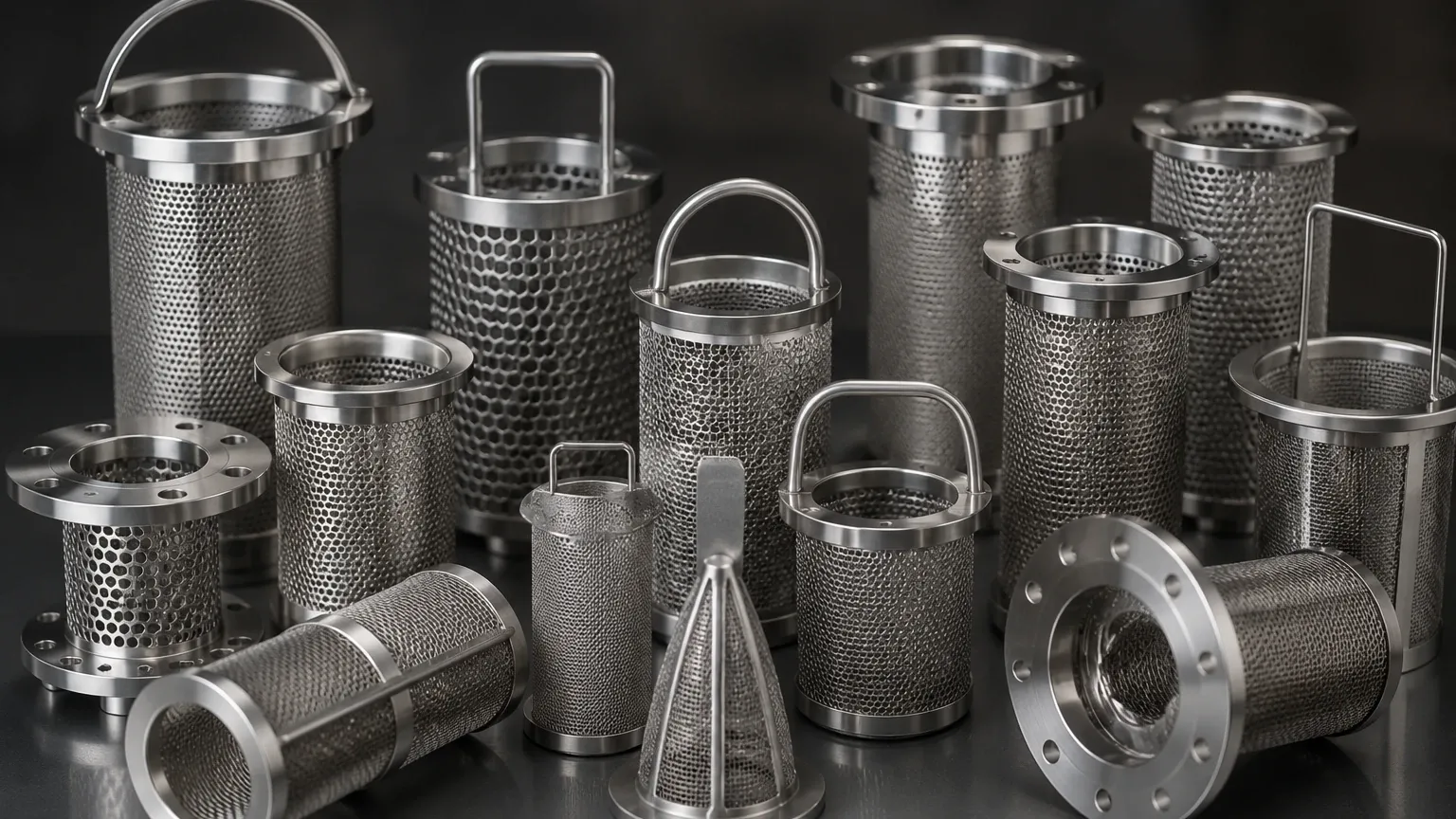
Beyond the standard simplex and duplex housings, the internal basket itself can be customized to meet specific filtration challenges. The performance of any of the types of basket strainers is ultimately determined by the geometry and material of the internal element.
Multi-Basket Strainers
For very large pipe diameters (typically 12 inches and above), a single basket would be too heavy and cumbersome for manual removal. Multi-basket strainers use several smaller baskets within a single large housing. This design increases the total filtration surface area, which reduces the frequency of cleaning and lowers the initial pressure drop across the unit.
Steam-Jacketed Strainers
In industries such as food processing (chocolate, fats) or chemical manufacturing (resins, polymers), fluids may solidify or become too viscous to flow at ambient temperatures. Jacketed strainers allow for the circulation of steam or hot oil around the housing to maintain the fluid's temperature and ensure efficient filtration.
Magnetic Inserts
In systems where fine ferrous particles (such as pipe scale or wear particles from machinery) are a concern, magnetic inserts can be added to the basket. These magnets trap metallic fines that might otherwise pass through a standard mesh, providing an extra layer of protection for sensitive downstream equipment.
Engineering Considerations for Selection
Choosing between different types of basket strainers requires a technical analysis of the fluid properties and the system's operating parameters. Engineers should focus on the following four factors:
1. Pressure Drop and Open Area Ratio (OAR)
The pressure drop (ΔP) is the loss in fluid pressure as it passes through the strainer. A high initial pressure drop limits the amount of debris the strainer can hold before it must be cleaned. The Open Area Ratio (OAR) is a key metric here; it is the ratio of the total area of the holes in the basket to the cross-sectional area of the inlet pipe. A higher OAR (typically 4:1 or 6:1) results in a lower pressure drop and longer intervals between cleanings.
2. Filtration Accuracy (Micron Rating)
The choice of basket media—whether perforated metal or fine wire mesh—depends on the size of the particles that need to be removed. Perforated baskets are used for coarse straining (1/32" to 1/2" holes), while wire mesh linings are required for finer filtration (down to 40 microns or less). It is a common mistake to specify a mesh that is too fine, which leads to rapid clogging and unnecessary pressure loss.
3. Material Compatibility
Stainless steel (Grade 304 or 316L) is the preferred material for most industrial baskets due to its corrosion resistance and structural integrity. For highly corrosive environments, such as those involving seawater or concentrated acids, specialized alloys like Monel or Hastelloy may be required. The housing material must also be compatible with the piping system, with options typically including cast iron, carbon steel, or stainless steel.
4. Viscosity Effects
Fluid viscosity significantly impacts strainer performance. High-viscosity liquids (like heavy oils or syrups) create much higher pressure drops than water. In these cases, engineers must often oversize the strainer or select a design with a significantly larger filtration surface area to maintain flow rates.
Maintenance and Risk Mitigation
Regardless of the type selected, improper maintenance is the leading cause of strainer-related system failures. To mitigate risks, industrial installations should include:
* Differential Pressure Gauges: These provide a visual or electronic signal when the basket is reaching its holding capacity. Relying on a fixed schedule for cleaning is often inefficient, as debris loads can fluctuate.
* Spare Baskets: For simplex and duplex units, having a clean spare basket on hand allows for immediate replacement, minimizing the time the chamber is open and reducing the risk of process contamination.
* Correct Gasket Selection: Ensuring that the cover gaskets are compatible with the process fluid and temperature is vital to prevent leaks, especially in high-pressure applications.
Conclusion
Selecting the right Strainers & Baskets is a balance between process requirements, maintenance capabilities, and budget constraints. Simplex strainers offer simplicity for non-critical lines, duplex strainers ensure continuity for vital operations, and automatic systems provide a hands-off solution for high-debris environments. By focusing on engineering fundamentals—such as the Open Area Ratio, material compatibility, and the specific nature of the contaminants—technical professionals can ensure their filtration systems provide reliable, long-term protection for their industrial infrastructure.
For custom requirements, working with a manufacturer that understands the nuances of stainless steel fabrication and precision filtration is essential. Custom-engineered baskets and housings can often solve unique space constraints or particularly challenging filtration specifications that off-the-shelf units cannot accommodate.
