


Strainer Basket Boat
In the maritime industry, the reliability of onboard systems is directly linked to the quality of the raw water intake system. For vessels ranging from commercial fishing fleets to industrial transport ships, the raw water cooling system serves as the primary thermal management solution for engines, generators, and HVAC units. At the heart of this system is the sea strainer, and more specifically, the strainer basket boat configuration. This component acts as the first line of defense against environmental debris that could otherwise cause catastrophic mechanical failure or significant downtime.
Selecting the correct Strainers & Baskets requires a deep understanding of fluid dynamics, material science, and the specific environmental challenges of marine operations. As a professional manufacturer, Kaifil provides precision-engineered filtration solutions designed to meet the rigorous demands of marine and industrial applications, ensuring that every strainer basket boat component delivers optimal flow and debris retention.
The Role of the Strainer Basket in Marine Raw Water Systems
A marine raw water strainer is a specialized filter installed between the seacock (the intake valve) and the engine's heat exchanger. Its primary function is to remove solids—such as seaweed, grass, plastic debris, sand, and small marine life—from the water before it enters the cooling passages.
The "strainer basket boat" refers to the internal element that captures these contaminants. Unlike standard industrial filters that may handle consistent, pre-treated fluids, a marine basket must handle highly variable intake conditions. If the basket fails to capture debris, the heat exchanger tubes can become clogged, leading to rapid engine overheating. Conversely, if the basket is poorly designed and creates excessive flow resistance, the cooling system will be starved of water, leading to the same result.
Engineering Considerations for Marine Basket Selection
When engineers and purchasing teams evaluate a strainer basket boat for a vessel, several technical factors must be balanced to ensure system integrity.
1. Flow Rate and Velocity
The most critical factor is the flow rate, typically measured in gallons per minute (GPM) or cubic meters per hour (m³/h). The basket must have a large enough surface area to allow the required volume of water to pass through with minimal pressure drop. Engineers often look for a "free area ratio," which is the ratio of the open area of the basket holes to the area of the intake pipe. A common industry standard is a ratio of at least 6:1, which ensures that even as the basket begins to fill with debris, the flow remains sufficient for cooling.
2. Filtration Accuracy (Mesh vs. Perforation)
Marine baskets are usually constructed from perforated metal or a combination of perforated metal and wire mesh.
- Perforated Plate: Provides structural strength and is suitable for capturing larger debris like seaweed and shells. Common hole sizes range from 1/16" to 1/8".
- Wire Mesh Liners: For applications requiring finer filtration, such as protecting high-efficiency heat exchangers or auxiliary pumps, a fine wire mesh (e.g., 20 to 60 mesh) can be sintered or welded to the interior of the perforated basket. This provides the necessary filtration accuracy without sacrificing the structural rigidity needed to withstand suction pressure.
3. Pressure Drop (ΔP)
Every filter introduces a pressure drop. In a suction-side application like a boat's raw water intake, an excessive pressure drop can cause cavitation in the raw water pump. A well-engineered strainer basket boat is designed with a flow-optimized geometry to keep the clean pressure drop as low as possible, typically under 2-3 PSI at maximum flow velocity.
Material Selection: The Importance of Stainless Steel in Maritime Environments
The marine environment is one of the most corrosive atmospheres on Earth. The combination of high salinity, dissolved oxygen, and varying temperatures creates an ideal environment for galvanic and pitting corrosion.
316L Stainless Steel: The Industry Standard
While some smaller recreational vessels use bronze or plastic strainers, industrial and commercial marine applications rely heavily on 316L stainless steel. 316L contains molybdenum, which significantly enhances its resistance to chloride-induced pitting. For a strainer basket boat, using high-grade stainless steel ensures that the basket does not lose structural integrity over years of submersion in saltwater.
Corrosion Resistance and Longevity
Beyond the base material, the manufacturing process plays a role in longevity. At Kaifil, we utilize advanced welding techniques and surface treatments to ensure that the heat-affected zones of the welds are as corrosion-resistant as the base metal. This prevents "weld decay," a common failure point in lower-quality baskets where the mesh detaches from the frame due to localized corrosion.
Technical Specifications and Performance Metrics
To make an informed purchasing decision, technical professionals should confirm the following specifications for any strainer basket boat replacement or OEM integration:
* Material Grade: 304, 316, or 316L Stainless Steel. 316L is preferred for its lower carbon content, which reduces carbide precipitation during welding.
* Construction Type: Spot welded, TIG welded, or seam welded. For high-vibration marine environments, TIG welding provides the highest durability.
* Handle Design: Baskets should feature a robust, integrated handle. In a marine context, the basket must be easily removable for cleaning, often in cramped engine room conditions. A folding or fixed handle that does not obstruct the lid seal is essential.
* Reinforcement: For larger baskets (typically those with diameters over 6 inches), internal or external reinforcement rings may be necessary to prevent the basket from collapsing under the vacuum pressure of the intake pump.
* Micron Rating: If the application involves protecting sensitive components, the micron rating must be specified. Standard raw water straining usually falls between 500 and 2000 microns, but custom mesh liners can go much finer.
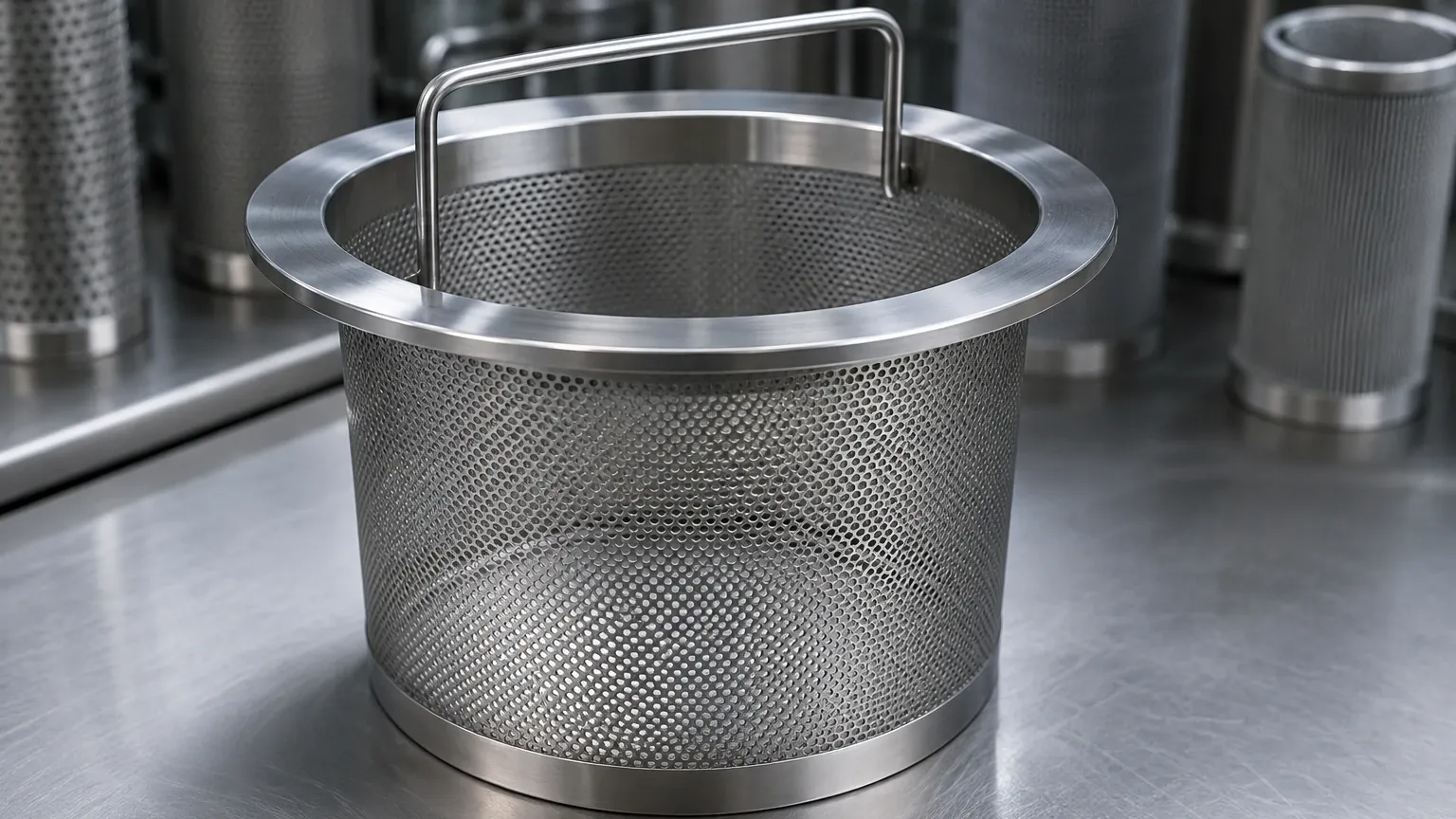
Customization and OEM Solutions for Marine Filtration
One of the primary challenges in marine engineering is the lack of standardized space. Engine rooms are often crowded, and the raw water system must be routed around existing bulkheads and machinery. This often necessitates custom-sized Strainers & Baskets that fit specific housing dimensions.
Kaifil specializes in custom stainless steel filtration solutions. For a strainer basket boat, customization options include:
* Variable Dimensions: Custom heights, diameters, and flange sizes to fit legacy strainer housings where the original manufacturer no longer provides parts.
* Multi-Stage Filtration: Designing baskets with nested layers of different mesh sizes to capture both large and small particulates in a single pass.
* Specialized Coatings: In some cases, electro-polishing is applied to the stainless steel to create a smoother surface, which reduces the rate of bio-fouling (the growth of barnacles and algae inside the basket).
By working directly with a manufacturer, engineers can specify the exact parameters required for their vessel's unique flow and pressure requirements, rather than settling for "off-the-shelf" components that may not provide the necessary performance margins.
Maintenance and Operational Longevity
Even the best-engineered strainer basket boat requires regular maintenance to function effectively. In marine applications, the maintenance cycle is heavily dependent on the operating environment. Vessels operating in shallow, sandy waters or areas with high seasonal algae blooms will require more frequent inspections.
Cleaning Protocols
Baskets should be inspected regularly. The process typically involves closing the seacock, opening the strainer lid, and removing the basket. Debris should be cleared manually, and the mesh should be inspected for signs of "blinding" (where small particles become permanently lodged in the mesh openings). If the mesh is blinded, it can often be cleared with a high-pressure water jet or a soft-bristle brush. Metal brushes should be avoided as they can scratch the stainless steel and create sites for corrosion.
Replacement Indicators
While stainless steel baskets are durable, they are not permanent. Signs that a strainer basket boat needs replacement include:
* Deformation: If the basket is no longer perfectly cylindrical or the bottom is bowed, it indicates that it has been subjected to excessive pressure, likely due to a clog.
* Mesh Separation: Any gaps between the mesh and the support frame allow bypass, meaning debris is reaching the engine.
* Pitting: Small, pin-sized holes in the metal indicate that the protective chromium oxide layer has failed, and the basket's structural integrity is compromised.
Conclusion: Optimizing Vessel Performance
The strainer basket boat is a small but vital component in the complex ecosystem of a vessel's mechanical systems. By prioritizing high-grade materials like 316L stainless steel, ensuring proper flow-to-area ratios, and selecting a manufacturer with the capability to provide custom OEM solutions, marine engineers can significantly reduce the risk of engine failure and maintenance costs.
At Kaifil, we understand that industrial filtration is about more than just capturing debris; it is about protecting the long-term assets of our clients. Whether you are designing a new cooling system or sourcing high-performance replacements for an existing fleet, our expertise in stainless steel wire mesh and precision metal components ensures that your filtration systems operate at peak efficiency. For those looking to upgrade their marine filtration hardware, we invite you to review our technical capabilities and explore our range of custom Strainers & Baskets to find the ideal solution for your specific maritime application.
