


Basket Strainer Catalogue PDF
In industrial fluid handling systems, the selection of effective filtration components is critical to protecting downstream equipment such as pumps, valves, and heat exchangers. For engineers and procurement specialists, a basket strainer catalogue pdf serves as more than just a product list; it is a vital technical document containing the dimensions, material specifications, and performance curves necessary for system integration.
When evaluating Strainers & Baskets, understanding the engineering nuances behind the data is essential. This guide examines the technical parameters typically found in these catalogues and how to interpret them to ensure optimal filtration performance in demanding environments like chemical processing, water treatment, and food production.
The Role of Technical Catalogues in Industrial Filtration Selection
A comprehensive basket strainer catalogue pdf provides the foundational data required for the initial design phase of a piping system. Unlike simple y-strainers, basket strainers are designed for applications requiring higher flow capacities and easier maintenance. Because the basket is oriented vertically, it can hold more debris than a wye-type strainer, resulting in longer intervals between cleaning cycles.
For a technical professional, the catalogue is a reference for:
* Dimensional Accuracy: Ensuring the face-to-face dimensions align with existing piping layouts.
* Pressure Ratings: Verifying that the housing can withstand the maximum operating pressure of the system, often categorized by ANSI or DIN standards.
* Material Compatibility: Identifying the correct alloys for the specific chemical composition of the process fluid.
By consulting these documents early in the procurement process, engineering teams can avoid costly installation errors and ensure that the selected filtration solution meets the longevity requirements of the facility.
Key Technical Parameters Found in a Basket Strainer Catalogue PDF
When reviewing a catalogue, several critical specifications dictate the suitability of a strainer for a specific application. These parameters are usually presented in tabular format or through engineering drawings.
Connection Types and Sizes
Industrial strainers are available in various connection styles, including flanged (raised face or flat face), threaded (NPT or BSP), and socket weld. The catalogue will specify the available line sizes, typically ranging from 1/2 inch to 24 inches or larger for custom industrial applications. Selecting the correct connection type is vital for maintaining seal integrity and preventing leaks in high-pressure systems.
Pressure and Temperature Ratings
The relationship between pressure and temperature is a fundamental engineering consideration. As temperature increases, the maximum allowable working pressure (MAWP) of the metal housing typically decreases. A high-quality basket strainer catalogue pdf will include pressure-temperature charts that allow engineers to verify that the strainer remains safe under peak operating conditions.
Effective Filtration Area (EFA)
The EFA refers to the total open area of the mesh or perforated plate within the basket. A higher EFA results in a lower initial pressure drop and a higher dirt-holding capacity. Catalogues often list the "Open Area Ratio," which compares the open area of the basket to the cross-sectional area of the inlet pipe. A ratio of 6:1 or higher is often preferred for systems with high solids loading.
Material Engineering for Strainers & Baskets
Material selection is perhaps the most critical factor in determining the service life of a strainer. Kaifil specializes in stainless steel solutions, which offer superior corrosion resistance and structural integrity compared to cast iron or carbon steel alternatives.
Stainless Steel 304 vs. 316
* SS304: Suitable for general industrial applications, water treatment, and food processing where moderate corrosion resistance is required.
* SS316/316L: Contains molybdenum, which provides enhanced resistance to chlorides and acids. This is the standard choice for marine environments, pharmaceutical production, and aggressive chemical processing.
Specialized Alloys
In some instances, standard stainless steel may not suffice. Catalogues may list options for Duplex stainless steel or Monel for highly specialized applications involving seawater or high-temperature hydrofluoric acid. The choice of material affects not only the housing but also the basket, the O-rings (Viton, EPDM, or PTFE), and the closure bolts.
Evaluating Filtration Efficiency: Mesh and Perforation Options
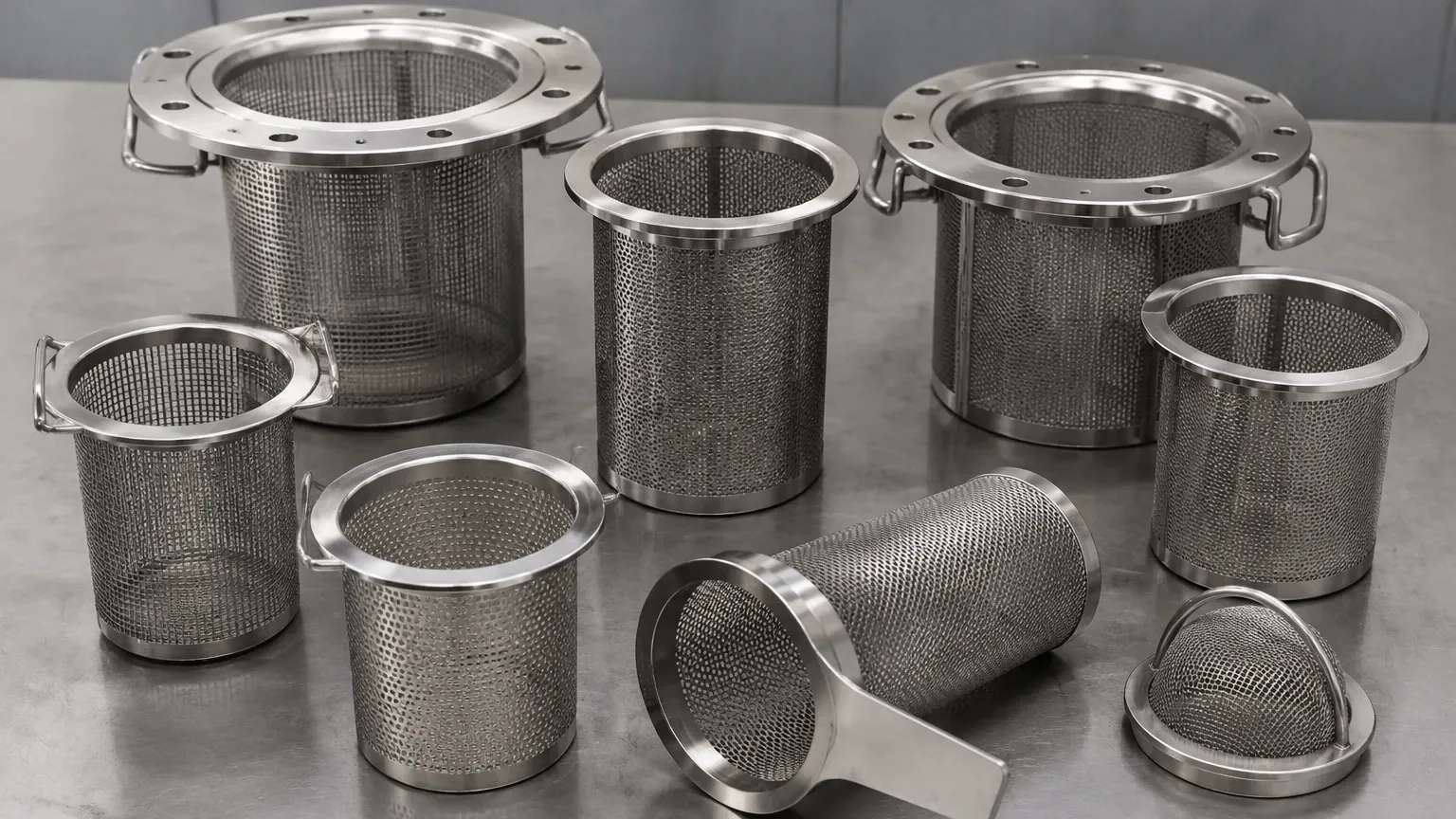
The "basket" in a basket strainer is the functional heart of the unit. It is typically constructed from a perforated metal sheet, which may be lined with a finer wire mesh depending on the required filtration accuracy.
Perforated Plates
Perforated plates are used for coarse straining, typically removing particles 1/32" to 1/2" in size. They provide the structural strength necessary to withstand high differential pressures. Common hole patterns include staggered or straight rows, with varying diameters to balance flow and strength.
Wire Mesh Liners
For finer filtration, a stainless steel wire mesh is welded to the inside or outside of the perforated basket. Mesh sizes are defined by the number of openings per linear inch. For example, a 100-mesh screen has 100 openings per inch and can capture particles down to approximately 150 microns. When reviewing a basket strainer catalogue pdf, engineers must determine the smallest particle size that needs to be removed to protect downstream components without causing excessive flow restriction.
Calculating Pressure Drop and Flow Capacity
One of the most important sections of any filtration catalogue is the flow data, often expressed through Cv factors (the volume of water in gallons per minute that will flow through the strainer with a 1 psi pressure drop).
The Significance of Delta P (ΔP)
As debris accumulates in the basket, the pressure drop across the strainer increases. Engineers use the flow curves in the catalogue to calculate the "clean pressure drop." It is a general rule of thumb that the initial pressure drop should not exceed 2 psi. If the calculated ΔP is higher, a larger strainer or a different basket configuration may be required.
Impact of Viscosity
Flow charts in a standard catalogue are usually based on water. If the process fluid is more viscous (such as oils or resins), the pressure drop will be significantly higher. Technical catalogues often provide correction factors for different viscosities, allowing for accurate sizing in non-water applications.
Custom OEM Solutions Beyond the Standard Catalogue
While a basket strainer catalogue pdf provides a wide range of standard options, many industrial applications require customized engineering. Kaifil provides extensive OEM capabilities to modify standard designs to meet specific project requirements.
Customization options often include:
* Modified Dimensions: Adjusting the height or width of the strainer to fit into tight mechanical rooms.
* Specialized Coatings: Applying epoxy or PTFE coatings for additional chemical resistance.
* Advanced Closures: Replacing standard bolted covers with quick-opening "swing bolt" or "clamp" covers to reduce downtime during cleaning.
* Multi-Basket Designs: For very large flow rates, multiple baskets can be housed in a single vessel to increase the filtration area and simplify handling.
Maintenance and Operational Longevity
To ensure the long-term reliability of Strainers & Baskets, maintenance protocols must be established based on the technical data provided by the manufacturer.
Cleaning Cycles
Most industrial strainers are equipped with differential pressure gauges. When the pressure drop reaches a predetermined level (usually 10-15 psi above the clean drop), the basket must be removed and cleaned. The catalogue will often specify the maximum allowable differential pressure before the basket risks structural collapse.
Replacement Parts
A reliable catalogue should also include a breakdown of wear parts. O-rings and gaskets should be inspected every time the cover is opened and replaced if they show signs of compression set or chemical degradation. Keeping a stock of replacement baskets is also recommended to allow for immediate swapping during cleaning cycles, minimizing process downtime.
Conclusion: Making Informed Purchasing Decisions
A basket strainer catalogue pdf is an indispensable tool for the modern engineer, providing the empirical data needed to design efficient and safe fluid systems. By focusing on material integrity, precise filtration ratings, and accurate flow calculations, procurement teams can select strainers that offer the best total cost of ownership.
Whether you are designing a new chemical plant or upgrading a municipal water treatment facility, the technical details found in these documents ensure that your filtration system performs as expected. For those requiring specialized configurations or high-performance stainless steel components, working with a manufacturer that understands both standard specifications and custom OEM requirements is the key to achieving long-term operational success.
