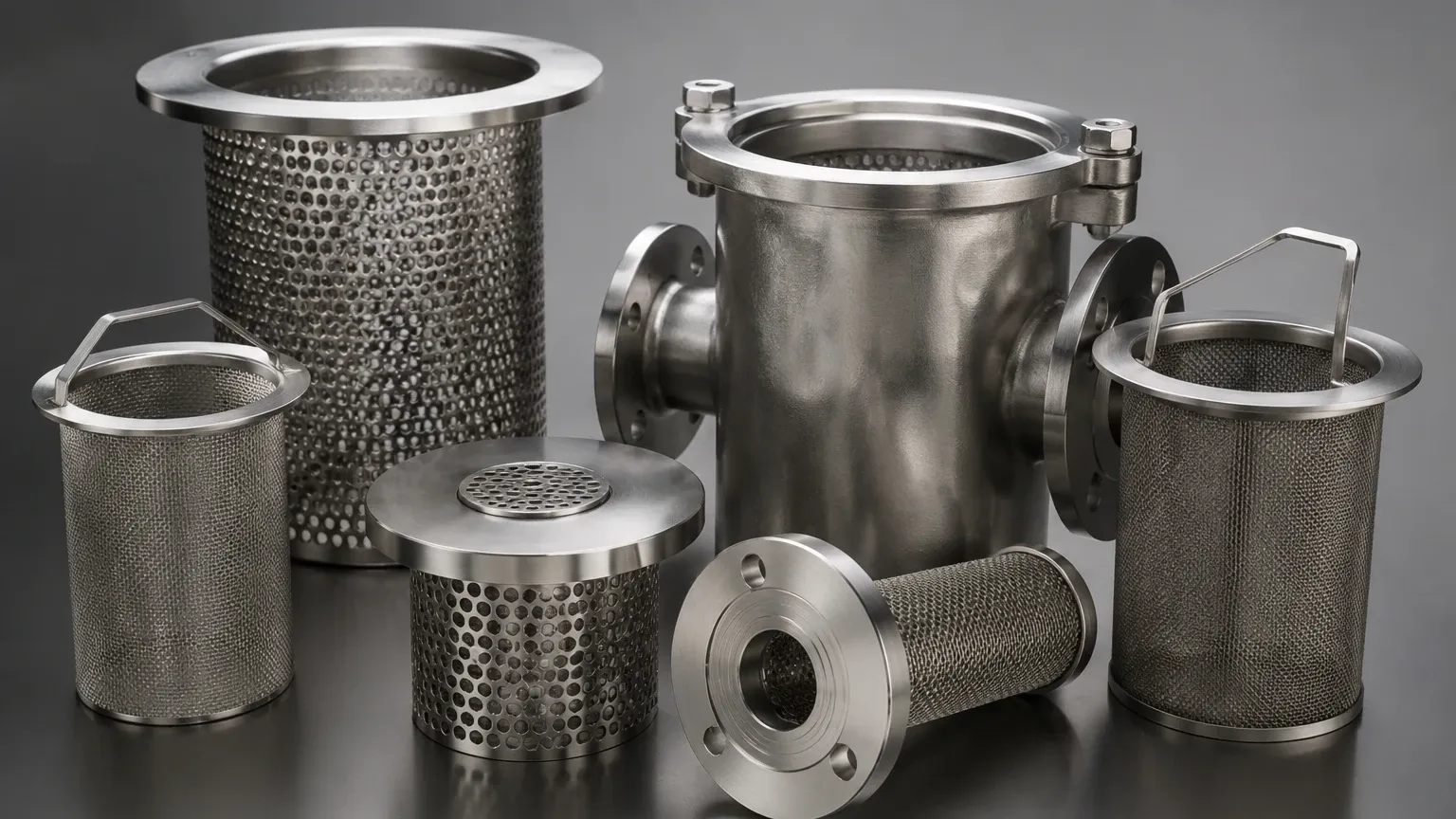
Basket Strainer Equivalent Length
In industrial piping design, accurately predicting pressure drop across every component is critical for ensuring system efficiency and pump longevity. Among the various components, Strainers & Baskets play a dual role: they protect downstream equipment from particulate damage while inevitably introducing a degree of flow resistance. To simplify complex fluid dynamics, engineers often use the concept of "equivalent length" to represent the head loss of a strainer in terms of a specific length of straight pipe. Understanding the basket strainer equivalent length is essential for calculating the total dynamic head (TDH) of a system and ensuring that pumps operate within their preferred operating range.
The Engineering Concept of Equivalent Length (L/D)
Equivalent length is a method used to express the pressure loss of valves, fittings, and filters as the length of a straight pipe of the same diameter that would produce the same pressure drop. This is typically expressed as an L/D ratio, where 'L' is the equivalent length and 'D' is the internal diameter of the pipe.
For a basket strainer, the equivalent length is significantly higher than that of a standard gate valve or elbow due to the internal obstruction of the basket and the mesh media. While a standard 90-degree elbow might have an L/D ratio of approximately 30, a clean basket strainer can have an L/D ratio ranging from 100 to 300 or more, depending on the internal geometry and the percentage of open area.
By converting the resistance of a basket strainer into an equivalent length of pipe, engineers can add this value to the actual physical length of the piping run. This total length is then used in the Darcy-Weisbach or Hazen-Williams equations to determine the total friction loss of the system. This simplification allows for faster manual calculations and provides a standard metric for comparing different strainer designs.
Why Basket Strainer Equivalent Length Matters for System Design
The calculation of basket strainer equivalent length is not merely a theoretical exercise; it has direct implications for the mechanical integrity and operational costs of industrial processes.
1. Pump Sizing and NPSH Requirements
If the equivalent length of a strainer is underestimated, the actual pressure drop will be higher than the design value. In suction-side applications, this can lead to insufficient Net Positive Suction Head Available (NPSHA). When NPSHA falls below the Net Positive Suction Head Required (NPSHR) by the pump, cavitation occurs. Cavitation leads to the formation and collapse of vapor bubbles, which can pit impellers, destroy seals, and cause premature pump failure.
2. Energy Consumption
Every unit of pressure drop caused by a strainer must be compensated for by the pump. In high-flow systems, a strainer with a high equivalent length increases the total head requirements, leading to higher electrical consumption. By selecting a basket strainer with an optimized L/D ratio—such as those engineered by Kaifil with high open-area ratios—facilities can reduce their long-term operational expenditures.
3. Flow Consistency
In industries like chemical processing or food and beverage production, maintaining a precise flow rate is vital for product quality. If the equivalent length of the filtration component is not properly accounted for, the system may fail to deliver the required volumetric flow, leading to batch inconsistencies or process delays.
Variables Affecting the L/D Ratio of Basket Strainers
The equivalent length of a basket strainer is not a fixed constant; it is influenced by several design and operational factors. Engineers must consider these variables when reviewing manufacturer data sheets.
Internal Geometry and Housing Design
The path the fluid takes through the strainer body significantly impacts the pressure drop. A "slant-top" or angled basket design may offer a more streamlined flow path compared to a traditional vertical entry. The transition from the inlet piping to the larger strainer body creates turbulence, and the smoother these transitions are, the lower the basket strainer equivalent length will be.
Open Area Ratio (OAR)
The Open Area Ratio is the relationship between the total area of the openings in the strainer basket and the internal cross-sectional area of the inlet pipe. A common industry standard is a 6:1 OAR. A higher OAR generally results in a lower equivalent length because the fluid has more paths to exit the basket, reducing the localized velocity through the mesh. Kaifil specializes in custom stainless steel baskets that maximize OAR while maintaining the structural integrity required for high-pressure applications.
Mesh and Perforation Size
The finer the filtration, the higher the resistance. A basket lined with a 200-mesh stainless steel screen will have a much higher equivalent length than a basket with 1/4-inch perforations. This is because the finer wires occupy more space and create more friction. When specifying Strainers & Baskets, engineers must balance the need for fine filtration with the allowable pressure drop of the system.
Fluid Viscosity and Density
Equivalent length calculations are typically based on water at standard temperature. However, as fluid viscosity increases, the friction factor changes. For highly viscous fluids, such as heavy oils or syrups, the effective equivalent length of a basket strainer increases dramatically. In these cases, the standard L/D ratios provided for water must be corrected using viscosity correction factors.
Technical Calculation Methods: K-Factors vs. L/D
While equivalent length is a popular metric, many engineers prefer using the Resistance Coefficient (K-factor). The relationship between the K-factor and the equivalent length is defined by the formula:
**K = f * (L/D)**
Where:
* K is the dimensionless resistance coefficient.
* f is the Darcy friction factor for the pipe.
* L is the equivalent length.
* D is the pipe diameter.
The pressure drop (ΔP) can then be calculated using the velocity of the fluid (v):
**ΔP = K * (ρ * v²) / 2**
In this equation, ρ represents the fluid density. Manufacturer data for basket strainers often provides a Cv value (flow coefficient), which is the number of gallons per minute of 60°F water that will flow through the strainer with a 1 psi pressure drop. The Cv can be converted to a K-factor or an equivalent length to integrate the strainer into a broader hydraulic model.
When calculating the basket strainer equivalent length for a specific installation, it is important to use the friction factor (f) that corresponds to the pipe material and Reynolds number of the actual application. Using a generic friction factor can lead to errors in the final head loss estimation.
The Impact of Clogging on Equivalent Length
One of the most critical considerations in industrial filtration is that the basket strainer equivalent length is only "standard" when the basket is clean. As the strainer performs its job and captures debris, the available open area decreases, and the equivalent length increases exponentially.
In many design scenarios, engineers use a "fouled" equivalent length for their calculations. For example, a system might be designed to operate efficiently even when the strainer is 50% clogged. At this point, the pressure drop may be double or triple the clean pressure drop.
To manage this, high-performance systems utilize differential pressure (DP) gauges. By monitoring the pressure difference between the inlet and outlet of the basket strainer, operators can determine exactly when the equivalent length has reached a critical threshold that requires cleaning. This proactive maintenance prevents the system from reaching a state where the pump is forced to operate at the end of its curve, which can lead to overheating and mechanical failure.
Customization and OEM Solutions for Optimized Filtration
Standard off-the-shelf strainers may not always meet the specific L/D requirements of a complex piping system. This is where custom manufacturing becomes essential. Kaifil provides tailored Strainers & Baskets designed to meet specific filtration accuracies while minimizing the basket strainer equivalent length.
Material Selection
Using high-grade stainless steel (304, 316, or 316L) allows for thinner wire diameters in the mesh without sacrificing strength. Thinner wires mean more open area, which directly translates to a lower equivalent length. In corrosive environments, such as chemical processing, selecting the right alloy ensures that the basket does not degrade, which would otherwise increase turbulence and flow resistance over time.
Precision Engineering
Custom basket designs can include reinforcements like perforated metal backups for fine mesh linings. This ensures that the mesh remains taut and properly positioned even under high flow velocities. If a mesh lining collapses or deforms, it can block the flow path and cause a sudden, unpredictable spike in the equivalent length.
Application-Specific Designs
For industries like pharmaceuticals or food and beverage, the internal surfaces of the strainer must be polished to prevent bacterial growth. These smooth surfaces also contribute to a slight reduction in the friction factor within the strainer body, marginally improving the equivalent length compared to rough-cast industrial strainers.
Conclusion: Integrating Equivalent Length into Procurement
When engineers and purchasing teams evaluate filtration solutions, the focus should extend beyond the initial purchase price. The basket strainer equivalent length is a key indicator of the long-term energy cost and system reliability. A strainer with a lower equivalent length might have a higher upfront cost but can save thousands of dollars in energy consumption and pump maintenance over its service life.
Before finalizing a purchase, technical professionals should confirm the following with their supplier:
1. Clean Pressure Drop Data: Request Cv values or K-factors for the specific mesh size being used.
2. Open Area Ratio: Ensure the OAR is sufficient for the expected solids loading.
3. Viscosity Corrections: If the process fluid is not water, ask for corrected pressure drop curves.
4. Structural Limits: Confirm the maximum allowable differential pressure before the basket risks deformation.
By treating the basket strainer as a precision-engineered hydraulic component rather than a simple commodity, organizations can optimize their fluid handling systems for peak performance. Kaifil’s expertise in manufacturing high-quality stainless steel filtration components ensures that every basket strainer provides the necessary protection with the lowest possible impact on system head, helping engineers achieve a balanced and efficient design.