


Basket Strainer Manufacturer in Ahmedabad
In industrial fluid handling systems, the protection of downstream equipment is a critical engineering priority. Debris, scale, and particulate matter can cause catastrophic failure to pumps, valves, and precision meters if not effectively managed. This is where high-quality filtration components become indispensable. For procurement teams and engineers looking for a reliable basket strainer manufacturer in ahmedabad, understanding the technical nuances of strainer design, material selection, and manufacturing standards is essential for ensuring long-term system integrity.
Ahmedabad has established itself as a significant hub for industrial engineering and metal fabrication. When sourcing Strainers & Baskets from this region, technical professionals must look beyond surface-level specifications. A professional manufacturer must demonstrate an ability to balance flow efficiency with filtration precision, providing solutions that withstand the rigorous demands of chemical processing, water treatment, and oil and gas applications.
Engineering Fundamentals of Basket Strainers
A basket strainer is a closed vessel with a removable screen or basket designed to remove solids from flowing liquids. Unlike Y-strainers, which are often used for smaller amounts of debris in steam or gas lines, basket strainers are typically used in liquid applications where the amount of debris is higher and frequent cleaning is required.
Flow Dynamics and Pressure Drop
One of the primary engineering considerations when selecting a basket strainer is the pressure drop (ΔP). Every filtration element introduces some resistance to flow. A well-designed basket should offer a high "Open Area Ratio" (OAR). The OAR is the relationship between the internal cross-sectional area of the inlet pipe and the total open area of the strainer screen. For industrial applications, an OAR of 6:1 or 8:1 is often preferred to ensure that the strainer can accumulate a significant amount of debris before the pressure drop reaches a critical level that necessitates cleaning.
Simplex vs. Duplex Configurations
Engineers must decide between simplex and duplex designs based on the continuity of the process.
- Simplex Basket Strainers: These are used in systems where the flow can be interrupted for basket cleaning. They are cost-effective and simpler to maintain but require a system shutdown.
- Duplex (Twin) Basket Strainers: These consist of two separate strainer chambers connected by a valve. This allows the flow to be diverted from one chamber to the other without stopping the process, making them ideal for continuous-duty applications like cooling water systems or fuel lines.
Material Selection and Durability Factors
The longevity of a filtration system is directly tied to the materials used in its construction. As a specialist in stainless steel filtration, Kaifil emphasizes the importance of selecting alloys that match the chemical and thermal profile of the fluid being processed.
Stainless Steel Grades
Most industrial basket strainers are manufactured from 300-series stainless steel due to its excellent corrosion resistance and mechanical strength.
- SS 304: Suitable for general-purpose applications, including water treatment and food processing where mild corrosion resistance is required.
- SS 316/316L: The preferred choice for chemical processing and marine environments. The addition of molybdenum provides superior resistance to chlorides and pitting.
- Specialty Alloys: For highly corrosive environments involving concentrated acids or high-temperature steam, manufacturers may utilize Monel, Hastelloy, or Duplex stainless steels.
Structural Integrity
The basket itself must be engineered to withstand the differential pressure that occurs as it becomes clogged. If the mesh is too fine or the support structure is too weak, the basket can collapse, sending debris downstream and potentially damaging the very equipment it was meant to protect. Professional manufacturers use perforated metal backings to provide structural rigidity to fine wire mesh linings.
Evaluating a Basket Strainer Manufacturer in Ahmedabad
When vetting a basket strainer manufacturer in ahmedabad, engineering teams should evaluate the supplier’s technical infrastructure and quality control protocols. Ahmedabad’s industrial landscape offers a wide range of suppliers, but B2B buyers must distinguish between general fabricators and specialized filtration engineers.
Quality Standards and Certifications
A reliable manufacturer should adhere to international standards such as ASME (American Society of Mechanical Engineers) Section VIII for pressure vessel construction. Key evaluation criteria include:
- Hydrostatic Testing: Ensuring the strainer body can handle pressures significantly higher than the operating pressure without leaking or deforming.
- Dye Penetrant Testing: Checking for surface-breaking defects in welds, which is crucial for high-pressure or hazardous fluid applications.
- Material Traceability: Providing Mill Test Reports (MTRs) to verify that the stainless steel used meets the required chemical and physical properties.
OEM and Customization Capabilities
Industrial systems rarely follow a one-size-fits-all model. A professional manufacturer must offer OEM capabilities, allowing for the customization of flange connections (ANSI, DIN, or JIS), drain ports, and vent valves. Customization also extends to the filtration media itself, where the micron rating must be precisely calibrated to the particle size distribution of the contaminants.
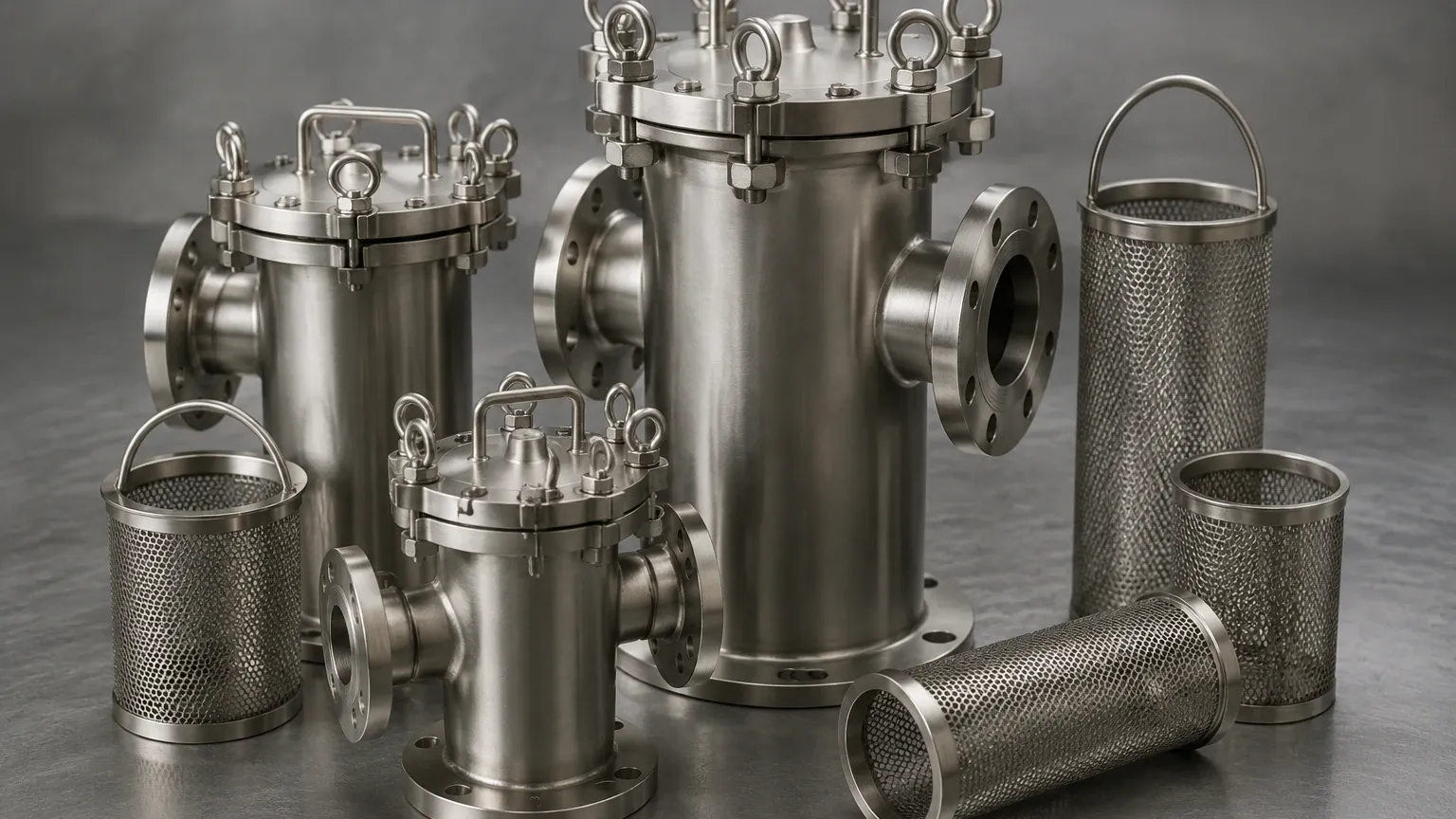
Customization Options for Industrial Applications
Customization is at the heart of effective industrial filtration. Strainers & Baskets can be tailored in several ways to optimize performance for specific environmental conditions.
Mesh and Perforation Selection
The filtration media typically consists of a perforated plate, a wire mesh, or a combination of both.
- Perforated Plates: Used for coarse filtration (typically 1/2" down to 1/32" holes). They are robust and easy to clean.
- Wire Mesh: Used for fine filtration (down to 5 microns). It is usually layered over a perforated basket for support.
Specialized Features
To enhance the functionality of a basket strainer, several features can be added during the manufacturing phase:
- Magnetic Inserts: These are placed inside the basket to capture fine iron or steel particles that might otherwise pass through the mesh. This is particularly useful in hydraulic systems and lubricating oil lines.
- Differential Pressure Gauges: Installing gauges at the inlet and outlet allows operators to monitor the pressure drop in real-time, providing a clear signal for when the basket needs cleaning.
- Quick-Opening Covers: For applications requiring frequent cleaning, bolted covers can be replaced with clamp-style or swing-bolt covers to reduce downtime.
Performance Evaluation and Maintenance Protocols
The total cost of ownership (TCO) of a basket strainer is influenced more by its maintenance requirements and performance efficiency than its initial purchase price. Engineers should establish clear protocols for the operation and upkeep of these components.
Monitoring Differential Pressure
The most effective way to evaluate strainer performance is by monitoring the differential pressure. A clean strainer will have a baseline ΔP. As debris accumulates, the ΔP increases. Manufacturers generally recommend cleaning the basket when the pressure drop reaches 5-10 psi above the clean baseline. Waiting too long can lead to "blinding" of the screen, which significantly restricts flow and increases the risk of basket failure.
Cleaning and Replacement Cycles
Maintenance teams should be trained on the proper handling of stainless steel baskets. Cleaning should involve non-abrasive methods to avoid damaging the wire mesh. In high-precision applications, such as pharmaceutical or food and beverage production, baskets may have a defined service life after which they must be replaced to ensure that the filtration integrity (micron rating) has not been compromised by repeated cleaning or mechanical stress.
Selection Criteria for Purchasing Teams
For a purchasing manager, selecting a basket strainer manufacturer in ahmedabad involves a balance of technical competence and logistical reliability. Before finalizing a supplier, confirm the following:
1. Technical Documentation: Does the manufacturer provide detailed GA (General Arrangement) drawings and flow coefficient (Cv) charts?
2. Application Expertise: Can the manufacturer provide case studies or references for similar applications in your specific industry?
3. Lead Times and Scalability: Can the manufacturer meet project timelines, especially for custom-engineered solutions that require specialized tooling?
4. After-Sales Support: Is there a clear process for sourcing replacement baskets or gaskets?
By focusing on these technical and operational benchmarks, companies can secure filtration solutions that provide reliable protection for their industrial infrastructure. Whether the application involves simple water filtration or complex chemical processing, the quality of the Strainers & Baskets remains a cornerstone of system efficiency and safety. Kaifil continues to support global industries by providing precision-engineered stainless steel filtration components that meet these rigorous standards, ensuring that every installation benefits from optimized flow and superior particulate removal.
